
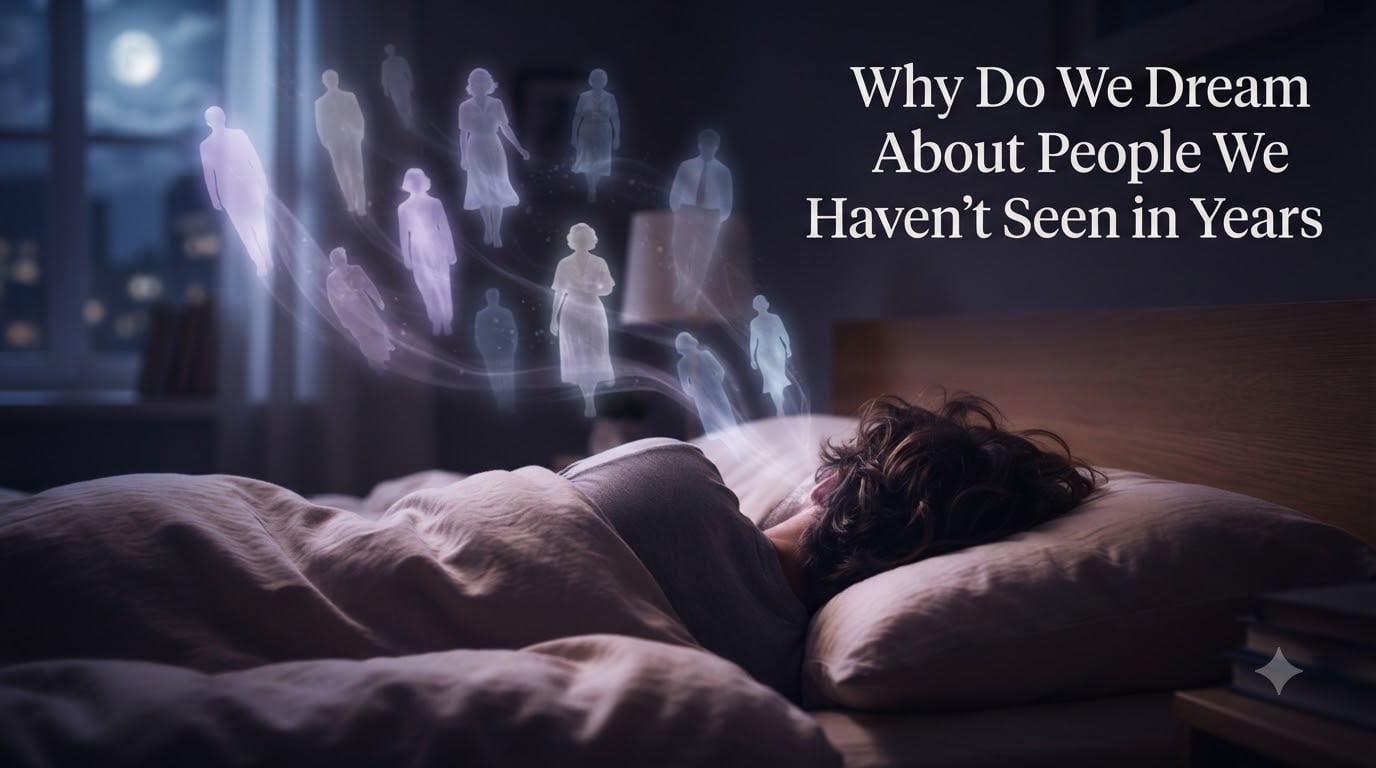
You wake up puzzled, holding onto the image of a face you haven’t thought about in a decade. The strange part is that you had not seen, mentioned, or even remembered this person before your dream pulled them from somewhere deep in your mind. I have experienced this myself, and so have most people I know.
Dreaming about people we haven’t seen in years is one of the most common and confusing parts of sleep. In this guide, I will walk you through the science of REM sleep, memory consolidation, emotional processing, and the three major psychological theories that explain why forgotten people walk back into our dreams. By the end, you will have a clear, research-backed understanding of what is happening inside your sleeping brain.
Table of Contents
Why Do We Dream About People We Haven’t Seen in Years
Dreaming about people you haven’t seen in years happens because your brain uses sleep to replay and reorganize memories, including emotional ones that you have not consciously thought about for a long time. During REM sleep, your hippocampus and other memory regions activate stored memories, and people with strong emotional ties often resurface.
The short answer is this:
Your brain is sorting memories while you sleep, not just replaying recent ones.
Emotionally significant people leave stronger memory traces that last for years.
Current stress, life changes, or triggers can pull old faces back into your dreams.
The dream state is symbolic, so the person may represent a feeling, not a literal message.
Across the forum discussions I have studied on Reddit and Quora, this experience is nearly universal. Whether the face belongs to a childhood friend, a former coworker, or someone you dated briefly in college, the mechanism behind the dream is the same.
Memory Consolidation and the Sleeping Brain
Memory consolidation is the process your brain uses to stabilize and store what you have learned during the day, and it happens mostly while you sleep. People you have not seen in years remain part of this memory network, which is why your brain can pull them out at night.
To understand why this happens, it helps to know what is going on inside your brain while you dream.
What Happens During REM Sleep
REM stands for rapid eye movement, and it is the stage of sleep most associated with vivid dreaming. Your brain becomes highly active, similar to when you are awake, while your body stays paralyzed so you do not act out the dream.
Three things are happening at once:
Your hippocampus, the memory center, replays events from your past.
Your amygdala, the emotion center, tags memories with emotional weight.
Your prefrontal cortex, the rational thinking area, is mostly offline, which is why dreams feel strange and unfiltered.
According to neuroscience research, the hippocampus is especially active during REM. It transfers short-term memories into long-term storage, and the brain uses this time to organize connections between memories that may seem unrelated when you are awake.
Why Old Memories Surface During Sleep
The brain does not store memories like files in a cabinet. Instead, memories are stored as networks of connections between brain cells. When you formed a strong relationship with someone, your brain built an entire neural network around that person, including their voice, face, shared experiences, and the emotions tied to those moments.
That network never fully goes away. Even after years of no contact, the neural pathways still exist. During sleep, when your brain is sorting and pruning memories, these older networks can get activated just as easily as recent ones. Sometimes they are even more likely to appear, because emotional weight makes a memory stronger than recency.
This is why you might dream about a third-grade classmate you have not thought about in twenty years. Your brain is not playing favorites by time, it is playing favorites by emotional importance.
Emotional Processing: Why Old Feelings Resurface
Old feelings resurface in dreams because your brain uses sleep to process emotions tied to past relationships, especially unfinished or unresolved ones. Dreams act as a kind of overnight therapy, helping your mind work through feelings you may not have time to handle during the day.
Many dream researchers call this the emotional regulation theory of dreaming. The idea is that sleep gives your brain a safe space to revisit emotional memories without the intensity of the original experience. Over time, this reduces the emotional charge of those memories.
A landmark study by Rosalind Cartwright, a sleep researcher, followed women going through divorce. She found that those who dreamed about their ex-partners recovered from depression faster than those who did not dream about them. The dreams were not a sign of being stuck. They were a sign that the brain was working through the loss.
The same principle applies to old friends, distant family members, and people you have not seen in years. Your brain may be processing:
Unfinished conversations you wish you had had.
Lessons you learned from that relationship.
Patterns from the past that show up in your current life.
Grief or unresolved feelings about how the relationship ended.
Psychological Explanations: Jungian, Freudian, and Modern Views
Psychological theories on dream content fall into three main schools of thought, and each one offers a different lens for understanding why people from your past appear in dreams. Looking at all three gives you a fuller picture than relying on just one.
The Jungian View: People as Symbols of Self
Carl Jung, a Swiss psychiatrist who founded analytical psychology, believed that every person in your dream represents a part of yourself. The people you dream about are not random. They embody traits, qualities, or emotions you need to look at.
In Jungian dream interpretation, dreaming about an old friend you have not seen in years might mean you are reconnecting with a part of yourself you have left behind. If that friend was kind and gentle, your dream may be telling you that you need more kindness in your current life. If the friend was creative or adventurous, your subconscious may be nudging you toward those qualities.
Jung called this the process of individuation, the lifelong journey of becoming your whole self. People from your past can show up in dreams to help you integrate the parts of yourself you have neglected.
The Freudian View: Wishes and Hidden Feelings
Sigmund Freud, the founder of psychoanalysis, had a different take. He believed dreams are the disguised expression of repressed wishes, especially ones connected to childhood experiences and sexuality. People from your past may appear because they are connected to feelings you pushed out of conscious awareness.
In Freudian dream analysis, an old acquaintance showing up in a dream could represent an unconscious desire or unresolved tension. Freud wrote about this extensively in his book The Interpretation of Dreams, published in 1900.
While many of Freud’s specific ideas are no longer accepted by modern science, his core insight that dreams connect to unconscious feelings still influences how therapists think about dream content.
The Neuroscience View: Brain Networks at Work
Modern neuroscience focuses less on symbolism and more on what the brain is physically doing. From this perspective, dreaming about someone you have not seen in years is simply your memory network activating old but still-present connections during REM sleep.
There is no hidden meaning required. The brain is doing maintenance work, sorting, pruning, and reorganizing the vast web of memories you have stored. People from your past are simply part of that web.
That said, modern dream scientists like Dr. Deirdre Barrett at Harvard Medical School argue that dreams can still be meaningful. She believes dreams reflect current concerns, even when they use old characters. So a dream about an old friend might be using that face to work through something happening in your present life.
Why Do We Keep Dreaming About the Same Person?
You keep dreaming about the same person because that individual represents an emotionally important memory your brain has not finished processing. Recurring dreams are one of the most common dream patterns, and they almost always point to something unresolved.
Psychologist Ian Wallace, who has studied over 150,000 dreams, says that recurring dream characters usually show up because your subconscious wants you to pay attention to a feeling or situation you have been avoiding. The person keeps returning because the message has not yet been heard.
Common reasons for recurring dreams about someone you have not seen in years include:
Unresolved conflict or guilt connected to that person.
Traits they had that you are missing in your current life.
A major life transition that echoes the time you knew them.
Lessons from the relationship that you have not fully integrated.
Symbolic processing of a current situation through an old face.
Pay attention to how you feel during the dream and upon waking. The emotion is usually the key, not the identity of the person.
Scientific Research Behind Dreaming About Someone
Scientific research shows that about 65 percent of dream characters are people we have already met in real life, with strangers making up the rest. The majority of dream characters are familiar faces, which explains why people from our past show up so often.
Research by the late psychologist Calvin Hall, who analyzed over 50,000 dream reports, found that dream characters tend to come from the dreamer’s past. Hall’s data showed that less than 1 percent of dream characters are actual strangers. The rest are people you have met at some point, even if only briefly.
A few key findings from dream research:
The average person interacts with around 150 people a year, giving your brain a steady supply of faces to draw from.
Emotionally charged relationships are remembered more vividly and appear in dreams more often.
REM sleep activates the same brain regions used during real social interaction, which is why dream conversations feel realistic.
Dreams often pull faces we have not thought about consciously, because those memories were filed away without being tagged for active recall.
A 2015 study published in the journal Brain Sciences found that dreams may help consolidate emotional memories by reactivating them during REM sleep. This supports the idea that dreaming about past people is part of healthy memory processing, not a glitch or a supernatural signal.
How to Interpret Dreams About People From Your Past
To interpret dreams about people from your past, focus on the emotion you felt during the dream, the situation in your current life, and what the person represents to you rather than what they actually mean in real life. Dream interpretation works best as a tool for self-reflection, not as fortune-telling.
Here is a simple three-step framework I have used myself and recommend to friends.
Step 1: Notice the Emotion
Before anything else, ask yourself how you felt in the dream. Were you happy, anxious, angry, sad, or confused? The emotion is the most reliable signal your dream is giving you. A dream about an old friend that leaves you feeling warm and safe is probably pointing to comfort you are missing now. A dream that leaves you tense or upset is pointing to unresolved tension.
Step 2: Look at Your Current Life
Dreams rarely come out of nowhere. Think about what is happening in your life right now. Are you going through a change, a loss, a new relationship, or a stress spike? Your brain often uses old characters to process current situations, because the old memory is already strongly wired.
Step 3: Ask What the Person Represents
Using the Jungian approach, ask what qualities that person had that might be relevant to you now. Were they confident, funny, honest, reckless, kind? The answer often points to a part of yourself you need to pay attention to.
One caution: if a dream is causing significant distress, recurring nightmares are disrupting your sleep, or old memories are surfacing in ways that feel overwhelming, talking to a therapist can help. Dreams are powerful, and sometimes they need professional support to process.
Do These Dreams Mean Someone Is Thinking About You?
No, dreaming about someone does not scientifically mean they are thinking about you at that moment. There is no research supporting the idea that dreams act as a telepathic link between two people. The dream is coming from inside your own brain.
That said, thinking about a person, even briefly, makes them more likely to appear in your dreams later. So if you both thought about each other on the same day, it would not be strange for both of you to dream about the other person. The connection is shared human experience, not psychic energy.
If you had a meaningful dream about someone you have not seen in years and you want to reach out, that is fine. Just do it for healthy reasons, because you want to reconnect, not because you believe the dream was a message from them.
Final Thoughts on Dreaming About Forgotten People
Dreaming about people we have not seen in years is one of the most ordinary and meaningful parts of being human. It is your brain doing its nightly work of sorting memories, processing emotions, and rehearsing social situations.
Whether you look at it through the lens of neuroscience, Jungian psychology, or simple emotional processing, the core message is the same. Your dreams are working for you, not against you. They help you remember what mattered, heal what hurt, and become more fully yourself.
The next time a face from years ago shows up in your sleep, take a moment to ask what they might represent. The answer may surprise you.
FAQs
What does it mean if you dream about someone you haven’t seen for years?
Dreaming about someone you haven’t seen for years usually means your brain is reactivating an old but emotionally important memory during REM sleep. It does not mean the person is sending you a message. It is a normal part of memory consolidation and emotional processing.
Why am I dreaming about people no longer in my life?
People no longer in your life appear in dreams because your brain stores memories as networks of connections, not as files that disappear. Emotionally significant relationships create strong neural pathways that remain active even after years of no contact. Sleep activates these networks while sorting memories.
Why do I keep dreaming about the same person I haven’t seen in years?
Recurring dreams about the same person usually point to something emotionally unresolved. Your subconscious keeps bringing them back because there is a feeling, lesson, or pattern you have not yet processed. The person is a symbol as much as a real individual.
What’s the science behind dreaming about someone?
The science behind dreaming about someone involves REM sleep, memory consolidation, and emotional regulation. During REM, the hippocampus replays memories while the amygdala processes emotions. People with strong emotional ties are more likely to surface, especially during stress or major life changes.
Is it true that if you dream about someone they are thinking about you?
No, there is no scientific evidence that dreaming about someone means they are thinking about you at the same time. Dreams are produced inside your own brain. However, thinking about someone briefly during the day can make them more likely to appear in your dreams later.
What dreams should you never ignore?
Dreams you should never ignore include recurring nightmares that disrupt sleep, dreams tied to trauma, and dreams that cause intense emotional distress. These can signal unresolved issues that benefit from professional support, such as therapy or counseling.