
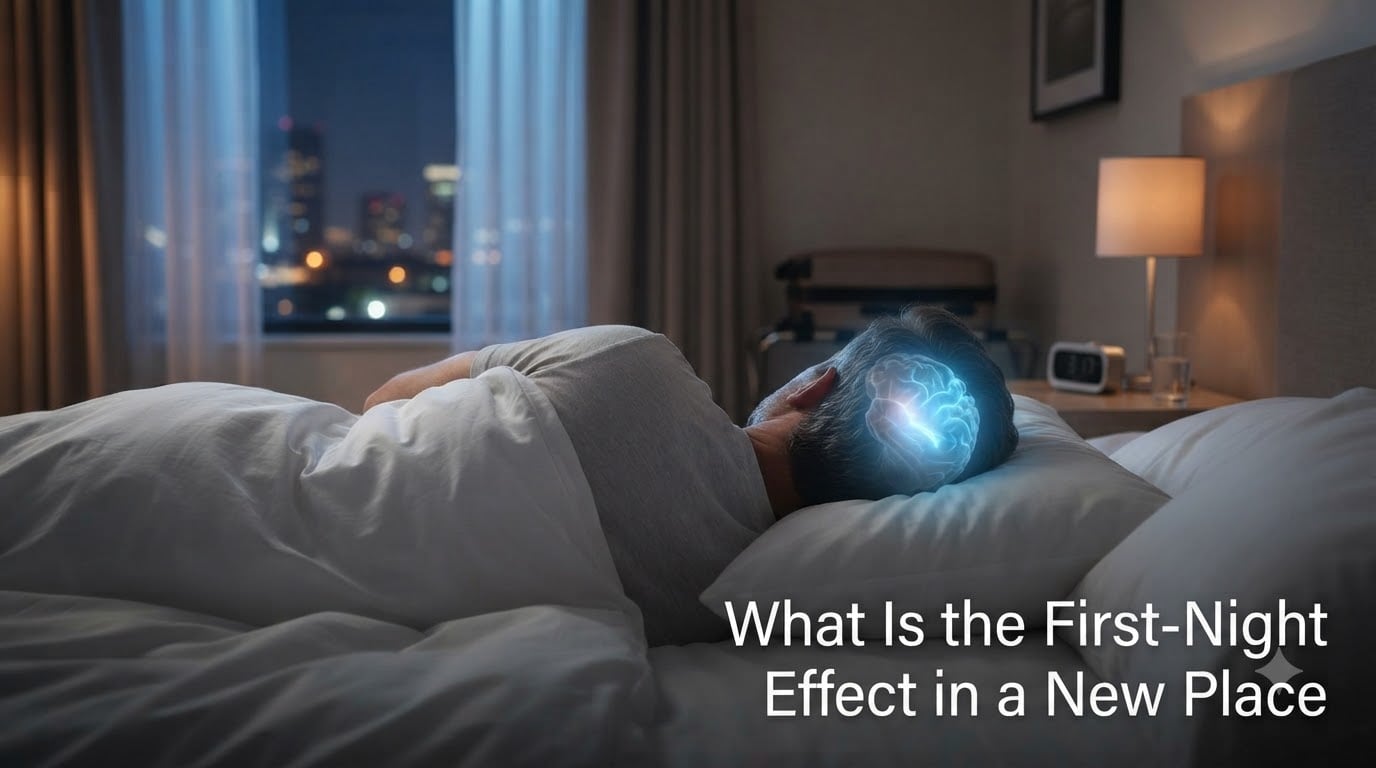
If you have ever tossed and turned the first night in a hotel, a new apartment, or even a friend’s guest room, you are not alone. Millions of people experience this exact same thing. Scientists call it the first-night effect, and it is a well-documented phenomenon where one half of your brain literally refuses to fully shut down in an unfamiliar environment.
The first-night effect new place experience goes beyond simple discomfort. It affects your sleep quality, your mood, and your cognitive performance the next day. Business travelers, vacation goers, and people moving to new homes all deal with it.
In this guide, we break down what causes the first-night effect, what happens inside your brain when you sleep somewhere new, and practical strategies to minimize its impact so you wake up refreshed instead of exhausted.
Table of Contents
What Is the First-Night Effect?
The first-night effect is a sleep phenomenon where your brain sleeps lighter and more restlessly during your first night in an unfamiliar environment. Your body essentially runs a background security check, reducing deep slow-wave sleep and increasing vigilance in response to new surroundings.
This is not a character flaw or a sign of weakness. It is a universal biological response documented in sleep labs around the world. In fact, sleep researchers have known about it for decades because it complicates overnight sleep studies. The first night of data collected in a sleep lab is typically discarded as an adaptation night.
Common symptoms include difficulty falling asleep, frequent awakenings throughout the night, lighter and more fragmented sleep, and a lingering sense of restlessness. Many people describe feeling hyperaware of every sound and sensation in the room.
One Reddit user captured the experience perfectly: “Anytime I sleep somewhere new, that first night I may get an hour here and there of sleep. I usually drag the rest of the day.” That exhaustion is the hallmark of the first-night effect.
The Science: Half Your Brain Stays Alert
The most fascinating discovery about the first-night effect came from a landmark 2016 study by researchers at Brown University. Using advanced electroencephalography (EEG) monitoring, they found that one hemisphere of the brain literally stays more awake than the other during the first night in a new place.
Specifically, the left hemisphere of the brain remains in a heightened state of vigilance during slow-wave sleep, which is your deepest sleep stage. The right hemisphere, meanwhile, settles into normal deep sleep. This asymmetric brain activity is your brain’s way of keeping watch while still getting some rest.
The researchers tested this by playing random sounds near sleeping participants. On the first night, people woke up much faster in response to these sounds because their vigilant left hemisphere was actively monitoring the environment. By the second night, this asymmetry disappeared, and participants slept normally.
This discovery was groundbreaking because it mirrored something scientists had already observed in marine mammals. Dolphins and whales sleep with one hemisphere at a time so they can surface to breathe and watch for predators. Humans, it turns out, use a milder version of the same survival mechanism.
Why It Happens: An Evolutionary Safety Mechanism
The first-night effect is rooted in human evolution. For most of our species’ history, sleeping in an unfamiliar location meant real danger. Predators, hostile groups, and environmental hazards all posed threats that our ancestors needed to detect quickly.
Your brain has not fully caught up with the fact that a Holiday Inn is not a predator-filled savanna. When you check into a new room, your default-mode network flags the environment as uncertain. The left hemisphere goes into night-watch mode as a protective response.
This explains why the effect is strongest the first night and fades over subsequent nights. Once your brain has gathered enough data about the safety and predictability of the environment, it relaxes its vigilance and allows both hemispheres to sleep normally.
It also explains why certain triggers make the effect worse. Unfamiliar sounds, odd smells, strange lighting patterns, and different temperatures all feed the brain’s threat-assessment system, keeping that left hemisphere on high alert.
Environmental and Sensory Factors
Your physical surroundings play a massive role in how strongly you experience the first-night effect. A hotel room near an elevator, an Airbnb facing a busy street, or a new apartment with unfamiliar creaks and hums all feed sensory input to your vigilant brain.
Sound is the biggest culprit. Unfamiliar sounds like traffic, HVAC systems, elevator chimes, and neighboring rooms trigger micro-arousals throughout the night. Your brain treats each new sound as a potential signal that needs evaluation.
Light matters too. Streetlights filtering through unfamiliar curtains, bright alarm clock displays, and hallway lights under the door all disrupt melatonin production. Temperature is another factor. A room that is too warm or too cold fragments your sleep architecture and keeps you in lighter stages.
Even the bed itself contributes. An unfamiliar mattress with different firmness, strange-smelling sheets, and pillows that do not match your usual support all send novelty signals to a brain already on edge.
Psychological Factors: Stress, Anxiety, and Novelty
While brain hemisphere asymmetry is the biological driver, psychological factors amplify the first-night effect significantly. Travel stress, work pressure, and the simple anxiety of being somewhere new all feed into poor sleep quality.
People with underlying anxiety tendencies often experience the first-night effect more intensely. Their minds race, their hearts beat faster, and they feel wide awake despite being exhausted. As one forum user described it: “My heart beats fast, I feel wide awake, my mind is racing, and I’m anything but relaxed.”
This hyperawareness is your fight-or-flight system engaging when it should be powering down. Cortisol and adrenaline stay elevated, making it nearly impossible to transition into deep sleep even when your body desperately needs it.
Broken sleep routines make things worse. When you travel across time zones, eat at different times, and go to bed at unusual hours, your circadian rhythm gets disrupted on top of everything else. The combination of circadian misalignment and environmental novelty is a recipe for a terrible night.
The Paradox: Why Some People Sleep Better Away From Home
Not everyone sleeps worse in a new place. Some people actually experience the opposite and sleep better away from home than they do in their own beds. This paradox is real and has several explanations.
If your home sleep environment is subpar, a high-quality hotel mattress, blackout curtains, and climate-controlled room can actually improve your sleep. Some people carry stress from their daily lives into their bedrooms at home, and getting away from that environment provides relief.
A new environment can also reset negative sleep associations. If you have developed a pattern of lying awake stressing about work in your home bed, a different bed breaks that conditioned response. The novelty works in your favor instead of against you.
However, for most people, the first-night effect still wins out. The paradoxical improvers tend to be those whose home sleep conditions are worse than their travel conditions, or those whose anxiety is specifically tied to their home environment.
How Long Does the First-Night Effect Last?
For most people, the first-night effect lasts exactly one night. By the second night in a new environment, the brain’s left hemisphere typically drops its vigilance and both hemispheres return to normal sleep patterns.
This timeline varies based on individual differences and environment quality. Some people need two or three nights to fully adapt, especially if they are dealing with significant jet lag or an extremely noisy environment.
The good news is that the effect is temporary and self-correcting. Your brain is designed to adapt. Once it determines the environment is safe, it stops wasting energy on vigilance and allows you to sleep normally.
Tips to Overcome the First-Night Effect
While you cannot fully switch off your brain’s protective mechanism, you can reduce its severity with a few practical strategies. Here are the approaches our team has found most effective.
Bring familiar sensory cues. Pack your own pillow, a familiar blanket, or even a small item that smells like home. These cues signal safety to your brain and help dampen the novelty response.
Use white noise. A white noise machine, a fan, or a white noise app on your phone masks unfamiliar environmental sounds. This is one of the most effective tricks for hotel stays and is frequently recommended by frequent travelers on sleep forums.
Control light exposure. Pack a sleep mask and earplugs in your travel kit. Close curtains fully and turn off or cover any glowing displays. Even small amounts of light can suppress melatonin and keep you in lighter sleep stages.
Arrive early. If possible, arrive at your destination with several hours of daylight left. This gives your brain time to process and categorize the new environment before bedtime, reducing the novelty spike that comes with arriving at 11 PM.
Maintain your bedtime routine. Do whatever you normally do before bed at home. If you read for 20 minutes, brush your teeth in a specific order, or listen to a particular podcast, replicate that routine. Familiar patterns cue your brain that it is safe to power down.
Avoid alcohol and heavy meals. Alcohol might help you fall asleep faster, but it fragments sleep and reduces deep slow-wave sleep. Since the first-night effect already compromises deep sleep, adding alcohol makes it worse.
Manage temperature. Set the room to around 65 degrees Fahrenheit (18 degrees Celsius) if possible. A cool room supports the natural drop in body temperature that accompanies deep sleep.
When to Seek Help
If you consistently cannot sleep in new environments even after multiple nights, or if sleep problems follow you home, it may be time to talk to a professional. Persistent insomnia that extends well beyond the first night can signal an underlying sleep disorder or anxiety condition.
Cognitive Behavioral Therapy for Insomnia (CBT-I) is a highly effective, evidence-based treatment that addresses the thought patterns and behaviors driving chronic sleep problems. A sleep specialist can help determine whether your difficulties go beyond the normal first-night effect.
Frequently Asked Questions
Is sleeping at a different place difficult the first night?
Yes, for most people. The first night in a new place typically brings lighter, more fragmented sleep because one hemisphere of your brain stays in a vigilant state. This is a normal biological response to unfamiliar environments, not a personal failing.
Why do I sleep better in a new place?
Some people sleep better away from home because their travel environment offers better conditions than home, such as a more comfortable mattress or quieter surroundings. Getting away from home-based stress and negative sleep associations can also reset your ability to fall asleep more easily.
How to fix the first night effect?
You cannot fully eliminate it, but you can reduce its severity. Bring familiar items like your own pillow, use white noise to mask unfamiliar sounds, control light with a sleep mask, maintain your normal bedtime routine, and keep the room cool around 65 degrees Fahrenheit.
What happens to your brain when you sleep in a new place?
During the first night in a new environment, your left brain hemisphere stays more alert than the right during slow-wave sleep. This asymmetric activity, discovered by Brown University researchers in 2016, functions as a night-watch system that monitors for threats. It typically disappears by the second night.
Conclusion
The first-night effect is your brain doing exactly what evolution programmed it to do: staying vigilant in unfamiliar territory. Understanding what is happening, from the left hemisphere’s night-watch role to the sensory and psychological factors that amplify it, takes the mystery out of those restless first nights.
While you cannot override millions of years of evolution, the practical strategies we covered can make a real difference. Familiar sensory cues, white noise, light control, and a consistent bedtime routine all help your brain conclude faster that the new environment is safe.
The next time you check into a hotel or move into a new place and find yourself staring at the ceiling at 2 AM, remember that your first-night effect new place experience is completely normal. Your brain is just doing its job, and by the second night, it will stand down.