
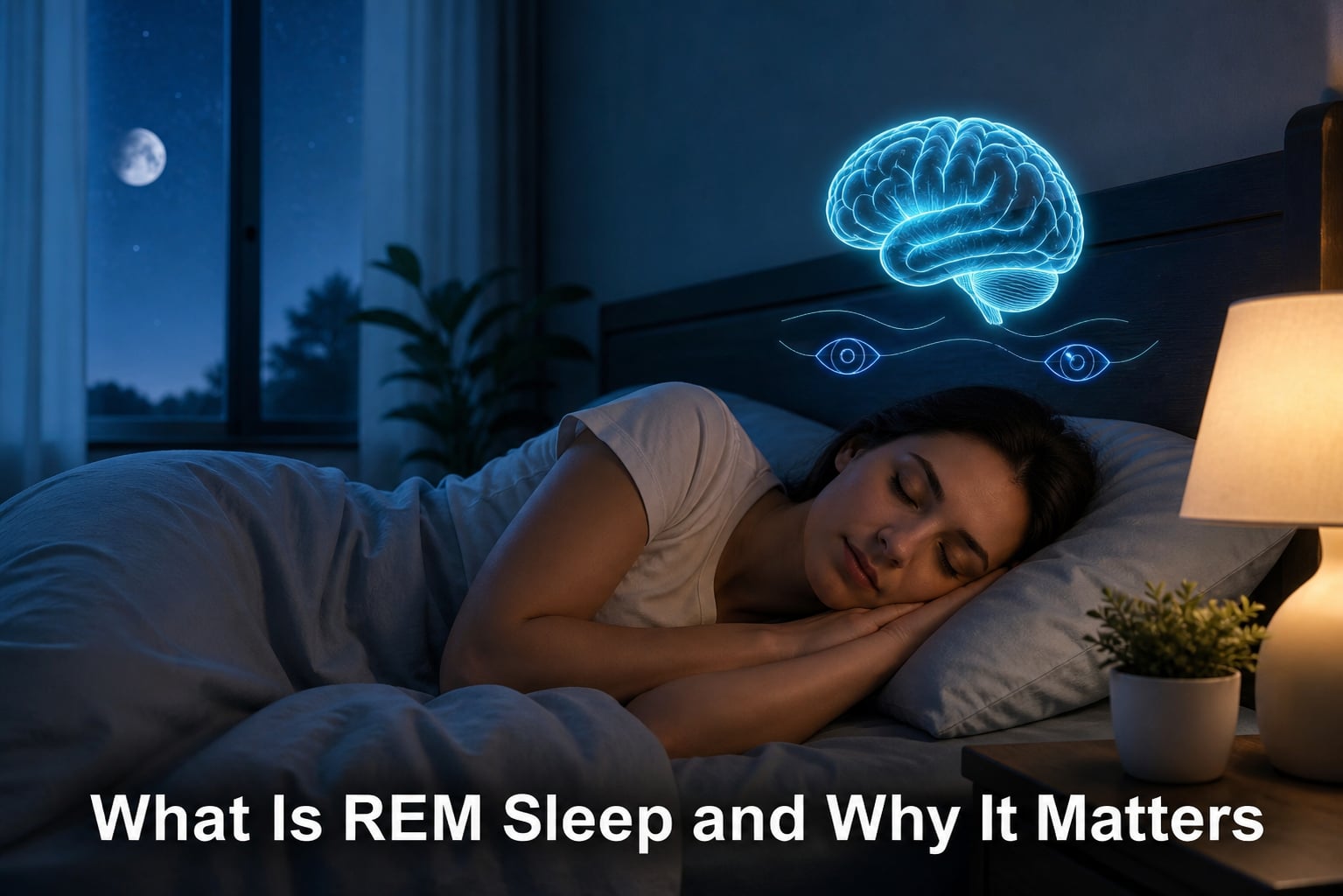
REM sleep (rapid eye movement sleep) is the fourth stage of sleep where most of your vivid dreaming takes place. During REM, your brain becomes highly active while your body experiences temporary muscle paralysis, your eyes move rapidly behind closed eyelids, and your heart rate and breathing speed up.
This stage makes up roughly 20 to 25 percent of an adult’s total sleep time, and it plays a central role in memory consolidation, emotional regulation, and brain development. I dug into the research, the top medical sources, and real user experiences from sleep forums to bring you a complete picture of what REM sleep actually does and why it matters more than most people realize.
In this guide, you’ll learn what REM sleep is, how it differs from other sleep stages, how much you actually need at every age, what happens in your body during this phase, and seven practical tips to get more of it tonight.
Table of Contents
What Is REM Sleep?
REM sleep is one of the four distinct stages of the human sleep cycle, and it is the stage where the most vivid and emotionally intense dreams occur. The name comes from the rapid, darting movements your eyes make behind closed eyelids during this phase, which scientists first observed in the 1950s.
Your brain activity during REM looks surprisingly similar to when you are awake. An electroencephalogram (EEG) shows low-voltage, fast-frequency beta waves that mirror focused waking thought. Meanwhile, your major voluntary muscles go temporarily slack, a phenomenon called REM atonia, so you do not physically act out your dreams.
Most adults spend about 90 to 120 minutes per night in REM sleep, spread across four to six separate REM periods. Newborns, by contrast, spend roughly 50 percent of their total sleep in REM, which is why REM is thought to be so important for early brain development.
What Happens in Your Body During REM Sleep?
REM sleep triggers a cascade of physiological changes that make it unique among the sleep stages. Here is what researchers observe during polysomnography (an overnight sleep study):
- Brain activity increases sharply. The brain uses more oxygen and glucose during REM than during most waking tasks, especially in the limbic system and visual cortex.
- Eyes move rapidly. Saccadic eye movements occur in bursts, often tied to dream content.
- Heart rate and blood pressure rise. Breathing becomes faster and less regular, sometimes briefly pausing.
- Muscle atonia sets in. Voluntary muscles lose tone, preventing you from physically acting out dreams.
- Body temperature drops. Thermoregulation becomes less precise, which is why a cooler bedroom supports deeper REM.
- Hormones shift. Cortisol and testosterone production climb, while growth hormone output largely pauses.
Together these shifts create the signature “paradox” of REM sleep. Your brain looks awake on a monitor, but your body is effectively paralyzed. I find this paradox fascinating because it shows how REM is built for internal processing rather than external action.
REM Sleep vs NREM Sleep: Understanding the Four Sleep Stages
Sleep is not one uniform state. Your night cycles through four distinct stages, three of them non-REM (NREM) and one REM. Each stage serves a different recovery function and shows up differently on a brain wave scan.
The table below summarizes the four stages, including how brain waves, eye movement, and muscle tone change in each.
| Stage | Name | Brain Activity | Eyes | Muscles | Typical Role |
|---|---|---|---|---|---|
| N1 | Light sleep (onset) | Theta waves, slowing from alpha | Slow rolling | Relaxed | Transition into sleep |
| N2 | Light sleep | Sleep spindles, K-complexes | Still | Relaxed | Memory processing begins |
| N3 | Deep sleep (slow wave) | High-amplitude delta waves | Still | Very relaxed | Physical recovery, immune repair |
| REM | Rapid eye movement | Beta waves, brain looks awake | Rapid bursts | Atonia (paralyzed) | Dreaming, memory, emotion |
NREM stages handle most of the body’s physical restoration. REM stage focuses on the mind. You need both. Skipping either one for long periods leads to measurable deficits in learning, mood, and immune function.
How Much REM Sleep Do You Need by Age?
REM sleep needs change dramatically across the lifespan. Premature babies spend the majority of their sleep in REM, while healthy adults settle into a roughly 20 to 25 percent range. Older adults often see this percentage drop slightly, even when total sleep time stays the same.
This table shows the typical REM sleep percentage and recommended nightly totals by age, based on National Sleep Foundation guidelines.
| Age Group | Recommended Total Sleep | REM as % of Sleep | Approx. REM Minutes |
|---|---|---|---|
| Newborn (0 to 3 months) | 14 to 17 hours | ~50% | 420 to 510 |
| Infant (4 to 11 months) | 12 to 15 hours | ~40% | 290 to 360 |
| Toddler (1 to 2 years) | 11 to 14 hours | ~30% | 200 to 250 |
| School age (6 to 13) | 9 to 11 hours | ~25% | 135 to 165 |
| Teen (14 to 17) | 8 to 10 hours | ~23% | 110 to 140 |
| Adult (18 to 64) | 7 to 9 hours | ~20 to 25% | 90 to 135 |
| Older adult (65+) | 7 to 8 hours | ~20% | 85 to 100 |
If you wear a sleep tracker, do not panic over exact percentages. Wrist-based devices are reasonably good at detecting sleep versus wake, but their REM estimates can be off by 10 to 15 percentage points. Use the numbers as a trend, not a verdict.
Why REM Sleep Matters: The Key Benefits
REM sleep is not just the “dream stage.” It drives several essential brain and body functions that other stages cannot fully cover.
Memory consolidation. REM sleep helps your brain move short-term memories into long-term storage. Studies show that people who learn a new task and then get healthy REM sleep perform significantly better the next day than those who are REM-deprived.
Emotional processing. During REM, activity in the amygdala (the brain’s emotional alarm) drops while the prefrontal cortex stays engaged. This is thought to help you process difficult feelings while keeping them in context. Skipping REM is linked to higher anxiety and mood instability.
Brain development. In infants and children, REM makes up a far larger share of sleep. Animal research suggests this is when the central nervous system wires itself up and prunes unused synapses.
Creativity and problem solving. REM dreams mix memories in unusual ways, which appears to support insight and creative thinking. Many artists and scientists, including Salvador Dali and Thomas Edison, deliberately used brief naps to tap into this state.
Long-term brain health. Research from Boston University found that poor REM sleep is associated with a higher risk of dementia later in life. REM may help clear metabolic waste from the brain, similar to how deep sleep supports glymphatic clearance.
The Sleep Cycle: When REM Happens Throughout the Night
A full sleep cycle takes about 90 minutes on average. You move through N1, N2, N3, and then REM, before the cycle restarts. Early in the night, the cycles are heavy on deep N3 sleep with short REM periods of 5 to 10 minutes each.
As the night progresses, deep sleep shrinks and REM periods get longer. By early morning, you may spend 30 to 60 minutes at a stretch in REM, which is why you remember your dreams more vividly when you wake up at 5 or 6 a.m.
This pattern has a practical lesson. If you cut your sleep short by an hour or two, you are cutting mostly REM time, not deep sleep. The result feels like cognitive fog, emotional flatness, and a sense that you did not really “rest.”
What Happens When You Don’t Get Enough REM Sleep?
Your body defends REM sleep surprisingly hard. If you go several days with reduced REM, your next bouts of REM grow longer and more intense, a process called REM rebound. This is why you might dream vividly the first night after pulling an all-nighter, or after stopping a sleep medication.
Common signs of REM deprivation include:
- Trouble focusing and slower reaction times during the day
- Irritability and heightened emotional reactions
- Reduced ability to learn new information
- Vivid, intense dreams after returning to normal sleep
- Increased appetite and cravings for high-calorie food
Forum users on r/sleep and r/Biohackers report the same pattern. One commenter said, “I went from barely any REM to normal REM during my first week on CPAP, and the dreams were so vivid I felt hungover.” That experience is exactly what REM rebound looks like in real life.
REM Sleep Disorders You Should Know About
Most competitors skip this part, so I want to spend a moment on REM-related disorders. Knowing them helps you recognize when to talk to a doctor.
REM sleep behavior disorder (RBD). In RBD, the normal muscle paralysis of REM fails. People physically act out their dreams, sometimes violently enough to injure themselves or a bed partner. RBD is also a recognized early warning sign of Parkinson’s disease and related conditions.
Narcolepsy. People with narcolepsy enter REM sleep unusually fast, sometimes within minutes of falling asleep. This causes sudden sleep attacks, cataplexy, and vivid dream-like hallucinations at the boundary of sleep and wake.
Sleep paralysis. This is a brief, harmless episode where you wake up but cannot move. It happens when REM atonia lingers for a few seconds after waking. It can be frightening, but it is not dangerous.
If you or someone you sleep with experiences repeated dream enactment, talking, punching, or kicking during sleep, please bring it up with a clinician. RBD in particular deserves a proper evaluation.
How to Get More REM Sleep: 7 Practical Tips
You cannot force yourself into REM, but you can give your body the conditions it needs to spend more time there. These are the steps I recommend based on the research and what our team has seen work.
1. Aim for 7 to 9 hours total. REM periods lengthen in the back half of the night, so longer sleep reliably produces more REM.
2. Keep a consistent sleep schedule. Going to bed and waking up at the same time every day stabilizes your circadian rhythm, which regulates when REM happens.
3. Skip alcohol close to bedtime. Alcohol may help you fall asleep, but it suppresses REM in the second half of the night, even in moderate amounts.
4. Cool your bedroom to about 18 degrees C. REM is more efficient when your body can offload heat. A cooler room supports the natural drop in core temperature during REM.
5. Limit screens an hour before bed. Blue light and stimulating content can delay sleep onset, which shortens the total window available for REM.
6. Treat sleep apnea and snoring. Fragmented sleep from apnea cuts REM short repeatedly. CPAP therapy often produces a dramatic REM rebound in the first weeks, as forum users regularly describe.
7. Review your medications. SSRIs, beta blockers, and some antihistamines suppress REM. Do not stop any medication on your own, but ask your doctor whether REM effects matter for your situation.
Frequently Asked Questions
Is it better to be in REM or deep sleep?
Both stages are essential and serve different roles. Deep sleep (N3) handles physical repair, immune function, and glymphatic cleanup, while REM sleep drives memory consolidation, emotional processing, and brain development. Trying to rank one over the other is misleading, because losing either one produces measurable deficits.
Is 40 minutes of REM sleep enough?
For most adults, no. The healthy target is roughly 90 to 120 minutes of REM per night, which equals about 20 to 25 percent of a 7 to 9 hour sleep window. A single night at 40 minutes of REM will likely trigger REM rebound the next night, where REM periods grow longer to recover what was lost.
What happens if you skip REM sleep?
Short-term skipping of REM leads to poor focus, emotional reactivity, slower learning, and reduced problem solving. After a few days, your body responds with REM rebound, where subsequent REM periods grow longer and dreams become unusually vivid. Chronically low REM has been linked to a higher long-term risk of dementia and mood disorders.
How do you fix your REM sleep?
Focus on sleep duration, schedule consistency, and removing REM suppressors like alcohol and certain medications. Aim for 7 to 9 hours per night at the same time each day, keep the bedroom cool and dark, and treat underlying conditions such as sleep apnea. Over the counter sleep trackers can help you monitor trends, but their REM estimates are not perfectly accurate.
Final Thoughts on REM Sleep
REM sleep is one of the most underappreciated drivers of how you think, feel, and remember. It is the stage where your brain processes emotions, locks in learning, and quietly supports long-term brain health.
The good news is that the most powerful tools for protecting REM sleep are free. Sleep enough, sleep consistently, keep the room cool, and avoid alcohol close to bedtime. Small changes compound across weeks, and you will likely notice the difference in your focus, mood, and dream quality before long.
If you wake up exhausted despite spending enough hours in bed, or if a bed partner describes you acting out vivid dreams, please talk to a doctor. A simple overnight sleep study can clarify what is going on and unlock treatments that change daily life.