
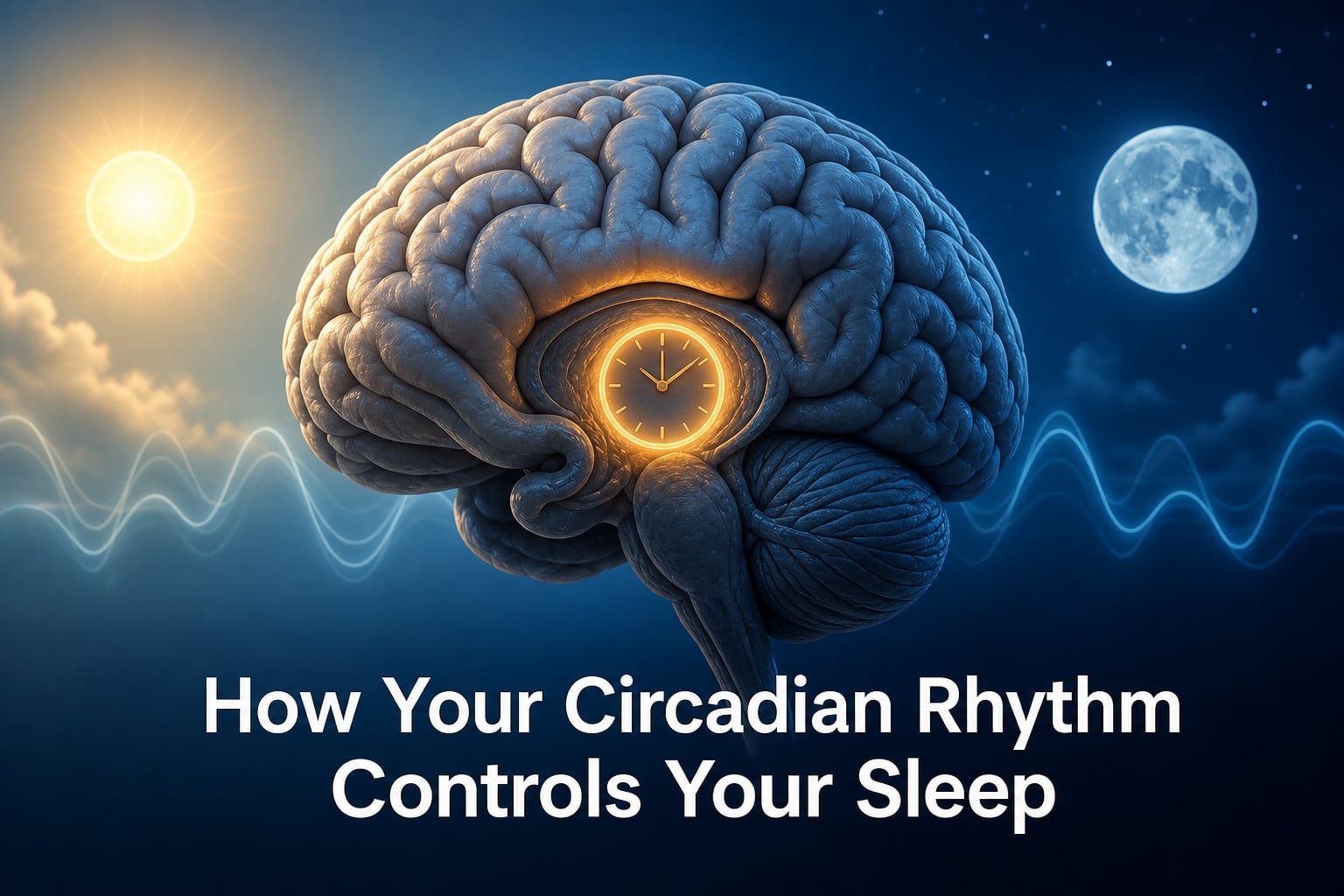
Have you ever wondered why you feel sleepy at night and alert during the day without anyone telling you when to rest? The answer lies in your circadian rhythm, a built-in biological clock that runs silently in the background of your body every single hour. This internal timekeeper controls far more than just sleep. It influences your hormone release, body temperature, digestion, immune function, and even how well you concentrate at work.
When people talk about being a “morning person” or a “night owl,” they are really describing their circadian rhythm in action. Your circadian rhythm controls sleep by coordinating a precise chemical cascade that tells your brain when to wind down and when to wake up. Understanding how this system works gives you real power over your energy levels, mood, and long-term health.
In this guide, we will walk through exactly how your circadian rhythm works, what throws it off track, and practical steps you can take to fix it. Whether you struggle with insomnia, jet lag, shift work, or just that dreaded 3 PM crash, the science of your internal clock holds the answers.
Table of Contents
What Is Circadian Rhythm?
Your circadian rhythm is your body’s natural 24-hour internal clock that regulates the sleep-wake cycle and many other biological processes. The word “circadian” comes from the Latin words “circa” (meaning “around”) and “diem” (meaning “day”). So the name itself describes a cycle that runs approximately one full day.
This clock does not just control when you feel sleepy. It governs hormone release, body temperature fluctuations, blood pressure, digestion, and cellular repair. Nearly every tissue and organ in your body has its own peripheral clock that syncs to a master clock in your brain.
Think of your circadian rhythm as the conductor of an orchestra. Each organ and system is a musician. When the conductor keeps good time, everything plays in harmony. When the conductor loses the beat, the whole performance falls apart.
The system evolved over millions of years in response to the rising and setting of the sun. Your body expects light during the day and darkness at night. Modern life with artificial lighting, screens, and irregular schedules constantly challenges this ancient system.
How Your Circadian Rhythm Controls Your Sleep
Your circadian rhythm controls sleep through a remarkable chain of events that starts with light entering your eyes and ends with chemical signals flooding your brain. The entire process centers on a tiny cluster of about 20,000 nerve cells called the suprachiasmatic nucleus, or SCN.
The Suprachiasmatic Nucleus: Your Master Clock
The SCN sits in the hypothalamus, a region deep in your brain. It serves as the master clock that coordinates all the peripheral clocks throughout your body. When the SCN fires signals, the rest of your body follows its lead.
Here is how the process works step by step. Special light-sensitive cells in your retina called intrinsically photosensitive retinal ganglion cells detect light in your environment. These cells send signals directly to the SCN through a pathway called the retinohypothalamic tract. This is how your brain knows whether it is day or night outside.
Melatonin: The Darkness Hormone
When the SCN detects that light is fading, it signals the pineal gland to start producing melatonin. Melatonin is often called the “sleep hormone” or “darkness hormone” because its release is triggered by darkness. As melatonin levels rise in the evening, you begin to feel drowsy and your body temperature drops slightly.
Melatonin does not force you to sleep. Instead, it opens the gate for sleep by signaling to your body that nighttime has arrived. Melatonin levels typically start rising about two hours before your habitual bedtime, a period scientists call the dim light melatonin onset or DLMO.
This is why bright screen light before bed causes so many sleep problems. Blue light from phones and laptops hits those same light-sensitive cells in your eyes, tricking your SCN into thinking the sun is still up. Your pineal gland holds back melatonin production, and you lie awake wondering why you cannot fall asleep.
Cortisol: The Wake-Up Hormone
In the morning, the opposite chemical shift occurs. As light enters your eyes, the SCN halts melatonin production and triggers a surge of cortisol. Cortisol is often labeled a “stress hormone,” but it plays a normal and necessary role in waking you up and sharpening your alertness.
Cortisol levels follow a predictable daily curve. They peak in the first 30 to 45 minutes after you wake up, a phenomenon researchers call the cortisol awakening response. This spike helps you feel alert and ready to face the day. Cortisol then gradually declines throughout the afternoon and reaches its lowest point around midnight.
Body Temperature and Sleep Drive
Your circadian rhythm also controls your core body temperature, which fluctuates by about one to two degrees Fahrenheit over 24 hours. Body temperature peaks in the late afternoon and drops to its lowest point in the early morning hours, typically around 5 AM. This temperature drop helps initiate and maintain deep sleep.
Alongside the circadian process, a second system called sleep homeostasis builds what scientists call “sleep pressure” or “sleep drive.” The longer you stay awake, a chemical called adenosine accumulates in your brain, making you feel progressively more tired. Sleep happens when your circadian rhythm opens the gate and your sleep drive pushes you through it.
What Affects and Disrupts Your Circadian Rhythm
Anything that changes the timing of light exposure, food intake, or physical activity can shift or scramble your circadian rhythm. Scientists call these external cues “zeitgebers,” a German word meaning “time givers.” Light is the most powerful zeitgeber, but it is not the only one.
Here are the most common factors that disrupt your circadian rhythm:
1. Artificial light at night. Blue light from phones, tablets, computers, and LED bulbs suppresses melatonin production and tricks your brain into thinking it is still daytime. Even small amounts of light during sleep can interfere with your rhythm.
2. Irregular sleep schedules. Going to bed at 10 PM one night and 1 AM the next confuses your master clock. Your body cannot establish a steady pattern when you constantly change the rules.
3. Caffeine consumption. Caffeine blocks adenosine receptors, masking sleep pressure. Consuming caffeine late in the day delays sleep onset and shifts your rhythm backward. Caffeine has a half-life of about five to six hours, meaning a 4 PM coffee still has half its stimulating power at 10 PM.
4. Alcohol before bed. Alcohol may help you fall asleep faster, but it fragments your sleep cycles and suppresses REM sleep. It also causes body temperature changes that can shift your circadian timing.
5. Shift work. People who work night shifts or rotating schedules fight against their biology every single day. Their circadian rhythm says sleep while their job demands alertness.
6. Jet lag. Crossing multiple time zones quickly moves your body to a new light-dark schedule before your internal clock can catch up. Your SCN may still be on New York time while you are trying to sleep in London.
7. Meal timing. Eating tells your digestive organs to activate, which acts as a zeitgeber for peripheral clocks in your liver, gut, and other tissues. Late-night meals send conflicting timing signals.
8. Lack of daytime light. Spending all day indoors under dim artificial lighting weakens the contrast between day and night that your circadian rhythm depends on.
What Happens When Your Circadian Rhythm Is Disrupted
Short-term circadian disruption feels awful. You experience daytime fatigue, difficulty concentrating, irritability, brain fog, and reduced coordination. Your reaction times slow down, and your decision-making suffers. Many people describe this as feeling “jet-lagged” even when they have not traveled anywhere.
The long-term consequences are far more serious. Chronic circadian misalignment has been linked to a wide range of health problems, and the research keeps growing each year.
Sleep disruption weakens your immune system, making you more susceptible to infections and slowing recovery from illness. Studies show that shift workers have higher rates of colds and flu compared to day workers.
Metabolic health takes a significant hit. When your circadian rhythm is out of sync, your body becomes less efficient at regulating blood sugar. This increases the risk of insulin resistance, weight gain, and type 2 diabetes. Your body processes food differently depending on the time of day, so eating at odd hours strains your metabolic system.
Cardiovascular problems also increase with chronic disruption. Blood pressure follows a circadian pattern, dipping at night and rising in the morning. Disrupted rhythms can keep blood pressure elevated around the clock, raising the risk of heart disease and stroke.
Mental health is deeply connected to circadian timing. People with disrupted rhythms have higher rates of depression, anxiety, and mood swings. The relationship works both ways: mental health conditions can disrupt sleep, and disrupted sleep can worsen mental health symptoms.
Cognitive performance suffers too. Memory consolidation, learning, and creative problem-solving all depend on properly timed sleep cycles. Students pulling all-nighters and professionals working erratic hours consistently show reduced cognitive performance compared to those with stable schedules.
Circadian Rhythm Across Different Life Stages
Your circadian rhythm is not a fixed system. It changes throughout your lifetime, and understanding these changes explains why sleep patterns shift so dramatically from infancy to old age.
Babies and Toddlers
Newborns do not have a fully developed circadian rhythm. They sleep in short bursts around the clock, typically 16 to 17 hours per day in periods of two to three hours. Their SCN is present at birth but takes time to mature and respond to light-dark cycles.
By about three to four months, babies begin to develop a more predictable day-night pattern. Most infants establish a regular circadian rhythm between four and six months of age, which is when many parents finally start getting longer stretches of sleep.
Teenagers and the Sleep Phase Delay
During puberty, a dramatic shift occurs. Teenagers experience what scientists call a delayed sleep phase. Their circadian rhythm shifts later by about two hours compared to pre-adolescents. This means a teenager’s body naturally wants to fall asleep around 11 PM or midnight and wake up around 8 or 9 AM.
This is biological, not laziness. The hormone changes of puberty alter the timing of melatonin release. Yet most high schools start before 8 AM, forcing teens to fight their own biology every morning. Sleep researchers have argued for years that later school start times would dramatically improve teen health, academic performance, and mental well-being.
Adults
Most adults have a circadian rhythm that favors a bedtime between 10 PM and midnight and a wake time between 6 and 8 AM. However, there is significant individual variation. Your chronotype, whether you are a morning lark or a night owl, is largely determined by genetics and influences your natural sleep timing.
Older Adults
As people age, the circadian rhythm tends to shift earlier. Many older adults find themselves getting sleepy in the early evening and waking up very early in the morning. This is called an advanced sleep phase. The SCN’s ability to respond to light weakens with age, and melatonin production decreases, which can lead to more fragmented sleep.
Morning Larks vs. Night Owls
Your chronotype is your natural tendency to sleep at certain times. Morning larks (also called early birds) feel most alert in the early part of the day and naturally want to sleep early. Night owls hit their peak energy in the evening and struggle with early mornings.
Chronotype is not a choice or a character flaw. It is written in your genes, specifically in variations of clock genes like PER3. Society generally favors morning larks with standard work and school schedules, which is why night owls often feel chronically sleep-deprived and out of sync.
Circadian Rhythm Sleep Disorders
Sometimes circadian disruption goes beyond occasional jet lag or a bad week of sleep. When the mismatch between your internal clock and your environment becomes chronic, it may qualify as a circadian rhythm sleep disorder. These are real medical conditions that affect millions of people.
Delayed sleep-wake phase disorder is the most common circadian disorder in teenagers and young adults. People with this condition naturally fall asleep very late, often between 2 and 6 AM, and then sleep late into the day. They cannot fall asleep earlier even when they try.
Advanced sleep-wake phase disorder is the opposite. People with this condition get sleepy in the early evening, sometimes as early as 6 or 7 PM, and wake up extremely early, around 2 or 3 AM. This disorder is more common in older adults and can run in families.
Shift work disorder affects people who work non-traditional hours. Their work schedule forces them to be awake when their circadian rhythm says sleep. Symptoms include insomnia during sleep periods, excessive sleepiness during work periods, and chronic fatigue.
Jet lag disorder occurs when you cross multiple time zones rapidly. Your internal clock remains aligned to your departure city while your body operates in the destination’s time zone. Symptoms include insomnia, daytime fatigue, digestive issues, and difficulty concentrating. Recovery typically takes about one day per time zone crossed.
Non-24-hour sleep-wake rhythm disorder is a rare condition where the circadian clock runs slightly longer or shorter than 24 hours. Without strong light cues, the person’s sleep time drifts later and later each day. This condition is most common in people who are totally blind, since they cannot receive light signals through their eyes.
How to Fix and Reset Your Circadian Rhythm
If your circadian rhythm has drifted off course, the good news is that you can reset it. The process takes consistency and patience, but the steps are straightforward and backed by solid science.
1. Get bright light first thing in the morning. Light is the strongest signal your SCN receives. Step outside for 10 to 30 minutes within an hour of waking up. Sunlight is far brighter than indoor lighting, and that intensity matters. If natural light is not available, consider a light therapy lamp that delivers 10,000 lux.
2. Stick to a consistent wake time. Wake up at the same time every single day, including weekends. Your wake time anchors your entire circadian rhythm. Once wake time is stable, your bedtime will gradually follow.
3. Reduce light exposure in the evening. Dim your household lights two to three hours before bed. Switch warm light bulbs in your bedroom. Put away phones and tablets at least one hour before sleep, or use blue-light-blocking glasses if you must use screens.
4. Cut off caffeine early. Stop consuming caffeine at least 8 hours before your target bedtime. That 2 PM coffee may be the reason you cannot fall asleep at 10 PM.
5. Time your meals consistently. Eat your meals at the same times each day to keep your peripheral clocks synchronized. Avoid heavy meals within three hours of bedtime. If you eat late at night, keep it light.
6. Exercise at the right time. Morning or afternoon exercise strengthens your circadian rhythm. Avoid vigorous exercise within two to three hours of bedtime, as it raises body temperature and heart rate at a time when both should be dropping.
7. Consider melatonin supplements carefully. A small dose of melatonin (0.3 to 1 mg) taken 30 to 60 minutes before your desired bedtime can help shift your rhythm earlier. Higher doses are not necessarily better and may leave you groggy the next morning. Talk to your doctor before starting any supplement.
8. Try light therapy for stubborn shifts. If you need to shift your sleep schedule earlier, use a bright light box in the morning. If you need to shift later, use bright light in the early evening. Timing matters as much as brightness.
9. Create a wind-down routine. Spend the last hour before bed doing calming activities like reading, gentle stretching, or taking a warm bath. The temperature drop after a warm bath actually helps signal sleep time to your body.
10. Keep your bedroom dark and cool. Use blackout curtains or a sleep mask. Keep the room temperature between 60 and 67 degrees Fahrenheit. Even small amounts of light during the night can disrupt melatonin production.
Expect the reset process to take one to two weeks. Your body will resist the change at first, but consistency wins. Do not nap during the transition period, as naps reduce your sleep drive and undermine the reset.
Signs Your Circadian Rhythm Is Out of Sync
How do you know if your circadian rhythm needs attention? The signs are often obvious once you know what to look for. People on forums like r/sleep and r/CircadianRhythm frequently describe the same cluster of symptoms when their internal clocks are misaligned.
Common signs include:
Trouble falling asleep at a normal hour, even when you feel exhausted. You lie in bed with your mind racing while your body refuses to wind down.
Extreme difficulty waking up in the morning. You hit snooze repeatedly and feel groggy for hours after getting up.
Feeling wide awake late at night. Your energy peaks when everyone else is going to sleep, and you cannot figure out why.
Daytime fatigue despite sleeping enough hours. You sleep seven to nine hours but still wake up feeling unrefreshed.
Difficulty concentrating, memory problems, and mood swings during the day. Your brain feels foggy and sluggish.
A sleep schedule that drifts later every day. You fall asleep at midnight one night, 2 AM the next, then 4 AM, and the pattern keeps pushing forward.
Sleeping until afternoon on weekends. If you need to sleep until noon on Saturday to catch up from the week, your weekday schedule does not match your biological clock.
When should you see a healthcare provider? If you have tried consistent sleep scheduling, light management, and good sleep hygiene for several weeks without improvement, it is time to seek professional help. A sleep specialist can evaluate you for circadian rhythm sleep disorders, sleep apnea, and other conditions that mimic circadian problems. They may recommend actigraphy monitoring, a sleep diary, or specialized testing to pinpoint the issue.
FAQs
What is the 3-3-3 rule for sleep?
The 3-3-3 rule for sleep is a simple guideline: stop eating heavy meals 3 hours before bed, stop looking at screens 3 hours before bed, and stop working or doing stressful tasks 3 hours before bed. This gives your body and mind time to wind down naturally so your circadian rhythm can transition into sleep mode without interference from digestion, blue light, or stress hormones.
How do I fix my sleep circadian rhythm?
To fix your circadian rhythm, follow these steps: (1) Get bright sunlight within an hour of waking up each morning. (2) Wake up at the same time every day, including weekends. (3) Reduce light exposure in the evening and avoid screens 1 to 2 hours before bed. (4) Stop caffeine at least 8 hours before bedtime. (5) Eat meals at consistent times. (6) Consider a small dose of melatonin (0.3 to 1 mg) 30 to 60 minutes before bed. Consistency is the key. Expect 1 to 2 weeks for your body to fully adjust.
What is the forbidden hour of sleep?
The forbidden hour of sleep refers to the period right before your natural bedtime when your circadian rhythm experiences a surge in alertness. For most people, this falls between 8 PM and 10 PM. During this window, you may feel a burst of energy that makes it hard to wind down. If you miss your natural sleep window and push through this alertness surge, you may find it much harder to fall asleep later because your circadian rhythm has moved into its next wake-promoting phase.
What hormone wakes you up at 3am?
If you wake up around 3am, the hormone most likely responsible is cortisol. Cortisol follows a circadian rhythm, reaching its lowest point around midnight and beginning to rise in the early morning hours. In some people, this cortisol rise starts earlier or more steeply than normal, causing a 3am or 4am awakening. Stress, anxiety, alcohol, and blood sugar drops during the night can also trigger cortisol spikes that wake you up prematurely.
Key Takeaways
Understanding how your circadian rhythm controls sleep is one of the most practical things you can do for your health. This 24-hour internal clock, run by the suprachiasmatic nucleus in your brain, coordinates the release of melatonin and cortisol, regulates your body temperature, and determines when you feel alert or drowsy.
When your circadian rhythm is aligned, sleep comes naturally and your energy holds steady throughout the day. When it is disrupted by irregular schedules, late-night screens, shift work, or jet lag, everything from your metabolism to your mood can suffer.
The fixes are simple but require consistency. Get morning light. Keep a stable wake time. Dim the lights at night. Cut caffeine early. Eat and exercise at predictable times. Give your body the clear day-night contrast it evolved to expect, and your internal clock will reward you with better sleep, sharper focus, and steadier energy.
Start tonight. Pick one change from the reset steps above and commit to it for two weeks. Your circadian rhythm is waiting to get back on track. All it needs is the right signals.