
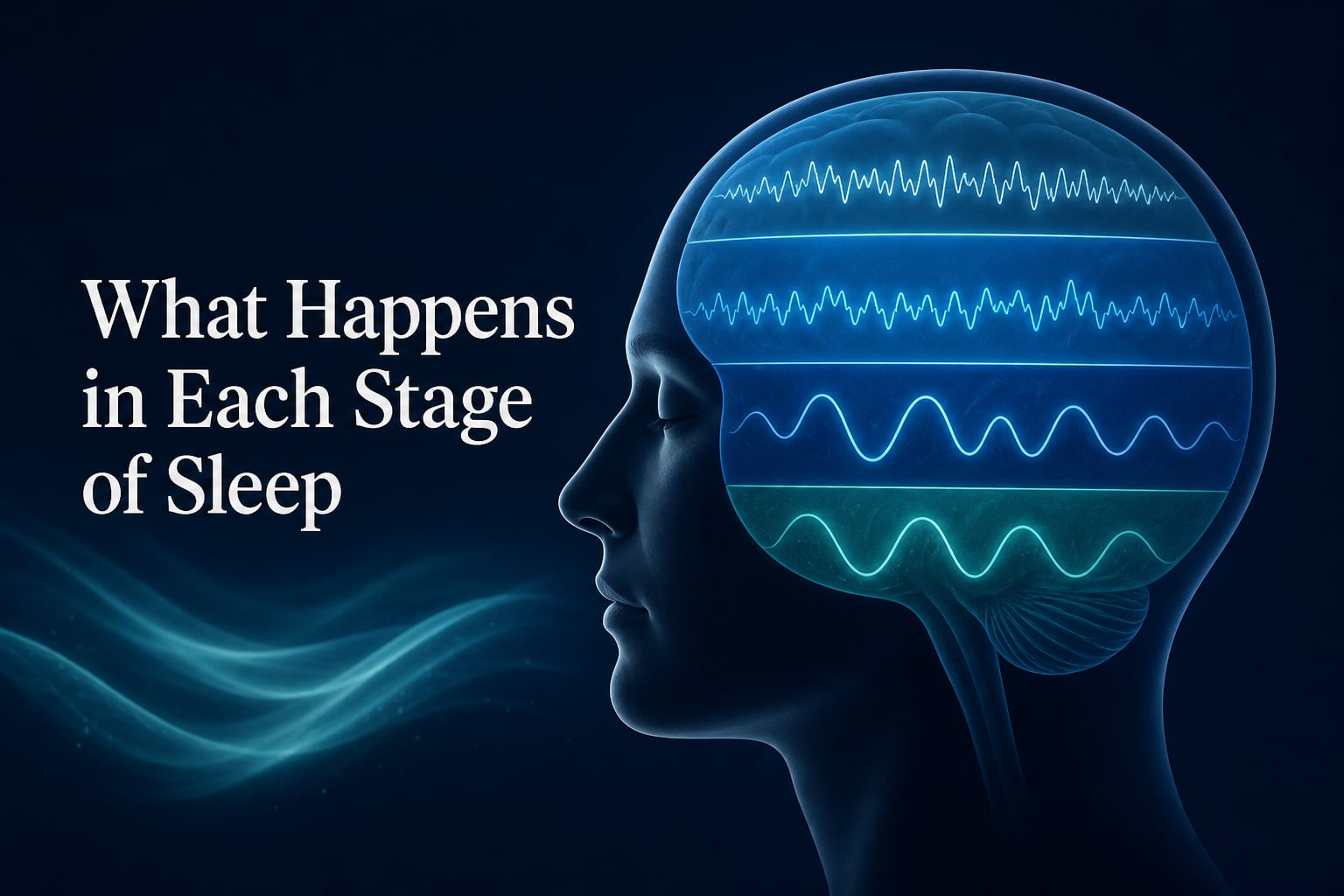
Every night, your brain runs through four distinct stages of sleep that repeat in cycles. I spent weeks reviewing clinical research and sleep lab studies to break down what actually happens during each stage of sleep, including the brain wave patterns scientists measure on EEG machines.
The four stages of sleep include three non-REM phases (N1, N2, and N3) plus REM sleep. Each stage serves different functions for your body and brain, and understanding them helps you recognize why some mornings leave you refreshed while others feel rough, even when you spent the same amount of time in bed.
Sleep isn’t one single state. It’s an active, structured process where your brainwaves, heart rate, breathing, and muscle tone all shift in predictable ways. When something disrupts that structure, you feel it the next day, even if you technically slept eight hours.
Table of Contents
The Four Stages of Sleep: A Quick Overview
Sleep stages cycle through your night in roughly 90 to 120 minute waves. Here’s a quick look at all four stages before we dig into each one.
- Stage 1 (N1) — Light sleep, transition from waking. Alpha to theta brain waves. Lasts 1 to 5 minutes. About 5% of total sleep.
- Stage 2 (N2) — True sleep onset. Sleep spindles and K-complexes appear on EEG. About 45% of total sleep.
- Stage 3 (N3) — Deep slow-wave sleep. Delta brain waves dominate. About 25% of total sleep. Tissue repair and immune function.
- REM Sleep — Rapid eye movement, vivid dreams, muscle paralysis. Beta-like brain waves. About 25% of total sleep. Memory and emotional processing.
The progression isn’t strictly linear. After N3, you cycle back up through lighter stages before dropping into REM. Each cycle through these stages of sleep looks different depending on what time of night it is.
The American Academy of Sleep Medicine updated its classification in 2007 to combine the older stages 3 and 4 into a single N3 stage. Some textbooks still use the 5-stage model, which is why you’ll see references to both online.
What Happens in Stage 1 Sleep (NREM N1)
Stage 1 is the lightest stage of sleep, and it is where you drift off after closing your eyes. Your brain is producing alpha waves, the same relaxed pattern you see during calm wakefulness, but they are giving way to theta waves, which are slower and slightly irregular.
This stage typically lasts only 1 to 5 minutes and accounts for roughly 5% of your total sleep time across the night. Your muscles begin to relax, your breathing slows, and you can still be easily woken up. A passing car horn, a phone notification, or someone calling your name will snap you back to full alertness.
Many people experience hypnic jerks during N1, those sudden muscle contractions that feel like falling. Hypnagogic hallucinations (vivid images or sounds as you fall asleep) also happen during this transition.
Because stage 1 is so light, you usually don’t feel rested after spending time in it. It’s simply the doorway to deeper sleep.
Researchers often call N1 the “dozing off” stage. If someone wakes you during N1, most people will insist they weren’t actually asleep yet, because the transition is so gradual.
What Happens in Stage 2 Sleep (NREM N2)
Stage 2 is where you spend the largest portion of your night, around 45% of total sleep time. Once considered a simple “transition” stage, modern sleep science now knows N2 is doing heavy lifting for memory and learning.
Two brain wave signatures define this stage: sleep spindles (short bursts of high-frequency activity lasting 0.5 to 2 seconds) and K-complexes (sudden sharp waves followed by slow waves). Scientists believe these bursts help transfer information from short-term to long-term memory and protect sleep from being disrupted by outside sounds.
During N2, your heart rate drops to about 20% below waking levels, your body temperature decreases by 1 to 2 degrees, and eye movements stop. Your muscles relax further but you can still move if needed. This stage lasts around 25 minutes in your first cycle and stretches longer with each subsequent cycle through the night.
Stage 2 is harder to wake from than N1, but still much easier than deep sleep. Most people who report “light sleep” are spending a lot of time here or being woken repeatedly during it.
A landmark study published in 2013 found that sounds timed to coincide with sleep spindles can boost memory performance the next day, suggesting that N2 is when your brain actively processes what you learned during the day.
What Happens in Stage 3 Sleep (NREM N3)
Stage 3, also called slow-wave sleep or delta sleep, is the deepest stage of sleep. Your brain produces large, slow delta waves (0.5 to 4 Hz) that sweep across the cortex in synchronized patterns. This is the stage where your body does its most important physical restoration work.
During N3, your body releases growth hormone, repairs muscle tissue, strengthens your immune system, and consolidates declarative memories (facts and information). Blood pressure drops, breathing becomes slow and regular, and your muscles are fully relaxed.
N3 makes up about 25% of total sleep time in healthy young adults, mostly concentrated in the first third of the night. This percentage drops sharply with age. A 70-year-old might get only a few minutes of stage 3 per night.
Waking someone from N3 produces sleep inertia, that groggy, disoriented feeling that can last 30 minutes or more. This is also the stage where parasomnias like sleepwalking, night terrors, and bedwetting occur, because the brain is partially active while the body remains deeply asleep.
Studies show that the immune system depends heavily on N3. People who get vaccinated produce a stronger antibody response when they sleep well afterward, specifically because slow-wave sleep strengthens immune memory.
Slow-wave sleep also appears to clear metabolic waste from the brain through the glymphatic system, a network that flushes out proteins like beta-amyloid, which is linked to Alzheimer’s disease when it accumulates.
What Happens During REM Sleep
REM (Rapid Eye Movement) sleep is the dreaming stage. Your eyes dart back and forth under closed lids, your brain activity looks almost identical to wakefulness on EEG, yet your body is essentially paralyzed through a mechanism called muscle atonia.
REM sleep accounts for roughly 25% of total sleep in adults, but the timing shifts across the night. Your first REM period starts about 90 minutes after falling asleep and lasts around 10 minutes. Each subsequent REM period grows longer, with the final one lasting up to 60 minutes.
The brain uses REM sleep to process emotions, consolidate procedural memories (skills and motor patterns), and integrate new information with existing knowledge. Neurotransmitter levels shift dramatically: serotonin and norepinephrine drop nearly to zero while acetylcholine rises, which is why dreams feel emotionally intense but often lack rational logic.
REM is also when most vivid dreaming happens. You can dream in other stages, but REM dreams are longer, more visual, more emotional, and easier to recall upon waking.
The muscle atonia that paralyzes you during REM is actually protective. Without it, you would physically act out your dreams, which is exactly what happens in REM sleep behavior disorder, a condition where the paralysis fails and people punch, kick, or jump out of bed during vivid nightmares.
How Sleep Cycles Progress Through the Night
A complete sleep cycle through all four stages of sleep takes 90 to 120 minutes, and most adults complete 4 to 6 full cycles per night. The structure of those cycles changes as the night goes on.
Early in the night, your cycles are weighted heavily toward deep N3 sleep with shorter REM periods. As morning approaches, N3 essentially disappears and REM periods stretch longer. This is why you remember dreams more clearly from early morning, and why pulling an all-nighter leaves you physically exhausted but eventually craving REM rebound.
Between cycles, you often rise briefly into light sleep or near-waking without realizing it. These micro-arousals happen dozens of times per night in healthy sleepers and aren’t remembered.
The pattern of all these cycles is called sleep architecture, and when plotted on a graph (called a hypnogram) it looks like a series of descending stairs that gradually shift upward toward REM as morning approaches.
Total sleep architecture tends to follow a predictable pattern: roughly 5% N1, 45% N2, 25% N3, and 25% REM. Any major deviation from those percentages usually signals a sleep disorder or external disruption worth investigating.
Brain Wave Patterns During Each Sleep Stage
Scientists measure sleep stages primarily through electroencephalography (EEG), which records electrical activity in your brain. Each stage of sleep has a distinct wave signature.
During alert wakefulness, your brain produces fast, low-amplitude beta waves (13 to 30 Hz). When you close your eyes and relax, alpha waves (8 to 12 Hz) appear, the smooth, rhythmic pattern associated with calm awareness.
As you fall asleep, theta waves (4 to 7 Hz) emerge during N1 and continue into N2, where they get interrupted by sleep spindles and K-complexes. During N3 deep sleep, your brain synchronizes into large, slow delta waves (0.5 to 4 Hz), the hallmark of true restorative sleep.
REM sleep breaks the pattern. Your brain returns to fast, desynchronized beta and gamma wave activity, similar to waking concentration, which is why REM is sometimes called “paradoxical sleep.” Your body is deeply asleep but your brain is electrically active.
The transition between these wave types is what sleep technicians look for when scoring a polysomnogram (sleep study). They assign each 30-second window of recording to a specific stage based on which waves dominate.
How Age Changes Your Sleep Stages
The distribution of sleep stages changes dramatically across your lifespan. Newborns spend about 50% of their sleep in REM, which researchers believe supports massive brain development. By age 5, REM drops to adult levels around 25%.
Deep N3 sleep declines steadily after age 30. A 25-year-old might get 90 to 120 minutes of slow-wave sleep per night, while a 65-year-old might get less than 30 minutes. This is one reason older adults report lighter, more easily disturbed sleep.
Children and adolescents often have very high N3 percentages, which is why a teenager can sleep 10 hours and still seem tired if their schedule cuts it short. Their deep sleep demands are simply higher.
Elderly sleep tends to feature more frequent awakenings, more time in N1 and N2, less N3, and fragmented REM periods. These changes are normal but they do affect how refreshed people feel upon waking.
Sleep also becomes more fragmented with age, meaning more awakenings per night and more time spent in lighter stages. This is partly why older adults often nap during the day, their nighttime architecture no longer delivers all the deep sleep they need in one continuous block.
What Affects Your Sleep Stages
Several lifestyle factors can shift how much time you spend in each stage of sleep, often without you realizing it.
Alcohol suppresses REM sleep in the first half of the night and fragments sleep in the second half. Caffeine blocks adenosine receptors and can delay sleep onset, reducing total N3. Nicotine causes frequent awakenings that fragment deep sleep.
Stress and anxiety increase time spent in light N1 sleep at the expense of deep N3 and REM. Screen exposure before bed delays melatonin release, pushing your sleep cycles later. Room temperature above 70 degrees disrupts the natural temperature drop needed for efficient deep sleep.
Sleep disorders like obstructive sleep apnea repeatedly pull you out of deep sleep into light sleep or wakefulness, sometimes hundreds of times per night. Insomnia often means more time in light stages and less in restorative deep and REM sleep.
Medications matter too. Benzodiazepines suppress deep sleep. Antidepressants often suppress REM. Many over-the-counter sleep aids increase total sleep time but reduce its quality across the stages.
Shift work, jet lag, and irregular schedules all disrupt your circadian rhythm, which is the internal clock that coordinates when each stage of sleep should occur. Even a one-hour shift in your sleep window can move your REM periods outside their natural peak.
How Sleep Trackers Measure Your Stages
Consumer wearables like Oura Ring, Apple Watch, and Fitbit use a combination of heart rate variability, motion sensors, and sometimes blood oxygen to estimate your sleep stages. They are reasonably accurate at distinguishing deep from light sleep, but they tend to misclassify quiet wakefulness as light sleep and sometimes miss brief REM periods.
Clinical polysomnography (a sleep lab study) remains the gold standard because it uses EEG electrodes on the scalp, plus eye movement and muscle tone monitors. No consumer device can match that precision yet.
If your tracker shows you got 45 minutes of deep sleep and 90 minutes of REM, those numbers are estimates, not exact measurements. Treat them as trends over time rather than precise readings on any given night.
How to Get More Deep Sleep and Better REM Sleep
You can’t directly control which stage of sleep you’re in, but you can set conditions that favor healthy cycling through all four stages.
Keep a consistent sleep schedule, even on weekends. Going to bed and waking at the same time anchors your circadian rhythm and supports stable sleep architecture.
Keep your bedroom cool, ideally between 65 and 68 degrees Fahrenheit. Your body needs to drop its core temperature to enter and stay in deep sleep, and a warm room fights that process.
The 3-3-3 rule for sleep is a simple framework: stop drinking caffeine 3 hours before bed, stop eating 3 hours before bed, and stop screen time 3 hours before bed. It gives your body a clear runway into deeper sleep stages.
Exercise regularly, but finish intense workouts at least 3 to 4 hours before bed. Morning or afternoon exercise increases deep sleep without disrupting sleep onset.
Get bright light exposure within an hour of waking, and dim your lights in the evening. Light is the strongest signal your circadian system uses to time your sleep cycles.
Avoid alcohol close to bedtime. Even one or two drinks will cut your REM sleep, fragment the second half of your night, and reduce overall sleep quality even if you fall asleep faster.
If you want to increase REM sleep specifically, the most reliable levers are stress reduction and consistent wake times. REM tends to favor regular sleep schedules and lower evening cortisol levels.
Frequently Asked Questions About Sleep Stages
What are the 5 stages of sleep and what do they do?
Modern sleep science classifies sleep into 4 stages: N1 (light sleep transition), N2 (sleep spindles and memory consolidation), N3 (deep slow-wave sleep for physical restoration), and REM (dreaming and emotional processing). The older 5-stage model splits N3 into stage 3 and stage 4, but the American Academy of Sleep Medicine now groups them as a single deep sleep stage. Each stage plays a distinct role in recovery, learning, and brain health.
What is better, REM or deep sleep?
Neither is better; your body needs both. Deep N3 sleep is when your body repairs tissues, releases growth hormone, and strengthens your immune system. REM sleep is when your brain consolidates memories, processes emotions, and supports learning. Cutting either one short leaves specific functions unmet, which is why balanced cycling through all stages of sleep matters more than maximizing any single one.
What is the 3-3-3 rule for sleep?
The 3-3-3 rule is a simple sleep hygiene guideline: stop drinking caffeine 3 hours before bed, stop eating 3 hours before bed, and stop using screens 3 hours before bed. This gives your nervous system time to wind down, supports melatonin release, and helps you enter deeper sleep stages faster.
Which sleep cycle is worst to wake up in?
Waking during deep N3 sleep produces the worst grogginess, called sleep inertia, which can last 30 minutes or longer. You feel disoriented, slow, and mentally foggy. Waking during light N1 or N2 stages is much easier and tends to feel natural. This is why sleep experts recommend timing alarms to fall during lighter stages at the end of a 90-minute cycle rather than the middle of deep sleep.
How many sleep cycles do I need each night?
Most adults need 4 to 6 complete sleep cycles per night, each lasting 90 to 120 minutes. Five full cycles equals roughly 7.5 hours of sleep, which is why this number is often recommended. The exact number varies by individual sleep needs, genetics, and how much deep versus REM sleep your body requires that particular night.
How much deep sleep do I need per night?
Healthy adults typically need 1.5 to 2 hours of deep N3 slow-wave sleep per night, which represents about 20 to 25% of total sleep time. Children and adolescents need more, sometimes up to 40% of their sleep in deep stages. Deep sleep is hardest to achieve later in the night, which is why early sleep hours matter most for physical restoration.
Why Understanding Sleep Stages Matters
The stages of sleep aren’t just academic labels. They are the reason your body feels restored, your mind feels clear, and your mood stays stable. Each stage of sleep, from light N1 transition through deep N3 slow-wave sleep and into REM dreaming, contributes something your waking hours depend on.
Once you understand how sleep cycles work, you can make smarter choices about bedtime, alcohol, screen time, and room temperature. Quality matters more than quantity, and quality means cycling through all four stages of sleep the way your brain is designed to do.
Start tonight with one small change: a cooler room, a consistent bedtime, or simply putting your phone away 30 minutes earlier. Your sleep stages will respond, and so will your mornings.
Whether you are trying to recover from burnout, train harder at the gym, study more effectively, or simply stop waking up tired, the answer is almost always the same. Protect all four stages of sleep, every night, and your daytime life gets noticeably better.