
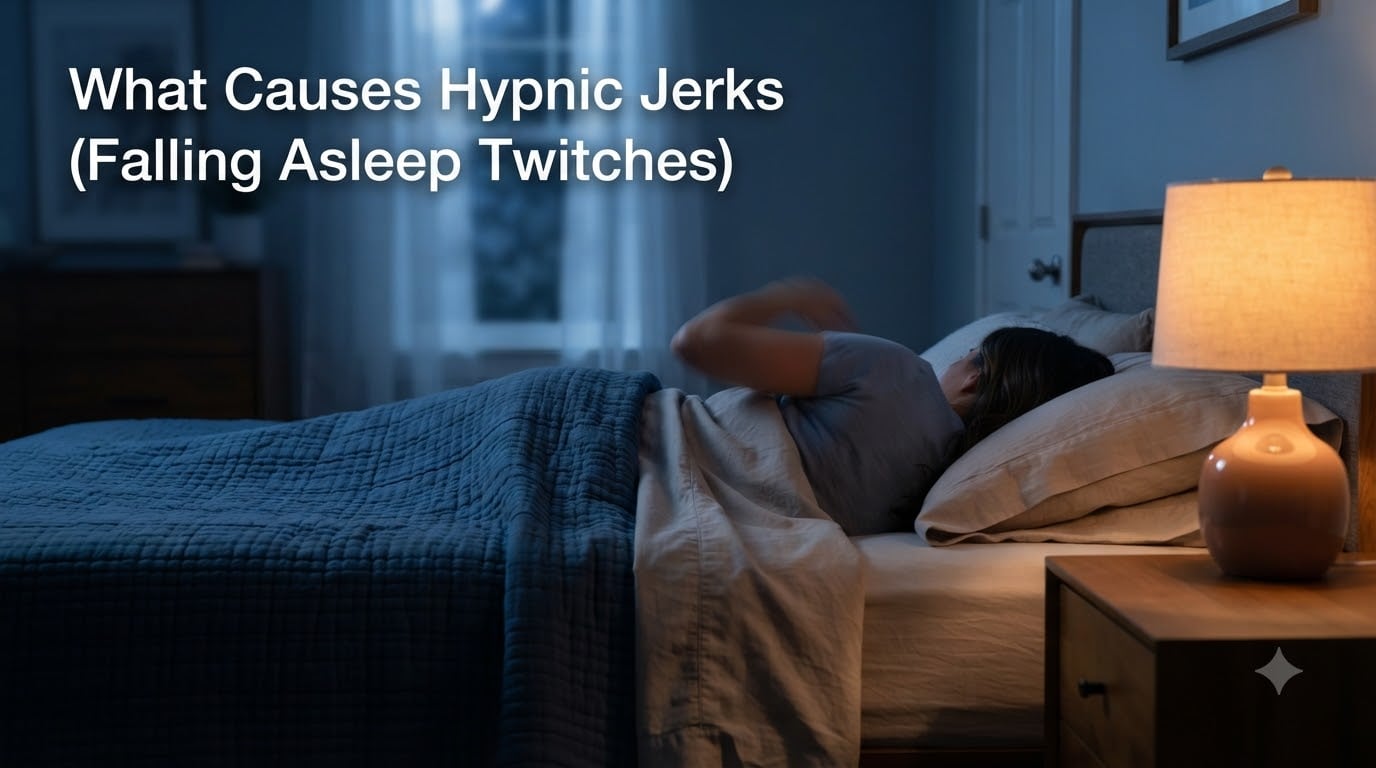
You are drifting off to sleep, finally relaxed, when suddenly your body jolts awake with a violent twitch. Your heart races for a moment, and you wonder if something is wrong with you. The answer is almost always no — you just experienced a hypnic jerk, and up to 70% of people have them at some point in their lives. Understanding what causes hypnic jerks can ease that anxiety and help you sleep more peacefully.
These falling asleep twitches, also called sleep starts or hypnagogic jerks, are a normal part of the sleep transition. They are completely harmless in the vast majority of cases. Our team put together this guide to explain exactly why they happen, what triggers them, and when you should actually pay closer attention.
Table of Contents
What Is a Hypnic Jerk?
A hypnic jerk is a sudden, involuntary muscle contraction that happens as you transition from wakefulness to sleep. The twitch usually affects the whole body, though sometimes only an arm or leg moves. It typically occurs during the first stage of sleep, when your muscles relax and your brain begins to shift gears.
Doctors classify hypnic jerks as a type of benign myoclonus, which simply means a quick, involuntary muscle movement. Hiccups are another familiar form of myoclonus. The difference is that hiccups happen while you are awake, while hypnic jerks occur specifically at sleep onset.
Researchers have observed a pattern on EEG readings called vertex sharp waves that often accompany these jerks. These brainwave changes appear as your nervous system shifts from active wakefulness into stage 1 sleep, suggesting the jerk is a byproduct of that handoff.
What Hypnic Jerks Feel Like
The sensation is hard to forget once you have experienced it. Most people describe a sudden jolt, as if they slipped or tripped, followed by a brief moment of full alertness. Some people report a vivid but fragmented dream — like falling off a curb or down stairs — right before the twitch.
A few people also notice a flash of light, a loud snap or popping sound, or a tingling sensation in their limbs. The whole episode usually lasts only a second or two, but the adrenaline spike can leave you wide awake for several minutes afterward.
If the jerks happen repeatedly in one night, the constant jolting can feel genuinely exhausting. Many people in sleep forums describe this exact frustration — being jolted awake dozens of times just as they start to drift off. That cycle can feed on itself, because the more tired and anxious you become, the more likely the jerks are to continue.
What Causes Hypnic Jerks?
No single cause explains every hypnic jerk. Instead, several factors increase how often and how intensely they happen. Understanding what causes hypnic jerks comes down to looking at how your brain, nervous system, and daily habits interact at the moment you fall asleep.
Here is the most widely accepted explanation: as you fall asleep, your muscles relax progressively. Parts of your brain, particularly the reticular brainstem, can briefly misinterpret that relaxation as your body actually falling. The brain fires a reflexive muscle contraction to “catch” you, producing the jerk.
Several triggers make this misfire more likely:
Stress and anxiety — A nervous system stuck in hyperarousal has trouble switching into sleep mode. The transition becomes jerky instead of smooth, and adrenaline from daily stress can make the contractions feel more intense.
Caffeine and stimulants — Coffee, energy drinks, certain teas, and some medications keep your nervous system wired. The leftover stimulation interferes with the relaxation needed for a calm sleep onset.
Sleep deprivation — Being overtired disrupts the normal staged progression into sleep. Your brain tries to rush through the transition, which seems to trigger more frequent and forceful jerks.
Vigorous late-day exercise — Intense workouts close to bedtime keep your heart rate elevated and your muscles primed for action rather than rest.
Alcohol and nicotine — Both disrupt the quality of your sleep onset and can increase muscle activity during the wake-to-sleep transition.
Notice that none of these causes are dangerous on their own. They simply stack the odds against a smooth transition into sleep.
Hypnic Jerks vs Other Sleep Movements
Hypnic jerks are not the only movement that happens during sleep, and confusing them with other conditions is a common source of worry. Knowing the differences can help you figure out whether what you are experiencing is typical.
Restless Leg Syndrome (RLS) causes an irresistible urge to move your legs, usually with an uncomfortable crawling or tingling sensation. Unlike hypnic jerks, RLS happens while you are still awake and trying to settle in, and the urge to move persists until you actually shift position.
Periodic Limb Movements of Sleep (PLMS) involves repetitive leg or arm twitches that occur during sleep itself, not at the onset. You are typically unaware of them unless a bed partner mentions it. PLMS can fragment your sleep without you realizing why.
Sleep myoclonus is a broader category of brief muscle twitches that can occur during sleep. Hypnic jerks are technically a subtype that happens specifically at sleep onset. Other forms of myoclonus may point to neurological issues and warrant a medical evaluation.
Muscle fasciculations are tiny, visible ripples under the skin caused by individual muscle fibers firing. These are usually harmless and linked to fatigue, dehydration, or caffeine, but they feel very different from a full-body hypnic jerk.
Can Vitamin Deficiencies Cause Hypnic Jerks?
There is no single vitamin deficiency proven to directly cause hypnic jerks, but mineral imbalances may play a supporting role. Magnesium is the one most often discussed, because it helps regulate muscle and nerve function. Low magnesium can leave muscles more excitable and prone to twitching in general.
Calcium, potassium, and vitamin D also contribute to healthy muscle activity. If you suspect a deficiency is involved, the right move is to ask your doctor for a blood test rather than self-supplementing. Eating magnesium-rich foods like spinach, almonds, pumpkin seeds, and dark chocolate is a safe way to support your mineral intake through diet.
When to See a Doctor
Most hypnic jerks need no medical attention at all. But there are a few situations where it makes sense to talk to a healthcare provider.
The jerks happen so frequently that you cannot fall asleep for hours, night after night.
You injure yourself or a bed partner during a jerk.
The twitches are accompanied by tongue biting, loss of bladder control, or confusion afterward.
You notice jerking, twitching, or myoclonus while fully awake, not just at sleep onset.
You suspect an underlying issue like sleep apnea, since oxygen drops during apnea episodes can trigger sudden arousals that feel similar.
The sleep apnea connection is worth highlighting because several forum users report experiencing jerks that did not resolve until their apnea was treated. If you snore loudly, wake up gasping, or feel exhausted despite a full night in bed, an apnea screening may be worth requesting.
How to Stop or Reduce Hypnic Jerks
You cannot always prevent hypnic jerks completely, but you can significantly reduce how often they happen. The goal is to make your wake-to-sleep transition as smooth and calm as possible.
Cut back on caffeine late in the day. Stop consuming coffee, energy drinks, and other stimulants by early afternoon. Caffeine has a long half-life and can keep your nervous system on edge well into the evening.
Prioritize consistent sleep. Going to bed and waking up at the same time each day helps your brain learn a reliable sleep onset pattern. This reduces the rushed, jerky transitions that come with overtiredness.
Build a wind-down routine. Spend the last 30 to 60 minutes before bed on calming activities like reading, gentle stretching, or breathing exercises. This signals your nervous system that it is safe to relax.
Manage daytime stress. Because anxiety and hyperarousal are major triggers, addressing the source of your stress matters. Journaling, therapy, meditation, or even a short evening walk can lower the adrenaline that fuels the jerks.
Finish intense exercise earlier. Keep vigorous workouts at least three hours before bedtime. Light stretching or yoga closer to bed is fine and may actually help.
Limit alcohol and nicotine. Both fragment your sleep onset and increase muscle activity. Cutting back, especially in the evening, can make a noticeable difference.
Support your mineral intake. Eat magnesium-rich foods regularly, and ask your doctor whether a supplement makes sense for you.
One important tip from people who have dealt with persistent jerks: do not let the fear of a twitch keep you tense at bedtime. The more you worry about a jerk happening, the more likely it is to happen. Breaking that anxiety loop is often half the battle.
FAQs
Is a hypnic jerk a mild seizure?
No, a hypnic jerk is not a seizure. It is a normal, benign muscle reflex that happens as you fall asleep. Seizures involve abnormal electrical discharges in the brain, cause different symptoms, and can occur at any time. If you experience tongue biting, loss of consciousness, confusion, or jerking while fully awake, see a doctor to rule out a seizure disorder.
What vitamin deficiency causes hypnic jerks?
No single vitamin deficiency is proven to directly cause hypnic jerks. However, low magnesium is the most commonly discussed factor, since magnesium helps regulate muscle and nerve function. Calcium, potassium, and vitamin D also play roles in healthy muscle activity. Ask your doctor for a blood test if you suspect a deficiency.
What can be mistaken for hypnic jerks?
Several conditions can be confused with hypnic jerks, including restless leg syndrome (RLS), periodic limb movements of sleep (PLMS), sleep myoclonus, muscle fasciculations, and certain types of nocturnal seizures. The key difference is timing and pattern: hypnic jerks occur specifically at sleep onset and are isolated events, while the others have different triggers, frequencies, or occur during sleep itself.
When to worry about hypnic jerks?
You should see a doctor if the jerks happen so often you cannot sleep, if you injure yourself, or if they are accompanied by tongue biting, confusion, or loss of bladder control. Also seek help if you experience twitching while fully awake, suspect sleep apnea, or feel exhausted despite a full night in bed.
The Bottom Line on Falling Asleep Twitches
Hypnic jerks are one of the most common and harmless sleep experiences you can have. Knowing what causes hypnic jerks — stress, caffeine, overtiredness, and a brain adjusting to the sleep transition — takes most of the fear out of that sudden jolt.
If the twitches are disrupting your sleep or causing real anxiety, start with the lifestyle changes above. And if they persist, bring it up with your doctor so you can rule out anything else and get back to sleeping soundly in 2026.