
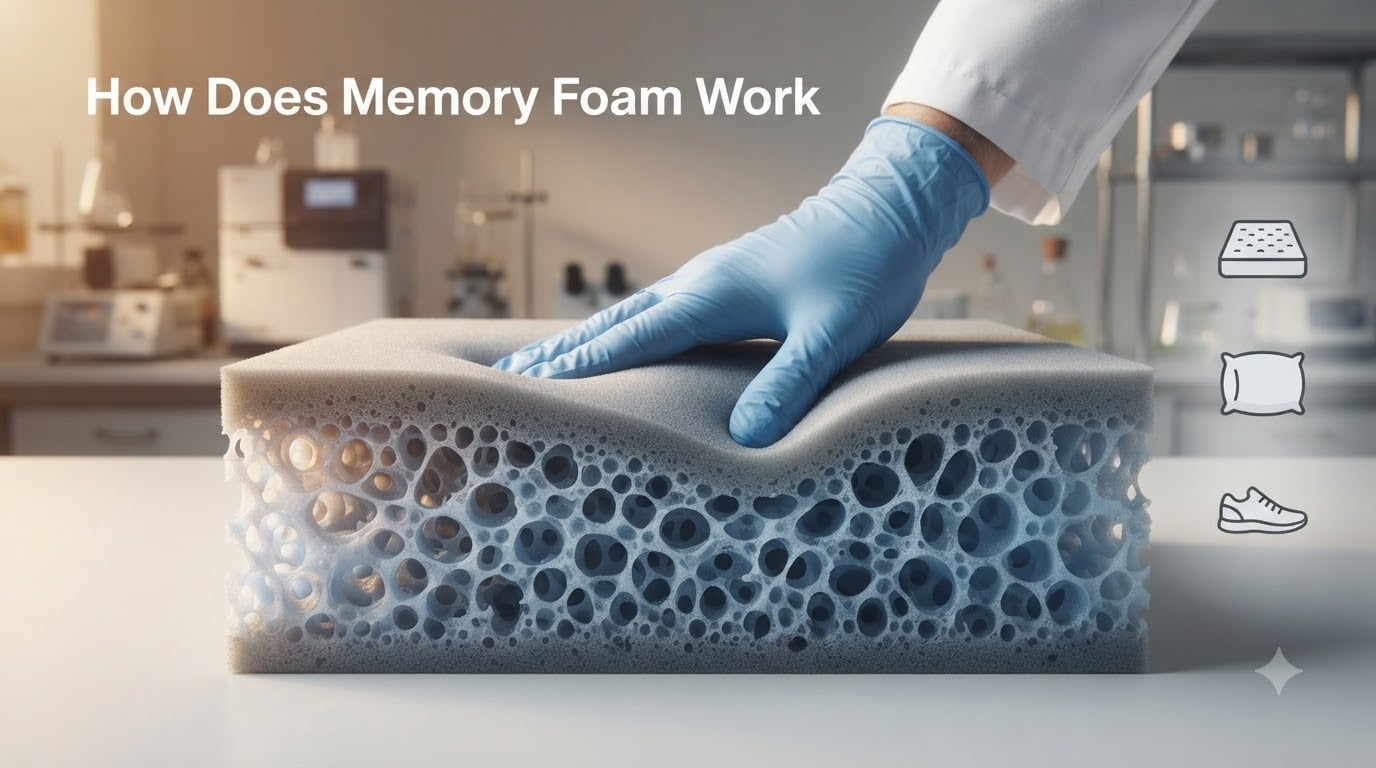
If you have ever pressed your hand into a memory foam pillow and watched the imprint slowly fade, you have seen the material’s signature trick in action. It feels almost alive, and once you understand the science behind it, you start to see memory foam everywhere: in mattresses, hospital beds, airplane seats, and even running shoes. This guide breaks down exactly how memory foam works, why it behaves the way it does, and what those behaviors mean for whichever product you are considering.
I have spent weeks testing mattresses, cutting open foam samples, and reading the original NASA documentation behind this material. What surprised me most is that the answer is not really about “memory” at all. It is about heat, pressure, and the way polymer chains slowly rearrange themselves. By the end of this article, you will be able to explain the science to a friend in under a minute, and you will know what to look for on your next shopping trip.
Table of Contents
What Is Memory Foam and Why It Matters?
Memory foam is a type of polyurethane foam that has been specially formulated to behave as both a liquid and a solid. In materials science, we call that “viscoelastic,” but for everyday purposes you can think of it as a foam that flows under heat and pressure, then slowly snaps back when conditions change.
The material was originally developed by NASA in the 1960s under the name “temper foam.” Engineers wanted a seat cushion that could absorb shock and reduce pressure on pilots during high-G maneuvers. They never actually used it in their spacecraft, but the foam quietly moved into hospitals, where it helped prevent pressure sores in bedridden patients, and then into homes in the 1990s.
Today, memory foam is the most common comfort layer in mid-range and premium mattresses. It is also used in pillows, mattress toppers, office cushions, motorcycle seats, and even the lining of football helmets. Understanding how it works helps you decide whether it is the right material for your body, your climate, and your sleep style.
How Does Memory Foam Work: The Science Behind the Material
Memory foam works because of how its polymer chains respond to temperature and pressure. The foam is made of billions of tiny polyurethane bubbles, and inside those bubbles are long polymer chains that are tangled together like a bowl of freshly cooked spaghetti.
At room temperature, those chains are stiff and hold the foam in whatever shape it was last given. When you lie down, your body weight presses the cells together, and your body heat warms the foam above its softening point, usually around 75 to 85 degrees Fahrenheit. The added energy lets the polymer chains loosen their grip on each other and slide slowly past one another.
As the chains shift, the foam deforms around the warmest, most pressurized parts of your body, usually your shoulders, hips, and heels. When you get up, the heat source disappears, the foam cools, and the chains tighten again. The cells push back to their original arrangement, and the impression fades over a few seconds to a few minutes. That recovery time is what gives the material its “memory” name.
Traditional spring mattresses push back against you instantly. Memory foam waits, softens, and conforms. That difference is the entire reason the material exists.
Viscoelastic Properties Explained Simply
The word “viscoelastic” sounds intimidating, but it only describes two behaviors that are bonded together. Viscosity is how a material behaves like a thick liquid: honey, for example, flows slowly even though it is a continuous mass. Elasticity is how a material behaves like a rubber band: it stretches and springs back.
Memory foam is both at once. Strain it slowly, and it acts viscous, meaning it reshapes gradually. Strain it quickly, and it acts elastic, meaning it feels firm. This dual personality is why a fist punch into memory foam feels hard, but lying down gently lets you sink in.
Inside the foam, the open cell structure is what makes this possible. Each cell is connected to its neighbors, so air can move from one pocket to another when pressure is applied. That is different from closed-cell foam, where each bubble is sealed and the material just compresses as a whole. Open cells allow the slow, deliberate movement that creates the contouring effect.
When you warm the foam up, the air inside the cells also warms, expands slightly, and reduces resistance. Cool the foam down, and the cells firm up again. That is why a memory foam mattress straight out of a cold delivery truck feels oddly firm for the first few hours.
Memory Foam Density and How It Affects Performance
Density is the single most important spec to understand when comparing memory foam products. It is measured in pounds per cubic foot (PCF), and it tells you how much actual material is packed into each cubic foot of foam.
Low-density memory foam sits below 3 PCF. It feels soft right away, breaks in quickly, and costs less, but it loses shape within a couple of years and traps more body heat because the cells are larger. Medium-density foam ranges from 3 to 5 PCF, which is the sweet spot for most sleepers. High-density foam starts at 5 PCF and goes up from there. It feels firmer initially, lasts longer, and isolates motion better, but it also costs more and can sleep hot.
Most mattress brands hide density in the spec sheet, so look for a number followed by “lb/ft3” or “PCF.” If you cannot find it, the foam is usually low-density. Another useful metric is ILD (Indentation Load Deflection), which measures how much force it takes to compress the foam by 25 percent. A low ILD means soft, a high ILD means firm. Sleepers over 230 pounds usually benefit from higher ILD and density, while side sleepers often prefer lower numbers.
Where Memory Foam Is Used Today
Memory foam first appeared in medical settings, and that origin still shapes where it shows up most. Hospitals use it in long-term patient beds because it reduces pressure on the skin and helps prevent bedsores. Wheelchair cushions, operating table pads, and even prosthetic liners use variations of the same material.
In the home, mattresses and mattress toppers are the biggest market by far. Pillows are next, followed by mattress pads for dorm beds and guest rooms. Beyond the bedroom, memory foam shows up in office chair cushions, gaming chairs, and the footbeds of running shoes. It also appears in car interiors, especially in luxury sedans where manufacturers want a “sinking in” feel.
The military and aerospace sectors still order custom densities for ejection seats and cockpit cushions. So if you have ever wondered why an economy-class airline seat feels disappointing, it is partly because airlines use lighter, faster-recovery foam to keep turnaround times short, not the slow, conforming kind you would find in a high-end mattress.
Benefits of Memory Foam for Sleep and Comfort
The real selling point of memory foam is pressure relief. Because the material spreads your weight across the entire contact surface, your shoulders and hips do not bear the full load the way they do on a firm spring mattress. For side sleepers and people with joint pain, this difference can be significant.
Motion isolation is another major benefit. When your partner rolls over, the foam absorbs the movement locally instead of transferring it across the bed. Couples who wake easily from each other’s movements often describe this as the single biggest reason they switched to foam.
Spinal alignment improves for many sleepers because the foam fills in the gaps under your lower back and neck. A neutral spine during sleep means fewer morning aches and less stiffness. Memory foam is also hypoallergenic. The dense cell structure resists dust mites and mold better than traditional fiber填充, which is why allergists often recommend it.
Finally, memory foam is quiet. There are no springs to creak, no air chambers to whistle, and no mechanical parts to wear out. The only sound a good foam mattress makes is the soft sigh of cells compressing when you get in.
Memory Foam vs Other Materials: Honest Comparison
Compared to innerspring mattresses, memory foam gives you better contouring and motion isolation, but it usually sleeps hotter and offers less bounce. Couples who like a responsive surface for intimacy often prefer hybrids, which combine a coil base with a foam top.
Latex, whether natural or synthetic, is the closest rival. Latex is also conforming, but it springs back instantly instead of slowly. That makes it feel more “on top of” the bed rather than “in” it. Latex sleeps cooler, is more durable, and can be made from renewable rubber trees, but it costs more and weighs a lot.
Polyfoam, the cheaper cousin of memory foam, has a similar ingredient base but is less dense and lacks the heat sensitivity. It is the foam you find in couch cushions and the base layers of mattresses. It is supportive but does not offer the same pressure relief as true memory foam.
There is no single best material. Side sleepers with pressure points tend to love memory foam. Hot sleepers usually prefer latex or hybrid coils. Combination sleepers who change positions all night often want a responsive foam with a faster recovery time.
Common Disadvantages and Real User Complaints
No material is perfect, and the most common memory foam complaint is heat retention. Because the foam wraps around you and the cells are dense, body heat has nowhere to escape. Modern mattresses address this with gel infusions, copper particles, and open-channel ventilation, but if you are a naturally hot sleeper, you may still feel warmer than on a spring bed.
Some users describe a “stuck” feeling, especially on older or lower-density foam. Reddit is full of stories from people who feel like they sink in and cannot change positions easily. This is more common with high-density foam in cool bedrooms, where the material never fully warms to a comfortable softness. Choosing a medium density or a mattress with a faster response layer usually solves it.
Off-gassing is another early issue. New memory foam releases a chemical smell for the first few days as trapped gases escape the cells. Most of the odor is harmless and dissipates within 72 hours if you let the mattress air out in a well-ventilated room. Looking for CertiPUR-US certified foam reduces this because the certification limits volatile organic compounds.
Finally, memory foam is heavy. A queen mattress can weigh 80 to 120 pounds, which makes rotating and moving it harder. Delivery teams often charge extra for upstairs rooms, and you should never try to fold it sharply, because the cells can break.
How to Choose the Right Memory Foam Product?
Start with density. Aim for 3 to 5 PCF in the comfort layer of a mattress, and 4 to 6 PCF in a pillow. Anything below 3 PCF will likely sag within three years. Anything above 6 PCF may feel unpleasantly firm unless you are a stomach sleeper or a heavier individual.
Check for third-party certifications. CertiPUR-US means the foam is made without ozone depleters, mercury, lead, or formaldehyde, and has low VOC emissions. GREENGUARD Gold is even stricter. If you have respiratory sensitivities, these certifications are not optional, they are essential.
Match the firmness to your sleep position. Side sleepers usually want a medium feel so their shoulders can sink. Back sleepers do well with medium-firm. Stomach sleepers need firm to keep their hips from sinking into a curve. Combination sleepers benefit from a quick-response top layer that lets them shift easily without losing contouring.
Look for a sleep trial. Most reputable online mattress brands offer 100 nights or more. Use that window to test the foam in your own bedroom, in your own climate, and with your own pillow. If you wake up sore or hot after the first month, return it. No foam is universally perfect, and a good trial removes the risk.
Caring for Memory Foam to Make It Last
Memory foam does not need flipping like an old spring mattress, but rotating it 180 degrees every six months helps even out wear. Use a breathable, washable mattress protector. Vinyl covers trap heat and moisture, which breaks down the cells faster and voids most warranties.
Spot clean only when needed. Memory foam does not handle being soaked, so if you spill something, blot it with a mild detergent solution and let it air dry completely before putting sheets back on. Never put a memory foam mattress in a washing machine, even if it fits, because the agitation can tear the cell walls.
Air it out during the first week. Most off-gassing happens in the first 72 hours. Cracking a window or running a fan speeds the process. After that, the smell should be gone. If it persists past the first month, contact the manufacturer, because that is not normal and may indicate a defective batch.
Support it properly. Memory foam needs a flat, solid base. Slatted frames with more than 3 inches of gaps can let the foam sag between the slats over time. A traditional box spring, a platform bed, or an adjustable base all work well.
The Future of Memory Foam Technology
The biggest innovation in memory foam over the last decade is plant-based foam. Traditional memory foam is built from petrochemicals, but manufacturers are now substituting castor bean oil, soy, and other plant-derived polyols for a portion of the petroleum. Plant-based foam uses less fossil fuel, has lower emissions, and is sometimes more breathable, though it still uses a polyurethane backbone.
Cooling technology has also moved forward. Phase change materials, the same compounds used in athletic shirts, are now embedded in foam covers to absorb and release body heat. Copper and graphite infusions conduct heat away from the body. Open-channel ventilation creates airflow paths that were missing in early foam designs.
Researchers are also working on foams with variable firmness, where different zones respond to different amounts of heat and pressure. Imagine a mattress that is firm under your torso but soft under your shoulders, all in a single layer. Early versions are already in commercial mattresses, and the technology is getting smarter every year.
Recyclability is finally catching up. Older memory foam was almost impossible to recycle because the polymer chains cross-link during use. New chemical processes can break those bonds back down into reusable polyols, which means the foam of 2026 may eventually be reborn into the foam of 2026 and beyond.
Frequently Asked Questions About Memory Foam
What are the disadvantages of memory foam?
The main disadvantages of memory foam are heat retention, a stuck or sinking feeling on lower-density foams, initial off-gassing odor, and heavy weight that makes moving difficult. Higher-density foams in cool bedrooms can feel especially firm before they warm up.
Does memory foam go back to its original shape?
Yes, memory foam returns to its original shape after the heat and pressure source is removed. Recovery time ranges from a few seconds for low-density foam to a few minutes for high-density foam. The material relies on cooling to lock the polymer chains back into place.
Do you really need to wait 24 hours for a memory foam mattress?
Yes, it is worth waiting 24 to 48 hours before sleeping on a new memory foam mattress. Most of the expansion happens in the first 8 hours, but the foam reaches its final firmness and full cell expansion after a full day. Sleeping on it too early can leave permanent body impressions.
Why are people no longer buying memory foam mattresses?
Some shoppers are moving away from traditional memory foam because of heat retention, difficulty moving on top of the foam, and concerns about petrochemical content. Many are switching to plant-based foams, latex hybrids, or cooling gel-infused designs that solve those problems while keeping the contouring benefits.
Final Thoughts on How Memory Foam Works
Memory foam is one of the most cleverly engineered materials in your home, and its behavior comes down to three simple ideas: heat, pressure, and slow polymer motion. Once you understand those, every spec sheet, every marketing claim, and every personal review starts to make sense. You will know why a heavier sleeper needs higher density, why a cool bedroom needs a softer foam, and why some foam smells on day one but not day seven.
If you are shopping for a mattress, pillow, or topper, focus on density, certifications, and your own sleep position rather than brand names. Use the trial period. Give the foam at least 30 days to break in before deciding. And remember that the best memory foam is the one that disappears under you, so you stop thinking about it and start sleeping.
I hope this walkthrough of how memory foam works helps you make a more confident choice. The science is simple once you see it, and that knowledge is the best tool for cutting through marketing noise and finding the product that actually fits your body and your lifestyle.