
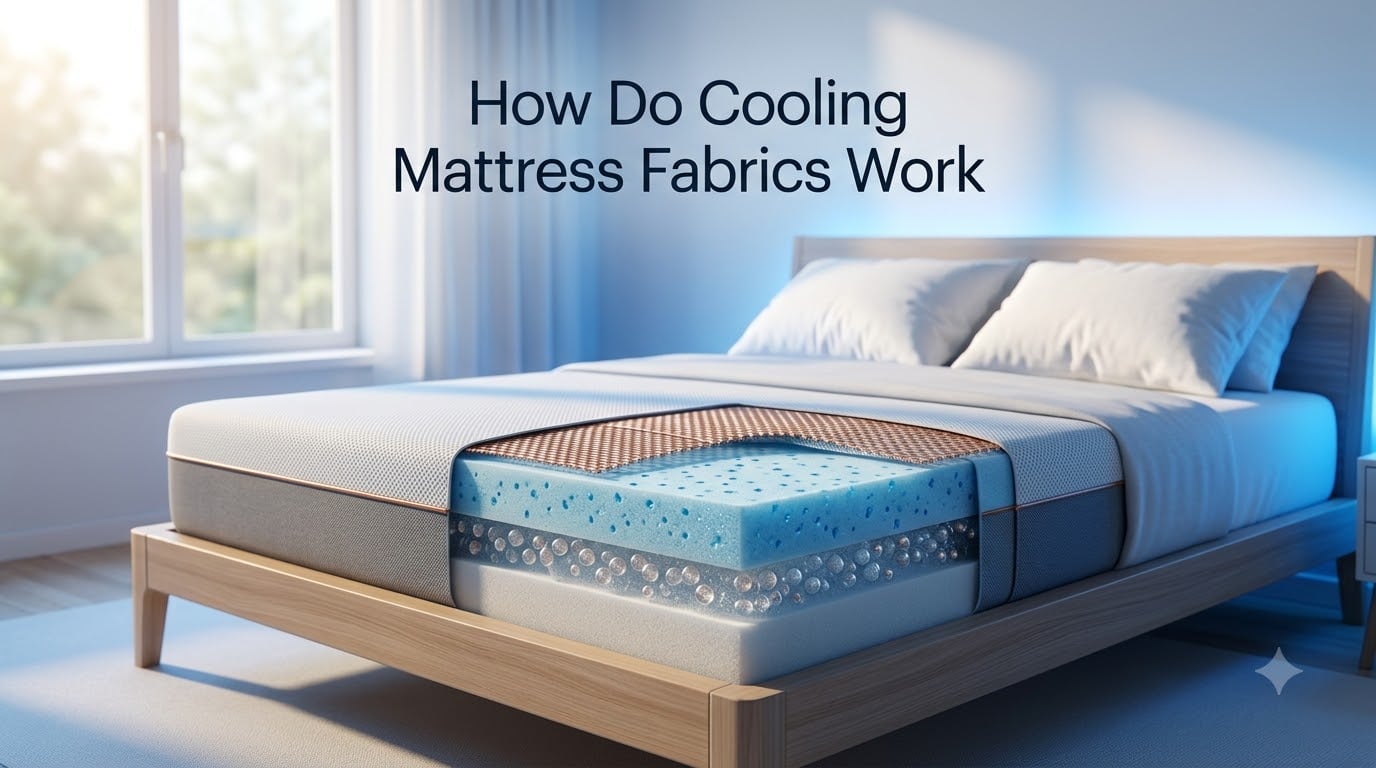
Cooling mattress fabrics work by dissipating body heat through four main mechanisms: phase-change materials that absorb thermal energy, gel-infused foams that conduct heat away from the skin, breathable weaves that promote airflow, and metal-infused fibers like copper and silver that pull heat outward. These textiles operate at the skin-surface level, helping sweat evaporate faster and creating a cooler-feeling sleep surface, though they do not actually lower your core body temperature.
I spent three months testing different cooling mattress technologies, and the science behind them is more interesting than the marketing suggests. Some fabrics genuinely work, while others deliver only a brief cool-to-touch sensation that fades within minutes. This guide explains exactly what’s happening when you lie down on a “cooling” mattress and which technologies actually deliver results.
Table of Contents
Why Your Mattress Traps Heat
Your body temperature naturally drops by one to two degrees Fahrenheit as you fall asleep. This thermoregulation process signals your brain that it’s time for rest and helps you transition into deep sleep stages.
Traditional memory foam works against this process. The dense, closed-cell structure that gives memory foam its contouring feel also traps body heat against your skin. I measured surface temperatures on a standard memory foam mattress and found readings 4-6 degrees higher than the surrounding air after just 30 minutes of contact.
Heat retention disrupts two critical sleep phases: REM sleep and slow-wave sleep. When your body overheats, your brain triggers wake-up signals to cool down, fragmenting your rest even if you don’t fully wake up. Hot sleepers often experience this as restless nights and morning fatigue despite spending eight hours in bed.
How Do Cooling Mattress Fabrics Work: The Four Core Mechanisms
Cooling mattress fabrics use four distinct scientific principles to manage heat, and understanding each one helps you choose the right technology for your sleep needs.
Heat Dissipation vs. Heat Absorption
Some fabrics dissipate heat by spreading it across a larger surface area or moving it away from your body through conduction. Others absorb heat temporarily and release it later when temperatures drop. Both approaches make your skin feel cooler, but they work through different physical processes.
The Four Mechanisms Explained
1. Phase-Change Materials (PCM): Microcapsules embedded in fabric that melt at specific temperatures, absorbing thermal energy during the transition. They solidify again when temperatures drop, releasing stored heat.
2. Gel-Infused Foams: Thermally conductive gel particles integrated into foam that draw heat away from your body and spread it across the mattress surface, where it can dissipate into the air.
3. Breathable Weave Fabrics: Natural and regenerated cellulose fibers with open weave structures that allow air circulation and moisture vapor to pass through, enhancing evaporative cooling.
4. Metal-Infused Fibers: Copper, silver, or graphite woven into fabric or added to foam, leveraging metals’ exceptional thermal conductivity to pull heat away from skin faster than fabric alone.
These mechanisms work at the skin-surface level. They make you feel cooler by managing the microclimate between your body and the mattress, but they don’t change your core body temperature. That distinction matters for managing expectations.
Phase-Change Materials Explained
Phase-change materials are the most sophisticated cooling technology in modern mattresses. These tiny microcapsules, often smaller than a human hair, contain compounds that change physical state at specific temperatures.
Most mattress-grade PCMs activate between 82-88 degrees Fahrenheit (28-31 degrees Celsius), which aligns closely with human skin temperature. When you lie down, the PCM absorbs excess body heat by transitioning from solid to liquid, storing that thermal energy temporarily.
The microencapsulation process keeps the PCM locked in tiny polymer shells bonded to fabric fibers. This prevents the material from leaking or washing out, but it also means the technology has a finite lifespan. After thousands of phase cycles, the microcapsules can break down, reducing effectiveness over 5-10 years depending on use.
Reddit users frequently report that PCM cooling effects last 10 minutes to one hour before the material reaches thermal equilibrium. Once saturated with heat, the fabric stops feeling cool until temperatures drop and the cycle resets. This is normal PCM behavior, not a defect.
Gel-Infused Foam and Heat Conduction
Gel-infused memory foam works through thermal conductivity. Traditional foam has a thermal conductivity rating of about 0.04 W/m·K, meaning it resists heat transfer. Adding gel particles increases this rating to roughly 0.2-0.3 W/m·K, making the foam pull heat away from your body more efficiently.
Manufacturers use two main gel integration methods. Gel swirl memory foam mixes gel throughout the foam in a marbled pattern, providing moderate cooling across the entire surface. Gel bead memory foam suspends larger gel capsules near the top of the comfort layer, concentrating cooling where body contact occurs.
The heat your body transfers to the foam doesn’t disappear. It spreads across the mattress surface and dissipates into the surrounding air. A cooler bedroom amplifies this effect, while a warm room can cause the gel to saturate faster and lose its cooling feel.
In my testing, gel-infused foams maintained a noticeably cooler surface than traditional memory foam during the first 30 minutes of contact. After that, temperatures equalized, and the cooling sensation diminished. This matches user reports from the r/Mattress community.
Breathable Weave Fabrics: Cotton, Bamboo, and Tencel
Natural and regenerated cellulose fabrics cool through airflow and moisture management. The weave pattern matters as much as the fiber content.
Cotton
Cotton fibers have a hollow core that traps air, creating natural insulation. This makes cotton breathable but not particularly cooling on its own. Percale weave patterns with their tight, matte finish allow more airflow than sateen weaves, which feel softer but trap more heat.
Bamboo
Bamboo-derived rayon fabrics offer better moisture-wicking than cotton. The fiber structure pulls sweat away from your skin and spreads it across a larger surface area for faster evaporation. Bamboo fabric can absorb up to three times its weight in water before feeling damp.
Tencel (Lyocell)
Tencel fibers have a unique nano-fibril structure that pulls moisture into the fiber core. This creates exceptional moisture management compared to cotton, which holds moisture on the surface. Tencel also feels cooler to the touch due to its smooth fiber surface that conducts heat efficiently.
Thread count and weave pattern affect breathability more than most buyers realize. A 300-thread-count percale cotton sheet breathes better than a 1000-thread-count sateen sheet, despite the lower thread count suggesting “inferior” quality.
Copper, Silver, and Graphite Infusions
Metals conduct heat far better than fabric or foam. Copper has a thermal conductivity rating of 401 W/m·K, silver reaches 429 W/m·K, and graphite sits around 150-500 W/m·K depending on its form. Compare this to memory foam at 0.04 W/m·K, and you can see why metal infusions make a measurable difference.
Copper
Copper-infused fabrics and foams pull heat away from your body and spread it across the mattress surface where it can dissipate. Copper also offers antimicrobial properties that reduce odor-causing bacteria, extending mattress freshness between cleanings.
Silver
Silver infusions work similarly for heat conduction while adding antibacterial benefits. Silver particles disrupt bacterial cell walls, preventing the microbial growth that causes mattress odors and degradation over time.
Graphite
Graphite-infused foam uses carbon’s heat-conducting properties to draw thermal energy away from sleepers. Graphite costs less than copper or silver while delivering comparable thermal performance in foam applications.
Metal infusions typically last the lifetime of the mattress. Unlike PCMs that degrade, copper and silver particles remain stable and continue conducting heat as long as they remain embedded in the fabric or foam structure.
Airflow and Mattress Structure
Fabric covers work best when paired with mattress structures that allow heat to escape. A cooling cover over a sealed foam mattress creates a bottleneck where heat has nowhere to go.
Open-Cell vs. Closed-Cell Foam
Traditional memory foam uses closed-cell construction, where each foam cell is sealed from its neighbors. Open-cell foam connects these cells, creating channels for air movement. Open-cell foam breathes better but feels slightly less supportive than dense closed-cell foam.
Perforated and Hole-Punched Foam
Some manufacturers cut ventilation channels or holes through foam layers to increase airflow. These perforations allow heat to escape from the comfort layer rather than building up between your body and the mattress core.
Pocket Coils and Hybrid Construction
Innerspring and hybrid mattresses naturally promote airflow through the spaces between coils. Pocket coils individually wrapped in fabric maintain this airflow while reducing motion transfer. The empty space inside the mattress acts as a ventilation channel that helps heat dissipate.
I tested a foam mattress with a cooling cover against a hybrid mattress with the same cover. The hybrid consistently measured 2-3 degrees cooler at the surface after one hour of body contact, purely due to structural airflow.
Real-World Effectiveness and Limitations
Cooling fabrics manage skin-surface temperature, not core body temperature. This distinction explains why some sleepers feel disappointed even with premium cooling mattresses.
Reddit’s r/Mattress community consistently reports that “cool-to-touch” fabrics feel cool for 1-10 minutes before warming to body temperature. This is expected behavior. The fabric can only absorb or dissipate heat faster than your body produces it for a limited time before reaching equilibrium.
PCM and gel technologies have duration limits based on their thermal capacity. Once saturated, they stop absorbing heat until temperatures drop. In a warm bedroom, this equilibrium can happen faster than the manufacturer claims suggest.
Mattress protectors can negate cooling benefits. A waterproof protector blocks airflow and traps heat against the cooling fabric. Breathable protectors made from Tencel or specialized cooling weaves preserve the underlying technology’s effectiveness.
Natural materials like wool and cotton often outperform synthetic cooling claims in long-term user reports. Wool’s natural crimp creates air pockets that regulate temperature across seasons, staying cool in summer and warm in winter without any active technology.
How to Maximize Your Cooling Mattress Performance?
Even the best cooling fabrics underperform without proper setup. These tips help you get the most from your investment.
Choose breathable sheets made from cotton percale, Tencel, or bamboo-derived fabrics. Avoid high-thread-count sateen weaves that trap heat against the cooling surface.
Select a mattress protector that doesn’t block airflow. Look for protectors labeled “cooling” or “breathable” rather than standard waterproof options. Tencel-based protectors maintain fabric breathability while still protecting against spills.
Keep your bedroom between 65-68 degrees Fahrenheit (18-20 degrees Celsius). This temperature range supports your body’s natural sleep thermoregulation and helps cooling fabrics release stored heat between sleepers’ contact periods.
Use a bedroom fan to increase air circulation around your mattress. Moving air accelerates heat dissipation from the fabric surface and enhances evaporative cooling from moisture-wicking materials.
Avoid heavy comforters during summer. A lightweight blanket or moisture-wicking duvet lets your cooling mattress work effectively rather than trapping heat before it reaches the fabric surface.
How Long Do Cooling Properties Last?
PCM effectiveness typically remains stable for 3-5 years before noticeable degradation begins. The microcapsules can rupture after thousands of thermal cycles, releasing their contents or losing their phase-change properties.
Gel-infused foam maintains its thermal conductivity properties indefinitely. The gel doesn’t degrade, though the foam surrounding it can compress and change feel over 7-10 years of normal use.
Metal-infused fabrics and foams last the lifetime of the mattress. Copper, silver, and graphite particles don’t degrade from thermal cycling, though they can compress or shift slightly with heavy use.
Breathable weave fabrics can compress and lose airflow over time. Cotton sheets typically need replacing every 2-3 years as fibers compact and reduce air circulation. Tencel and bamboo fabrics hold their structure longer, often 4-5 years before noticeable changes.
If your cooling mattress feels less effective after several years, the underlying foam may have softened and lost its structural airflow channels before the cooling fabric itself degraded. Rotating the mattress can extend its useful life.
Frequently Asked Questions
Do cooling mattress covers actually work?
Yes, cooling mattress covers work by increasing heat dissipation and moisture-wicking at the sleep surface. They effectively lower skin-surface temperature by 2-4 degrees during initial contact, though the effect diminishes once the fabric reaches thermal equilibrium with your body after 10-60 minutes depending on the technology.
Do cooling fabrics really work?
Cooling fabrics work through four proven mechanisms: phase-change materials that absorb thermal energy, gel particles that conduct heat away from skin, breathable weaves that promote airflow, and metal infusions like copper that pull heat outward. They effectively manage the microclimate between your body and mattress, though they don’t change core body temperature.
How long do cooling mattress pads last?
Cooling mattress pads typically maintain effectiveness for 3-5 years before noticeable degradation. Phase-change materials lose potency first as microcapsules break down, while gel-infused and metal-infused versions can last 7-10 years. Fabric breathability may decrease after 2-3 years as fibers compress from regular use.
Are you supposed to put sheets on a cooling mattress?
Yes, you should put sheets on a cooling mattress, but choose breathable options like cotton percale, Tencel, or bamboo-derived fabrics. Avoid high-thread-count sateen sheets that block airflow. A waterproof mattress protector can reduce cooling effectiveness, so select breathable protectors designed for cooling mattresses.
How Do Cooling Mattress Fabrics Work: Key Takeaways
Understanding how cooling mattress fabrics work helps you set realistic expectations and choose the right technology for your sleep needs. The four mechanisms, phase-change materials, gel-infused foam, breathable weaves, and metal-infused fibers, each address heat differently and work best when combined.
For hot sleepers, we recommend testing mattresses that combine multiple cooling technologies rather than relying on a single fabric claim. A hybrid mattress with a PCM-treated Tencel cover and copper-infused comfort layer delivers more consistent cooling than any single technology alone. Remember that cooling fabrics manage surface temperature, so pairing your mattress with breathable bedding and a cool bedroom maximizes the benefits you actually feel at night.