
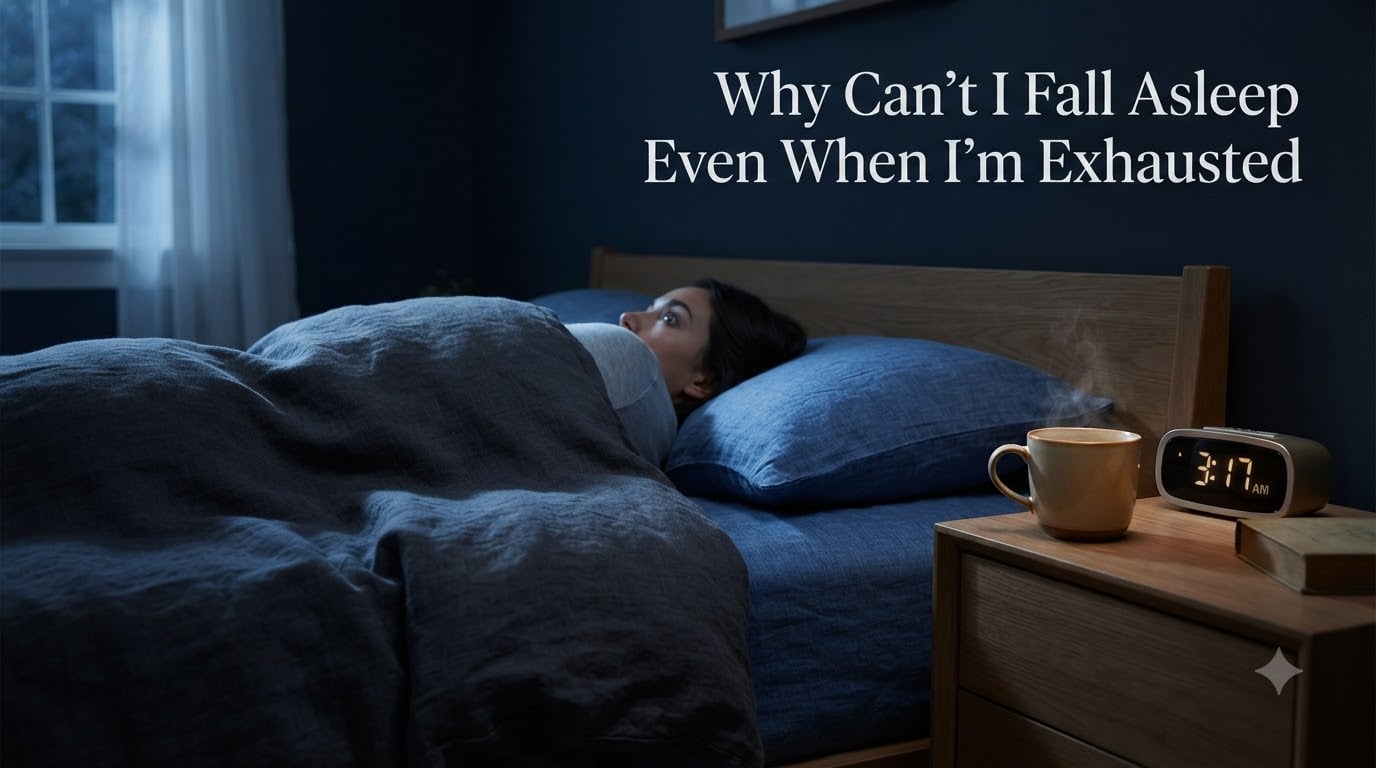
You know the feeling. Your body is heavy, your eyelids are dragging, and you can barely keep your head up. Then you lie down, close your eyes, and your brain decides it is the perfect moment to replay every conversation from the last decade. If you have ever wondered why you cannot fall asleep even when you are exhausted, you are far from alone. This is one of the most common sleep complaints people share, and it has a real biological explanation.
The short answer is that your body and your brain run on two different sleep systems. Your body can feel physically drained while your nervous system stays locked in alert mode. Stress hormones like cortisol and adrenaline keep your mind racing even as your muscles beg for rest. This creates that frustrating “tired but wired” experience where you feel exhausted but cannot actually sleep.
The good news is that once you understand what is happening in your body, you can take specific steps to fix it. In this guide, our team breaks down the science behind exhausted sleeplessness, the most common causes, what to do tonight to reset, and when it might be time to talk to a professional. Whether this happens occasionally or every night, there are proven strategies that work.
Table of Contents
The Science: Why Exhaustion Does Not Guarantee Sleep
To understand why you cannot sleep when tired, you need to know about two systems that control sleep. The first is called sleep pressure, which builds up through a chemical called adenosine. Every hour you are awake, adenosine accumulates in your brain. The longer you stay awake, the heavier this sleep pressure becomes. This is what makes you feel exhausted.
The second system is your circadian rhythm, your body’s internal 24-hour clock. This rhythm controls when melatonin gets released, signaling to your brain that it is time to wind down. Ideally, sleep pressure and your circadian rhythm work together. You build up enough adenosine during the day, melatonin rises in the evening, and you drift off.
The problem arises when these two systems fall out of sync. You might have enormous sleep pressure from being awake for 18 hours, but if your nervous system is stuck in fight-or-flight mode, your brain refuses to let you sleep. This is where cortisol enters the picture.
Cortisol is your body’s primary stress hormone. It is normally high in the morning to help you wake up and gradually drops throughout the day. But when you are under chronic stress, anxious about not sleeping, or have pushed past your natural bedtime, cortisol can spike at exactly the wrong moment. Sleep specialists call this the cortisol paradox. The more overtired you become, the more cortisol your body releases, and the harder it gets to fall asleep. This is why that “second wind” hits at midnight even though you were falling asleep at 10 PM.
Underneath all of this is the balance between your sympathetic and parasympathetic nervous systems. The sympathetic system drives fight-or-flight, keeping you alert and ready for action. The parasympathetic system handles rest and digestion. Falling asleep requires a shift into parasympathetic dominance. When stress, anxiety, or overstimulation keep the sympathetic system engaged, sleep becomes nearly impossible regardless of how tired your body feels.
Why Can’t I Fall Asleep Even When I’m Exhausted: Top Causes
Several factors can keep your nervous system stuck in high gear while your body is running on empty. Here are the most common culprits our team sees, ranked by how frequently they appear in sleep research and patient reports.
1. Stress and Racing Thoughts
Stress is the number one reason people cannot sleep when exhausted. When you have a demanding job, family pressures, financial worries, or any ongoing life stress, your brain interprets these as threats. This keeps the sympathetic nervous system activated and cortisol elevated. The moment your head hits the pillow and distractions fade, all those unprocessed worries flood in. People on sleep forums frequently describe their brains as “racing” the second they try to rest, replaying conversations and spiraling into anxiety about the future.
2. Anxiety and Sleep-Onset Worry
Anxiety about sleep itself creates a vicious cycle. The longer you lie awake, the more you worry about not sleeping. The more you worry, the more cortisol your body releases. This makes sleep even harder to achieve. Many people develop what specialists call conditioned insomnia, where the brain associates the bed with wakefulness and anxiety rather than rest. After several rough nights, just getting into bed triggers an anxiety response before you even try to sleep.
3. Circadian Rhythm Disruption
Your circadian rhythm relies on consistency and environmental cues, especially light exposure. If your sleep schedule varies wildly from day to day, or if you work shifts, your internal clock gets confused. You might feel physically exhausted at an unusual hour, but melatonin has not started rising yet, so your brain does not get the signal that it is time to sleep. Shift workers and people who travel across time zones experience this disconnect frequently.
4. Caffeine and Stimulant Effects
Caffeine works by blocking adenosine receptors in your brain. This means it literally prevents you from feeling sleep pressure. The problem is that caffeine has a half-life of roughly five to six hours, which means a 2 PM coffee still has half its stimulant effect at 8 PM. Many people are sensitive to caffeine without realizing it. Even a single afternoon cup can keep your nervous system wired hours later, making you feel exhausted but unable to cross the threshold into sleep.
5. Blue Light and Screen Time
The screens on your phone, tablet, computer, and television emit blue light that mimics daylight. When you use these devices in the evening, the light hits receptors in your eyes that tell your brain to suppress melatonin production. Your body does not get the chemical signal to start winding down. Research shows that even two hours of screen exposure before bed can delay melatonin release significantly, making it much harder to fall asleep when you finally put the phone down.
6. Overtiredness and the Cortisol Paradox
This is the cruelest twist in sleep science. When you push past your natural sleep window, whether by working late, scrolling your phone, or forcing yourself to stay awake, your body interprets the missed sleep as an emergency. It releases a surge of cortisol and adrenaline to keep you functional. This produces that false burst of energy known as a second wind. Your body is exhausted, but your brain is flooded with stimulating hormones that block sleep onset. The more overtired you get, the harder falling asleep becomes.
7. Undiagnosed Sleep Disorders
Sometimes the cause is a medical condition you do not yet know about. Sleep apnea, which causes repeated breathing interruptions during the night, can prevent you from falling asleep or staying asleep. Restless leg syndrome causes an irresistible urge to move your legs, especially at night, making sleep feel impossible. Periodic limb movement disorder, narcolepsy, and other conditions can all contribute to the experience of being exhausted but unable to sleep. If this has been happening for weeks or months, a sleep disorder is worth investigating.
8. Medications and Medical Conditions
Certain medications interfere with sleep as a side effect. Antidepressants, blood pressure medications, asthma inhalers, allergy medicines containing pseudoephedrine, and some thyroid medications can all keep you awake. Chronic pain conditions, thyroid disorders, acid reflux, and menopause can also disrupt sleep onset. If your sleeplessness started after beginning a new medication, that is worth discussing with your doctor.
The ‘Tired But Wired’ Phenomenon Explained
The “tired but wired” feeling is so common in the sleep community that it has become its own shorthand. People on insomnia forums describe it constantly. Your body feels heavy and drained, your eyes are burning, but your brain is buzzing with energy. It feels like your body and mind are operating on completely different frequencies.
This happens because of a state called hyperarousal. Your nervous system has become sensitized to staying alert, often from chronic stress, irregular sleep patterns, or repeated nights of poor sleep. The brain essentially gets stuck with the gas pedal pressed down, unable to shift into rest mode. Even when adenosine levels are high and your body is desperate for sleep, the sympathetic nervous system overrides the signal.
What makes this worse is the anxiety cycle. You feel wired, so you check the clock. You calculate how few hours of sleep you will get. That calculation triggers more anxiety, which releases more cortisol, which makes you feel even more wired. Sleep researchers call this sleep-onset insomnia maintained by conditioned arousal. The bed itself becomes a trigger for wakefulness.
Breaking this cycle requires two things. First, you need to stop trying to force sleep, because effort and sleep are biologically incompatible. Second, you need to shift your nervous system out of fight-or-flight mode. That is where specific reset techniques come in, which we cover in the next section.
Self-Assessment: Is This Occasional or a Sleep Disorder?
Most people occasionally have trouble sleeping when exhausted. A stressful day, a late coffee, or an unusual schedule can throw anyone off. But how do you know when it has crossed the line into something that needs professional attention?
Ask yourself these questions. Has this been happening three or more nights per week for a month or longer? Do you lie awake for more than 30 minutes before falling asleep on a regular basis? Do you feel significantly impaired during the day due to poor sleep? Do you snore loudly, gasp, or choke during the night? Do you experience an irresistible urge to move your legs when you lie down?
If you answered yes to several of these, it may be time to look deeper. Chronic insomnia is defined as difficulty falling or staying asleep at least three times per week for three months or more. This affects roughly 10 percent of adults and often does not resolve on its own without intervention.
For context, it normally takes a healthy person 10 to 20 minutes to fall asleep. If you are consistently taking longer than 30 minutes, that is a sign something is disrupting your sleep onset. If you are taking hours, the problem has likely become self-reinforcing through anxiety and conditioned arousal.
What to Do Right Now: Immediate Reset Techniques
If you are reading this at 2 AM while lying in bed, this section is for you. Here are the techniques that actually work when you are exhausted but cannot sleep. These are the same strategies sleep specialists recommend, and they are backed by research from cognitive behavioral therapy for insomnia.
The 20-Minute Rule: Get Out of Bed
This is the single most important thing you can do. If you have been lying in bed for more than 20 minutes without falling asleep, get up. Leave the bedroom and go to a dimly lit room. Do something quiet and not particularly interesting, like reading a physical book, doing a simple puzzle, or listening to calm music. Do not look at your phone or any screen. When you feel drowsy, go back to bed.
This technique, called stimulus control, breaks the association between your bed and wakefulness. It prevents your brain from learning that the bed is a place to lie awake and worry. It also stops the clock-watching anxiety cycle that feeds cortisol release. Many insomnia forum users say this was the technique that finally helped them after years of struggling.
4-7-8 Breathing Technique
This breathing exercise, developed by Dr. Andrew Weil, is one of the fastest ways to activate your parasympathetic nervous system and calm a racing mind. Here is exactly how to do it.
Step 1: Place the tip of your tongue against the ridge of tissue behind your upper front teeth. Keep it there throughout the exercise.
Step 2: Exhale completely through your mouth, making a whoosh sound.
Step 3: Close your mouth and inhale quietly through your nose to a mental count of four.
Step 4: Hold your breath for a count of seven.
Step 5: Exhale completely through your mouth, making a whoosh sound, to a count of eight.
Step 6: This completes one cycle. Repeat the cycle three more times for a total of four breaths.
The key is the ratio of four to seven to eight, not the speed. The extended exhale triggers your parasympathetic nervous system, which signals to your body that it is safe to relax. Do this twice a day, and use it whenever you cannot sleep.
Progressive Muscle Relaxation
This technique involves systematically tensing and then releasing each muscle group in your body. Start at your toes. Tense the muscles for five seconds, then release and notice the difference. Move slowly up through your legs, abdomen, arms, shoulders, neck, and face. By the time you reach your forehead, your body should feel noticeably heavier and more relaxed. This works because physical tension and mental arousal feed each other. Releasing one helps calm the other.
Hide the Clock
Turn your alarm clock around and put your phone out of reach. Every time you check the time, you do mental math about how much sleep you have left, which spikes anxiety and cortisol. Removing the clock from view eliminates this trigger entirely. Forum members consistently report that this simple change made an immediate difference in their sleep anxiety.
Long-Term Strategies to Prevent Exhausted Sleeplessness
Quick fixes help tonight, but lasting relief comes from addressing the root causes. These are the habits and strategies that prevent the tired-but-wired cycle from starting in the first place.
Keep a Consistent Sleep-Wake Schedule
Your circadian rhythm thrives on predictability. Go to bed and wake up at the same time every day, including weekends. This sounds rigid, but it is the foundation of healthy sleep. A consistent schedule trains your brain to release melatonin at the right time and keeps your sleep pressure aligned with your biological clock. Within two to three weeks of consistency, most people find falling asleep becomes noticeably easier.
Get Strategic Light Exposure
Light is the strongest signal your circadian rhythm responds to. Get bright light exposure within an hour of waking up, ideally by going outside for 10 to 15 minutes. This sets your internal clock and helps you feel alert during the day. In the evening, do the opposite. Dim your lights one to two hours before bed, switch to warm-toned bulbs, and minimize screen use. If you must use screens, blue light blocking glasses can help reduce the impact on melatonin production.
Set a Caffeine Curfew
Stop consuming caffeine at least eight hours before your target bedtime. If you go to bed at 10 PM, that means no caffeine after 2 PM. Remember that caffeine hides in chocolate, certain teas, some sodas, and even decaf coffee in small amounts. If you are sensitive to caffeine, even an early afternoon cup can interfere with sleep onset hours later. Try switching to herbal tea or water in the afternoon and notice the difference after a week.
Optimize Your Bedroom Environment
Your bedroom should be cool, dark, and quiet. The ideal sleeping temperature is between 60 and 67 degrees Fahrenheit. Use blackout curtains or a sleep mask to eliminate light. If noise is an issue, try a white noise machine or earplugs. Reserve the bed for sleep and intimacy only, not for working, scrolling, or watching television. This reinforces the mental association between your bed and sleep, which is the opposite of what conditioned insomnia does.
Consider CBT-I: The Gold Standard Treatment
If you have struggled with sleeplessness for more than a few weeks, cognitive behavioral therapy for insomnia (CBT-I) is the most effective treatment available. Studies consistently show it outperforms sleep medication both in the short term and long term. CBT-I works by identifying and changing the thoughts and behaviors that maintain insomnia. It typically involves sleep restriction, stimulus control, cognitive restructuring, and sleep hygiene education. You can work with a certified sleep therapist or use validated online programs. Many people see significant improvement within four to six sessions.
One important note about sleep medication. While prescription and over-the-counter sleep aids can provide short-term relief, they do not address the underlying causes of sleeplessness. They can also lead to dependence and lose effectiveness over time. If you are using sleep aids regularly, talk to your doctor about transitioning to CBT-I instead.
When to See a Doctor About Sleep Problems
Occasional sleeplessness is normal. But certain signs indicate it is time to seek professional help. You should consider seeing a doctor or sleep specialist if your sleep problems have persisted for more than a month, if they are significantly affecting your daily functioning, or if you suspect an underlying medical cause.
Specific red flags include loud snoring with pauses in breathing, which may indicate sleep apnea. An irresistible urge to move your legs at night may point to restless leg syndrome. Falling asleep at inappropriate times during the day could signal narcolepsy or severe sleep deprivation. Persistent anxiety or depression that interferes with sleep may require treatment from a mental health professional.
Your doctor may recommend a sleep study, which monitors your brain waves, breathing, heart rate, and movement overnight. This can identify sleep disorders that are impossible to diagnose from symptoms alone. Many sleep studies can now be done at home with portable equipment, making the process much less intimidating than it used to be.
Do not wait years to seek help. Chronic insomnia is treatable, especially when addressed early. The longer sleep problems persist, the more entrenched the anxiety-arousal cycle becomes and the harder it is to break. Reaching out for professional support is a sign of taking your health seriously, not a sign of failure.
FAQs
Why am I not able to sleep even after being tired?
You cannot sleep despite exhaustion because your nervous system is stuck in alert mode. Physical fatigue comes from adenosine build-up, but sleep onset requires your parasympathetic nervous system to take over. Stress, anxiety, caffeine, or pushing past your sleep window can keep cortisol elevated, blocking the transition into sleep even when your body feels drained.
Should I just stay up if I can’t sleep?
Yes, if you have been lying awake for more than 20 minutes, get out of bed. Go to a dim room and do something quiet and non-stimulating until you feel drowsy. Staying in bed while frustrated trains your brain to associate the bed with wakefulness and anxiety, which worsens insomnia over time.
What to do if you’re overtired and can’t sleep?
Get out of bed after 20 minutes of wakefulness. Try the 4-7-8 breathing technique to activate your parasympathetic nervous system. Hide the clock to stop anxiety spirals. Do something boring in dim light until drowsiness returns. Avoid screens, caffeine, and forcing sleep, as effort and sleep are biologically incompatible.
Why won’t my body let me sleep?
Your body fights sleep when stress hormones like cortisol and adrenaline keep the sympathetic nervous system engaged. This creates a state called hyperarousal, where your brain stays on high alert despite physical exhaustion. Chronic stress, anxiety about sleep, an irregular schedule, or a missed sleep window can all trigger this response.
What is the 3-3-3 rule for insomnia?
The 3-3-3 rule is a simplified sleep guideline. It suggests getting out of bed after roughly 20 to 30 minutes if you cannot sleep (some versions use 3 as a shorthand for a short period), doing a calming activity for a similar duration, and returning only when drowsy. The core principle is stimulus control, which is a key component of CBT-I and helps break the association between your bed and wakefulness.
Conclusion
Being unable to sleep when you are exhausted is a deeply frustrating experience, but it is not a mystery. It happens because your body’s physical fatigue and your brain’s sleep-control system are operating on different frequencies. When stress, anxiety, caffeine, circadian disruption, or overtiredness keep cortisol elevated, your nervous system stays locked in alert mode and blocks the transition into sleep.
The most important takeaway is this: stop trying to force sleep. Effort and sleep cannot coexist. If you have been awake in bed for 20 minutes, get up and reset. Use breathing techniques to shift your nervous system into rest mode. Build consistent sleep habits over time so your circadian rhythm and sleep pressure work together instead of against each other.
If this has been happening for weeks or months, do not hesitate to seek professional help. CBT-I is highly effective, and sleep specialists can identify underlying disorders that home remedies cannot address. Understanding why you cannot fall asleep even when you are exhausted is the first step toward solving it, and you have already taken that step by reading this guide.