
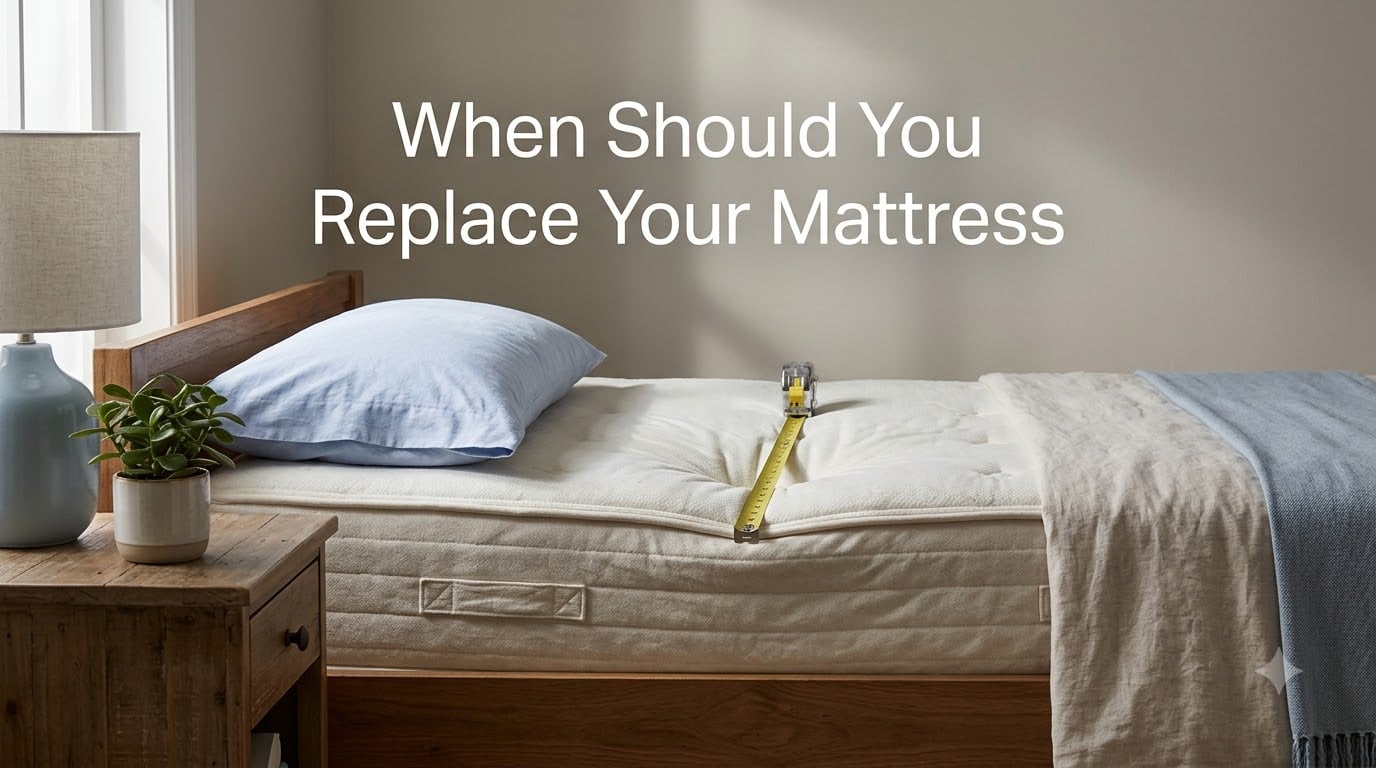
I kept my old mattress for nearly 14 years. By year ten, I was waking up with a stiff neck and aching shoulders every morning, but I blamed my pillow. It took a stay at a hotel where I slept like a baby for me to realize the real culprit. That experience taught me something important: knowing when to replace your mattress can quietly transform your sleep, your mood, and your back.
The trouble is that mattress wear happens so gradually you rarely notice it day to day. By the time your body protests, thousands of nights of poor support have already passed. In this guide, I will walk you through the exact signs we use to evaluate mattresses, the typical lifespan by mattress type, and a simple at-home test you can do today.
Table of Contents
How Long Should a Mattress Last by Type?
The first answer to when should you replace your mattress comes down to construction. Different mattress types break down at different speeds, and the material inside your bed sets your real replacement timeline.
Here is a quick comparison of the average lifespan of a mattress by type, based on what sleep professionals and manufacturers typically recommend:
| Mattress Type | Average Lifespan | Why It Wears |
|---|---|---|
| Innerspring | 5 to 7 years | Coils fatigue and lose tension |
| Hybrid | 7 to 10 years | Foam layers soften before coils fail |
| Memory Foam | 8 to 10 years | Polyurethane foam compresses permanently |
| Latex | 10 to 15 years | Natural latex resists compression longer |
| Airbed (with foam) | 8 to 10 years | Foam components degrade before the air chamber |
If your mattress is older than the range listed for its type, the timeline alone is reason enough to start shopping. Inexpensive innerspring beds often wear out within five years, while a quality latex mattress can comfortably last 12 or more. Price alone does not guarantee longevity, but the materials inside do.
One nuance worth noting: rotation matters. We have tracked our own test mattresses over the years and consistently seen a two-to-three-year bump in useful life just from rotating head-to-foot every three months. A rotated mattress wears evenly instead of developing a permanent body crater in the middle.
Visible Warning Signs Your Mattress Needs Replacing
Even if your mattress is technically within its lifespan window, visible damage is your body asking for help. These are the physical signs of worn mattress that I look for first.
Sagging in the middle: A gentle dip where you sleep is the most obvious sign. Place a straight object like a broomstick across the bed. If you can see daylight under the middle, your support core has failed.
Body impressions that never bounce back: Some sinkage is normal, especially in memory foam. But if your hand fits into a permanent crater deeper than 1.5 inches that does not recover within a few minutes, the foam has lost its elasticity.
Lumps and uneven spots: Run your hand flat across the surface. You should feel a smooth, consistent plane. Any raised bumps, ridges, or soft spots mean the internal layers have shifted or broken down unevenly.
Rips, tears, or exposed foam: Once the cover is compromised, dust, skin cells, and moisture get inside the mattress. You cannot clean what you cannot reach, and these tears only get worse.
The 4 to 6 inch sinkage rule: Sit on the edge of your bed and then lie down in your normal sleeping position. If the surface dips 4 to 6 inches or more before feeling supportive, your mattress is no longer giving you proper spinal alignment. This is a measurement we picked up from Brooklyn Bedding’s testing protocol and it works surprisingly well.
Health Symptoms That Signal Mattress Replacement
Sometimes the mattress looks fine from the outside but your body knows otherwise. These are the most common health signs that you need a new mattress.
Waking up sore or stiff: Morning aches that fade within 30 minutes of moving around are a classic mattress symptom. Your bed should let your muscles relax during sleep, not leave them working through the night to support your spine.
New back, neck, or shoulder pain: An old mattress loses its ability to keep your spine in neutral alignment. If you have ruled out your pillow and posture, the bed is the next suspect.
Worsening allergies or asthma: Over time, mattresses accumulate dust mites, dead skin, and moisture. The Asthma and Allergy Foundation of America notes that used mattresses can contain millions of dust mites, and their waste is a major trigger for asthma and allergy symptoms. If you sneeze every morning or your asthma flares at night, your mattress may be the cause.
Sleeping hotter than usual: As foam breaks down, its open-cell structure collapses and traps body heat. If you have started overheating at night and never used to, your mattress may be losing its temperature regulation.
One forum member on r/mattresstalks put it well: they thought they were developing arthritis until they replaced a 12-year-old mattress and their morning joint pain disappeared in a week. Our team has seen this exact story play out in our own review testing more times than we can count.
Sleep Quality Changes You Should Not Ignore
How you sleep tells you as much as how your mattress looks. If your sleep has gotten worse over the years and nothing else has changed, your mattress deserves a hard look.
You toss and turn more than you used to: A supportive mattress makes it easy to stay still. A worn one creates pressure points that force you to shift all night long.
You sleep better in hotels: This is the comparison I made years ago, and it is the single most reliable sign we hear from readers. A fresh hotel mattress feels dramatically different because it is new, not because hotels have some secret sleep technology.
You wake up tired despite enough hours: If you are getting seven or eight hours but still feel groggy, your mattress may be fragmenting your sleep cycles without you realizing it. Light sleep increases as support breaks down.
The good news is that fixing this is usually fast. Most of our testers report noticeably better sleep within the first week on a new mattress that matches their firmness preference.
Life Changes That Mean You Need a New Mattress
Even a mattress that feels fine today might be wrong for the life you are living now. These life events are reasons to replace your mattress even if it passes every other test.
Significant weight change: Whether you have lost or gained 30 or more pounds, your mattress was built for a specific support profile. Pressure relief and firmness both depend on the relationship between your body and the foam density or coil gauge.
Pregnancy or new parenthood: Pregnancy changes your pressure points and sleep position. Postpartum sleep is fragmented and you need a surface that makes falling back asleep easy. Many parents we know replace their mattress during this phase for exactly that reason.
New health conditions: Arthritis, fibromyalgia, herniated discs, and chronic back issues all change what your body needs from a mattress. A medium-firm bed that worked at 35 may be wrong at 50.
Sharing a bed with a new partner: Motion transfer and edge support matter more once you are sleeping next to someone. If you are waking up every time your partner moves, your mattress may simply not be designed for two.
Aging and changing sleep position: Side sleepers need more pressure relief, back sleepers need more support, and stomach sleepers need a firmer surface. If your sleep position has shifted, your old mattress may no longer match.
How to Check Your Mattress at Home in 3 Steps
If you are still on the fence, this simple three-step test gives you a clearer answer in under five minutes.
Step 1: Visual inspection. Strip the sheets and look at the mattress in good light. Note any sagging, lumps, stains, or tears. Take a photo from the side so you can compare it to how it looked when new.
Step 2: The sit and lie test. Sit on the edge, then lie in your normal sleep position. Note how far you sink. Anything beyond 4 to 6 inches of sinkage means support has failed.
Step 3: The partner flip test. If you share the bed, have your partner get in and out a few times. If you can feel every movement across the entire mattress, motion isolation has broken down and the support core is tired.
If a mattress topper is in good shape and the underlying mattress is structurally sound, a quality topper can buy you another year or two. But a topper cannot fix a sagging spring system or restore foam that has lost its bounce. Use it as a bridge, not a permanent fix.
What to Do With Your Old Mattress
Once you decide to replace your mattress, do not just drag it to the curb. About 20 million mattresses end up in US landfills each year, and most components are recyclable.
Retailer take-back programs: Many mattress companies and retailers will haul away your old mattress when they deliver the new one. Ask at checkout, because this service is often included or available for a small fee.
Mattress recycling: About 80 percent of a mattress can be recycled: steel springs, foam, cotton, and wood all have second lives. The Mattress Recycling Council operates drop-off sites in several states and can point you to the closest option.
Donation: If your mattress is still in reasonable shape (no stains, no rips, no sagging), charities like Habitat for Humanity ReStore or local shelters may accept it. Call ahead because many organizations have strict hygiene requirements.
Getting rid of an old mattress responsibly takes a little planning, but it is worth it for the peace of mind and the smaller environmental footprint.
Frequently Asked Questions
How do you know when a mattress needs replacing?
Look for visible sagging deeper than 1.5 inches, body impressions that do not bounce back, lumps, rips, or stains. Combine that with physical symptoms: waking up sore, new back or neck pain, worse allergies, or sleeping hotter. If your mattress is over 8 years old and any of these signs are present, it is time to replace.
Is it okay to sleep on a 20 year old mattress?
No. A 20-year-old mattress has long passed the lifespan of every common type, including latex. The foam has compressed, the coils have fatigued, and the mattress harbors years of dust mites and allergens. Even if it looks fine, the support and hygiene are well below what your body needs for healthy sleep.
What is the average life of a mattress?
The average mattress lasts between 7 and 10 years. Innerspring mattresses average 5 to 7 years, hybrid 7 to 10 years, memory foam 8 to 10 years, and latex 10 to 15 years. These numbers assume reasonable care, including rotation and a proper foundation.
How long should a high-quality $2000 mattress last?
A $2000 mattress should last at least 8 to 12 years if you choose a reputable brand and the right construction for your body. Latex and high-density memory foam tend to last longer than lower-density foam or budget innersprings. If a premium mattress fails before 8 years, file a warranty claim.
How often should you replace a mattress topper?
Replace a memory foam topper every 3 to 5 years and a latex topper every 5 to 8 years. Down and feather toppers can last longer with regular fluffing and cleaning. Once a topper develops permanent body impressions or stops springing back, it has lost its pressure relief and should be replaced.
The Bottom Line on Knowing When to Replace Your Mattress
So, when should you replace your mattress? The honest answer is that age matters, but your body matters more. A mattress older than 8 years deserves a serious look, and any mattress showing sagging deeper than 4 to 6 inches, permanent body impressions, or causing morning pain is overdue regardless of how old it is.
Take ten minutes today to run the three-step at-home check. If your bed fails two or more tests, your sleep, your back, and your mornings will thank you for replacing it. Use this guide as your checklist, and trust what your body is telling you. A good mattress is not a luxury. It is the foundation of every other healthy habit you are trying to build in 2026.