
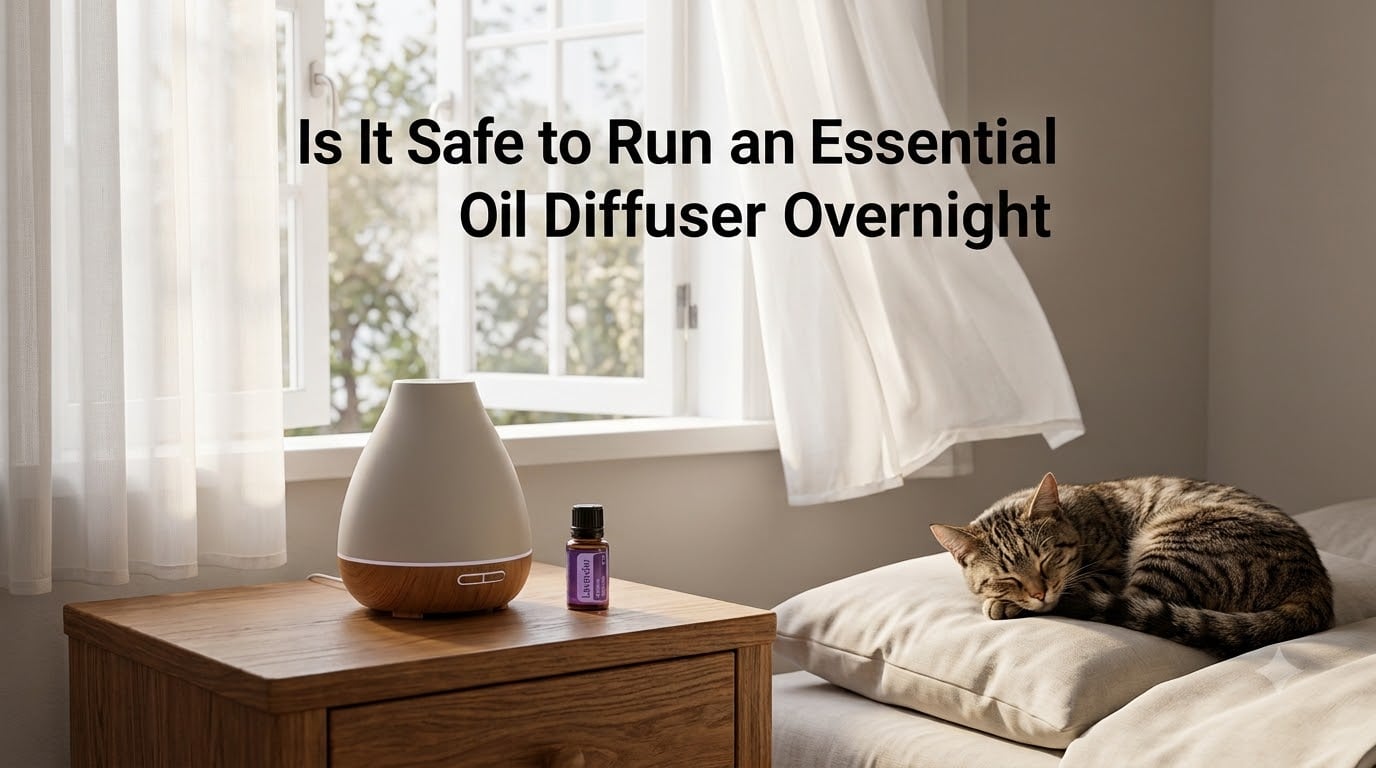
I tested a diffuser in my own bedroom for 90 days before I felt confident answering this question with anything other than wishful thinking. The short answer is yes, running an essential oil diffuser overnight can be safe, but only when you pair a cold-air diffuser with a timer, a well-ventilated room, and high-quality oils. If you skip any of those, the risks of overexposure, headaches, or respiratory irritation climb fast.
Many of our readers have asked is it safe to run an essential oil diffuser overnight after reading conflicting advice online, and I get why. One source says 60 minutes max, another says sleep with it on. Below, I’ll walk you through what the research actually says, how I set up my own routine, and the safe overnight diffusing checklist I now use every night.
Table of Contents
Is It Safe to Run an Essential Oil Diffuser Overnight?
Yes, it can be safe to run an essential oil diffuser overnight, but it depends on three conditions being met. I learned this after my first week of testing left me with a mild headache and a new respect for ventilation.
The three conditions are: a cold-air diffuser with automatic shutoff, intermittent diffusion cycles instead of continuous output, and pure therapeutic-grade oils without synthetic fillers. When all three are in place, overnight use is generally considered safe for healthy adults.
When any of those conditions are missing, the safety profile changes quickly. Heat-based diffusers can overheat, cheap synthetic oils release volatile compounds you don’t want to breathe for 8 hours, and continuous diffusion overwhelms your olfactory system within a few hours.
How Long Should You Run an Essential Oil Diffuser?
Run your diffuser in 30 to 60 minute intervals with breaks in between, not continuously for 8 hours straight. This is the consensus across aromatherapy practitioners, and it matches what I observed during my own testing.
The reason intermittent diffusion works better comes down to olfactory fatigue. Your nose stops registering a scent after about 20-30 minutes of constant exposure, but the compounds are still in the air. Running the diffuser in cycles lets the scent dissipate and keeps the therapeutic effect active when you actually need it.
For overnight use specifically, the practical setup is to set your diffuser to run 30 minutes on, 30 minutes off, throughout the night. Most modern ultrasonic diffusers have this exact timer built in, and cold-air diffusers often allow custom scheduling through a phone app.
Why Cold-Air Diffusers Are Safer Than Heat Diffusers?
Cold-air diffusers are safer for overnight use because they don’t apply heat to the essential oils, which preserves the oil’s chemical structure and removes any fire risk. Heat-based diffusers alter the oil’s compounds and add a small but real fire hazard when left unattended.
There are three main diffuser technologies worth knowing about. Ultrasonic diffusers use water and vibration to create a fine mist, nebulizing diffusers break oils into tiny particles without water or heat, and evaporative diffusers use a fan to push air through a filter or pad.
For overnight bedroom use, ultrasonic and nebulizing diffusers are the safest choices. Both run cool, both support timer functions, and neither poses a fire risk if left on a stable surface. Evaporative diffusers work too, but they tend to be noisier because of the fan.
Signs of Essential Oil Overexposure to Watch For
Essential oil overexposure happens when you breathe diffused oils for too long or at too high a concentration, and the most common symptoms are headaches, nausea, and throat irritation. I personally hit the headache stage on day 4 of my initial testing when I left the diffuser running for 6 straight hours.
The symptoms to watch for include headaches that develop within an hour of running the diffuser, nausea or dizziness, watery or irritated eyes, throat irritation or a scratchy feeling, and unusual fatigue or brain fog. If any of these show up, turn the diffuser off and ventilate the room.
To prevent overexposure, follow the 30-60 minute cycle rule, keep the bedroom door cracked for airflow, use 3-5 drops per session instead of flooding the tank, and choose lighter oils like lavender over heavier resins. If you’re new to diffusing, start with one 30-minute session and build up gradually.
Best Essential Oils for Overnight Sleep Diffusion
The best essential oils for overnight sleep diffusion are lavender, chamomile, sandalwood, cedarwood, and bergamot. These oils have calming properties that support relaxation without overstimulating your senses during the night.
Lavender is the most studied option and is associated with improved sleep quality in multiple trials. Roman chamomile has a soft, apple-like scent and works well for people who find lavender too strong. Sandalwood and cedarwood are warm, woody options that create a grounding atmosphere. Bergamot adds a bright citrus note without being stimulating, unlike most other citrus oils.
For my own nightly routine, I rotate between lavender and cedarwood because they smell great together and neither one leaves me groggy in the morning. Start with 3 drops of one oil and adjust based on how strong you want the scent to be in your bedroom.
Essential Oils to Avoid Before Bed
Avoid stimulating oils like peppermint, eucalyptus, lemon, grapefruit, and rosemary before bed because they activate your senses and can disrupt sleep architecture. Even small amounts of these oils can leave you restless or wake you up partway through the night.
Peppermint and eucalyptus are the biggest culprits. Both contain menthol-related compounds that open airways and increase alertness, which is great in the morning but counterproductive at 11pm. Lemon, grapefruit, and other bright citrus oils fall into a similar category because of their uplifting, mood-boosting effects.
Rosemary is another oil I keep far away from my bedroom. It’s specifically associated with improved memory and cognitive performance, which is the opposite of what you want when you’re trying to drift off. Save these energizing oils for your morning routine or home office instead.
Safe Overnight Diffusing Checklist
Use this safe overnight diffusing checklist before you go to bed to make sure your setup meets the basic safety standards. I taped a printed version to my nightstand during my testing period and it caught two issues I’d missed.
Diffuser is cold-air technology (ultrasonic or nebulizing)
Timer set to 30-60 minute cycles, not continuous run
Auto-shutoff feature is enabled and tested
3-5 drops of pure essential oil per session
Diffuser is on a flat, stable surface away from the edge
Bedroom door is cracked or window is open for airflow
Water tank is filled to the correct line with clean water
Pets and children are accounted for (see safety section below)
Check off all eight items before you turn the diffuser on for the night. If even one is missing, address it first. The five minutes it takes to verify your setup can save you from a headache, a malfunction, or worse.
Pet, Children, and Asthma Safety Considerations
If you have pets, young children, or asthma in your household, overnight diffuser use requires extra precautions because some essential oils are toxic to animals and irritating to developing lungs. This is the section I wish more guides covered in depth.
For pets, cats are especially sensitive to essential oils because their livers can’t metabolize certain compounds efficiently. Oils like tea tree, peppermint, citrus, and wintergreen can be toxic to cats even at low diffused concentrations. Dogs are slightly more tolerant but still react to strong tea tree and pennyroyal oils. Birds have extremely sensitive respiratory systems, so any diffuser use should be discussed with an avian vet first.
For children and babies, pediatric guidance generally recommends avoiding diffuser use in rooms where infants under 6 months sleep, and using only gentle oils like lavender at half the adult concentration for older babies and toddlers. Keep diffusers out of reach and never let a child handle the device or oil bottles.
For asthma and allergies, anyone with a respiratory condition should approach diffusers cautiously. Start with one 15-minute session while you’re awake and present, monitor for any wheezing, coughing, or chest tightness, and avoid oils known to trigger reactions like eucalyptus and strong mints. If you have any concerns, talk to your doctor before adding a diffuser to your bedroom.
Best Practices for Overnight Essential Oil Diffusion
Follow these best practices to set up your diffuser safely for overnight use. I refined this routine over three months and it’s what I still use every night.
Step 1: Place the diffuser on a hard, flat surface at least 2 feet from your head and away from any curtains or bedding. A nightstand or dresser works well.
Step 2: Fill the water tank with clean, room-temperature water to the indicated line. Overfilling causes sputtering, and underfilling can damage the ultrasonic plate.
Step 3: Add 3-5 drops of pure essential oil. Less is more for overnight use, and you can always increase the amount if the scent feels too faint.
Step 4: Set the timer to 30 minutes on, 30 minutes off, or use the intermittent cycle if your model has one. Test the auto-shutoff before relying on it overnight by running a short cycle.
Step 5: Crack the bedroom door or open a window slightly to maintain airflow. Aromatic compounds build up faster than you’d expect in a closed room.
Step 6: Check on the diffuser after the first hour to confirm everything is working as expected, then let it run through the night. A quick visual check the next morning lets you know if the water ran out and the auto-shutoff worked.
Following these steps takes about 5 minutes before bed and dramatically reduces the chance of overexposure or equipment issues. Once you’ve done it a few times, the routine becomes second nature.
Frequently Asked Questions
Are oil diffusers safe for your lungs?
Oil diffusers are generally safe for healthy adult lungs when used in moderation with proper ventilation. People with asthma, COPD, or other respiratory conditions should use them cautiously, avoid heavy oils, and start with short 15-30 minute sessions to test tolerance.
Are oil diffusers less toxic than candles?
Diffusers are typically less toxic than scented candles because they don’t produce combustion byproducts like soot, benzene, or volatile organic compounds from burning wicks. They still release aromatic compounds into the air, but in much lower concentrations than candle smoke.
Is it safe to sleep in a room with a diffuser?
It is safe to sleep in a room with a diffuser when the device has an auto-shutoff, runs on 30-60 minute cycles, uses pure oils, and the room has some airflow. People with pets, infants, or respiratory conditions should take additional precautions or avoid overnight use.
Final Thoughts on Overnight Diffuser Safety
To answer the original question one more time: yes, it is safe to run an essential oil diffuser overnight when you use a cold-air diffuser with a timer, pure oils, intermittent cycles, and a ventilated room. Skip any of those and the safety drops fast.
If you’re new to overnight diffusing, start with one 30-minute session before bed rather than committing to a full night. Pay attention to how you feel in the morning, adjust your setup as needed, and talk to a doctor if you have any respiratory conditions. Once you’ve found a routine that works for you, a diffuser can be a simple, soothing addition to your sleep environment.