
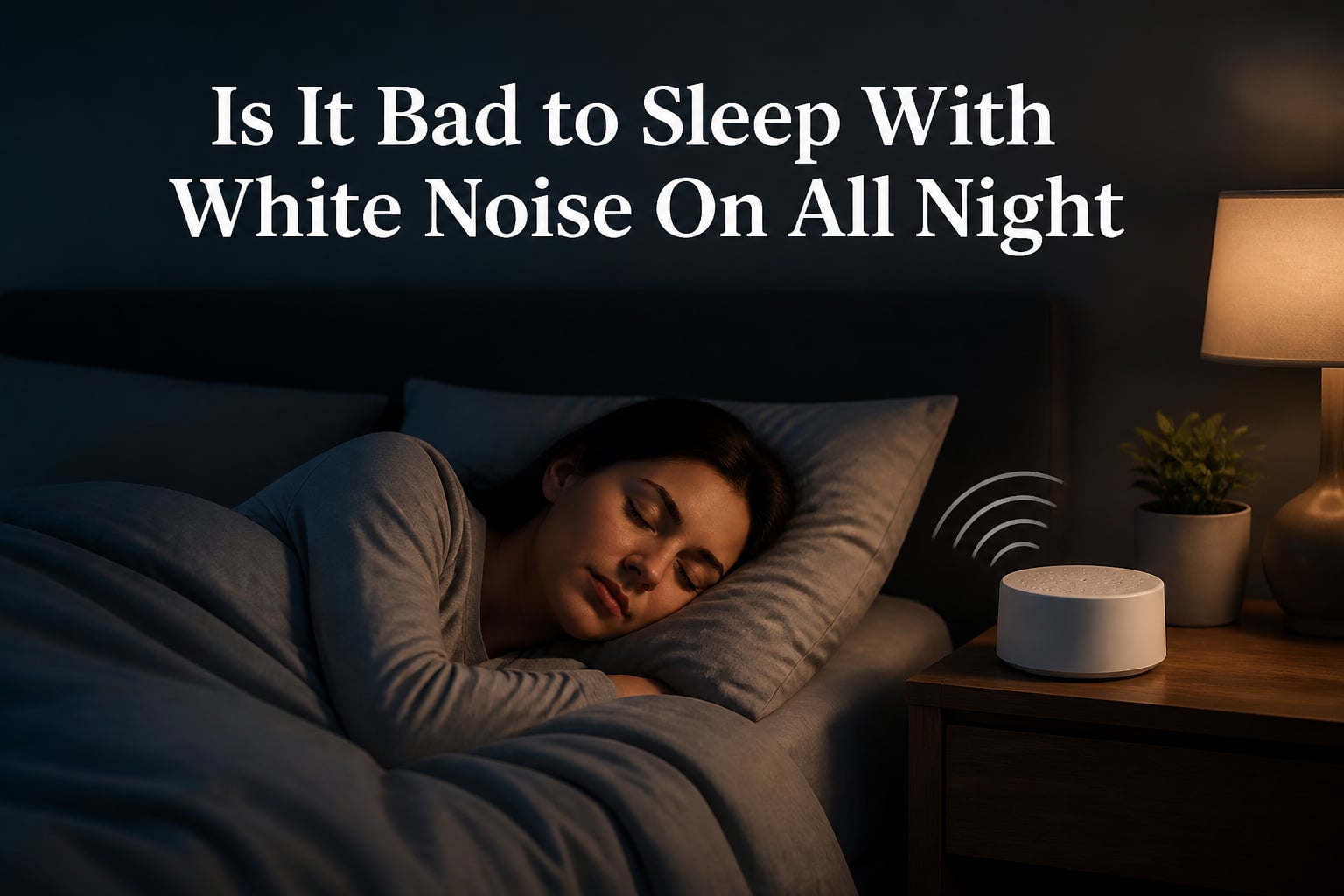
No, it is not bad to sleep with white noise on all night for most people, as long as you keep the volume under 60 decibels and place the device at least a few feet from where you sleep. The key factor is not how long the white noise plays, but how loud it is and how close the sound source sits to your ears. Millions of adults, babies, and light sleepers use white noise machines every night without any problems when they follow basic safety guidelines.
The question of whether sleeping with white noise on all night is harmful comes up constantly in parenting forums, sleep communities, and doctor visits. People worry about hearing damage, dependency, and long-term health effects. I have dug into the research, read through dozens of studies, and examined what experts at the American Academy of Pediatrics (AAP) and other health organizations actually say about this topic.
What I found is that white noise is a genuinely useful sleep aid when used correctly, but there are real risks if you get the volume wrong or place a machine too close to a baby’s crib. This guide breaks down everything you need to know so you can use white noise safely and confidently, whether it is for yourself, a partner, or a child.
Table of Contents
What Is White Noise and How Does It Work?
White noise is a type of sound that contains all audible frequencies played at the same intensity simultaneously. Think of it like white light, which combines every color in the spectrum into one beam. When you hear that steady, static-like hum from a sound machine or a fan, you are listening to white noise doing its job.
The reason white noise helps you sleep comes down to something called sound masking. Your brain is wired to notice changes in your environment, especially sudden sounds. A dog barking, a car door slamming, or a neighbor’s footsteps can jolt you awake because your brain detects a shift from silence to noise. White noise fills the auditory space with a constant, predictable sound, so those sudden disruptions blend into the background instead of standing out.
This masking effect works on a simple principle. If your room already has a baseline level of continuous sound, the difference between the background and a new noise becomes smaller. A smaller difference means your brain is less likely to register the new sound as something important enough to wake you. That is why many people sleep better with a fan running, even in winter. The steady hum creates a sound barrier that smooths over disruptions.
White noise machines take this concept further by producing a consistent, optimized frequency that is specifically designed for sleep. Some machines also offer nature sounds, heartbeats, or other variations. But the core mechanism is always the same: fill the room with steady sound so intermittent noises lose their power to wake you.
Is It Bad to Sleep With White Noise On All Night?
The short answer is no, it is not bad to leave white noise on all night, provided you follow two rules: keep the volume at or below 60 decibels and place the machine at a safe distance from your head or your baby’s crib. The duration of playback matters far less than the volume level and proximity.
Research on continuous white noise use during sleep is still evolving. A 2024 study published in JAMA Otolaryngology looked at the potential effects of white noise machines on infant hearing and development. The researchers found that the concern is not about the white noise itself, but about machines that exceed safe volume levels. Many commercial machines tested in studies were capable of producing sound levels above 85 decibels when placed close to a crib, which is well above the 50-decibel limit recommended by the AAP for infants.
For adults, the picture is clearer. Sleep specialists generally agree that white noise at low volumes is safe for nightly use. The American Academy of Sleep Medicine has not issued warnings against white noise for adults. The main concern experts raise is not physical harm but rather the possibility of psychological dependency, where you eventually struggle to fall asleep without the machine.
The Guardian published an article in 2020 citing a review that questioned whether white noise might disrupt sleep architecture rather than improve it. However, that review noted the overall quality of evidence was poor, and the findings were not strong enough to recommend against using white noise. Most sleep experts still consider it a safe and effective tool for people who struggle with environmental noise.
What matters most is how you use it. A machine playing at 50 decibels from across the room is completely different from a phone playing white noise at full volume six inches from your ear all night. The former is safe. The latter could contribute to hearing fatigue over time.
Benefits of Sleeping With White Noise
White noise offers several well-documented benefits for sleep quality. People who use it consistently tend to fall asleep faster, wake up fewer times during the night, and report feeling more rested in the morning. The steady sound creates a predictable auditory environment that helps your brain transition into and maintain deeper sleep stages.
For adults living in noisy environments, white noise can be transformative. Apartment dwellers dealing with street traffic, thin walls, or noisy neighbors often find that a sound machine makes the difference between a restless night and solid sleep. I have seen people in forums describe white noise as the single most effective change they made to their sleep routine after moving to a loud city.
Babies and young children are particularly responsive to white noise. Infants are used to the constant, whooshing sounds of the womb, which are surprisingly loud. White noise mimics that environment, helping newborns feel secure and settle into sleep more easily. Many pediatric sleep consultants recommend white noise as one of the first tools to try for fussy babies.
Light sleepers benefit too. If you wake up every time your partner rolls over or a floorboard creaks, white noise can reduce the number of micro-arousals you experience throughout the night. Fewer disruptions mean more time spent in restorative deep sleep and REM sleep, which translates to better daytime energy and cognitive function.
People with tinnitus also report significant relief from white noise. The constant sound helps mask the ringing or buzzing in their ears, making it easier to fall asleep when the house would otherwise be silent.
Potential Risks of Leaving White Noise On All Night
While white noise is safe for most people, there are legitimate risks to be aware of. Understanding these risks helps you use white noise in a way that avoids problems entirely.
Hearing Concerns at High Volumes
The most significant risk is hearing damage from prolonged exposure to loud sound. If your white noise machine is set above 70 decibels and sits close to your head, you are exposing your ears to continuous noise for eight or more hours every night. Over time, this can contribute to noise-induced hearing loss. The risk is higher for infants because their ear canals are smaller and their auditory systems are still developing.
A study from the Hospital for Sick Children in Toronto tested 14 popular infant sound machines and found that several could produce sound levels exceeding 85 decibels at the distance of a typical crib. At that level, the researchers warned, continuous exposure could damage an infant’s hearing. The solution is simple: lower the volume and move the machine farther away.
Dependency and Sleep Associations
Another common concern is psychological dependency. Some people who use white noise every night eventually find they cannot sleep without it. This is not a health danger, but it can be inconvenient when traveling, staying at a hotel, or sleeping somewhere without access to a machine.
For babies, dependency is a mixed issue. A sleep association with white noise is generally considered harmless and is much easier to manage than associations with rocking, feeding, or being held. You can gradually reduce the volume when you are ready to transition away from it.
Developmental Concerns for Infants
Some researchers have raised concerns that continuous white noise might interfere with infant language development. The theory is that if a baby’s auditory environment is constantly filled with white noise, they get less exposure to speech and ambient sounds that support language learning. A 2024 study published in Sleep Medicine suggested a possible link between prolonged white noise exposure and delayed auditory processing in young children, though the evidence was not strong enough to draw firm conclusions.
The practical takeaway is to use white noise during sleep times only, not during waking hours. During the day when your baby is alert and playing, they should hear normal household sounds and conversation without background noise competing for their attention.
Poor Sleep Quality from Excessive Volume
Counterintuitively, white noise that is too loud can actually disrupt your sleep rather than improve it. If the volume is high enough to continuously stimulate your auditory system, your brain may spend more time in lighter sleep stages. The result is more time in bed but lower quality rest. Keeping the volume low enough that it blends into the background is essential for getting the sleep benefits without the drawbacks.
How to Use White Noise Safely All Night
Using white noise safely comes down to managing two variables: volume and distance. When you control both, you can leave white noise running all night with confidence. Here are the specific guidelines that sleep experts and pediatricians recommend.
Safe Decibel Levels
For adults, aim for a volume between 40 and 60 decibels at the level of your pillow. For context, 50 decibels is roughly equivalent to the sound of light rainfall or a quiet conversation. You can download a free decibel meter app on your phone to check the level at your sleeping position. If you can hear the white noise clearly but it does not drown out someone talking to you at a normal volume, you are likely in the safe range.
For babies, the AAP recommends keeping sound levels at or below 50 decibels. This is lower than the adult guideline because infants’ ears are more sensitive and their auditory systems are still developing. You should be able to hold a normal conversation over the sound of the machine without raising your voice.
Distance Recommendations
Placement matters as much as volume. Sound intensity drops off quickly with distance, so moving a machine just a few feet can dramatically reduce the decibel level at the listener’s position. For nurseries, the AAP recommends placing the sound machine at least 7 feet away from the crib. Never place a sound machine inside the crib, on the crib rail, or right next to the baby’s head.
For adults, try to keep the machine at least 3 to 5 feet from your pillow. If your space is small and you cannot achieve enough distance, lower the volume accordingly to compensate.
Quick Safety Checklist
Use this checklist to make sure your white noise setup is safe for all-night use:
– Volume at the listener’s position is 60 dB or lower for adults, 50 dB or lower for babies.
– Machine is at least 7 feet from a baby’s crib or 3 to 5 feet from an adult’s pillow.
– You can comfortably hold a conversation over the sound.
– The machine is not inside or attached to the crib.
– White noise plays during sleep only, not during waking hours for babies.
– You use a decibel meter app to verify the level periodically.
White Noise vs Pink Noise vs Brown Noise: Which Is Best for Sleep?
If you have started exploring sound machines, you have probably noticed that they offer different noise colors. Each color refers to a different distribution of frequencies, and the differences can affect how the sound feels and how well it helps you sleep.
White noise contains all frequencies at equal intensity. It sounds bright, crisp, and somewhat like TV static or a hissing fan. This is the most studied and most commonly used noise color for sleep. Its even distribution makes it excellent for masking a wide range of environmental sounds.
Pink noise has more power in the lower frequencies, giving it a deeper, softer quality. It sounds more like steady rain or wind rustling through trees. Some research suggests pink noise may be even better than white noise for sleep because its deeper tones are less harsh and more closely resemble natural sounds. A 2017 study found that pink noise enhanced deep sleep in older adults, though more research is needed to confirm these findings.
Brown noise is deeper still, with a low, rumbling quality reminiscent of a distant waterfall or the low roar of an airplane cabin. Many people find brown noise the most soothing of all because it feels rich and full without any high-pitched harshness. It has gained significant popularity online, with communities of users swearing by it for both sleep and concentration.
Green noise focuses on mid-range frequencies and is often described as sounding like nature. It is less commonly available on sound machines but is growing in popularity.
So which is best? There is no universally correct answer. White noise has the most research behind it and is the standard recommendation for babies. For adults, experimenting with pink or brown noise may yield better results if you find white noise too harsh. The best approach is to try each for a few nights and see which one helps you fall asleep faster and stay asleep longer.
How to Wean Off White Noise When You Are Ready
Whether you are concerned about dependency or simply want to transition away from using a sound machine, weaning off white noise is a straightforward process. The key is to do it gradually so your brain has time to adjust to sleeping without the constant background sound.
For adults, start by turning the volume down slightly every few nights. Reduce it by about 10 percent each time until the machine is barely audible, then turn it off entirely. Most people adjust within one to two weeks using this method. If you find you genuinely cannot sleep without it, try substituting a fan or an open window for ambient sound during the transition.
For babies and toddlers, the approach is similar. Lower the volume gradually over the course of a week or two. Many parents start this process around 12 to 18 months of age, though there is no rush. Some families use white noise well into the toddler years without any issues. The decision of when to stop depends more on your child’s sleep patterns and your family’s needs than on any hard developmental deadline.
Signs that you or your child may be overly dependent on white noise include difficulty falling asleep in any environment without it, extreme distress when the machine is turned off, or waking immediately if the sound stops. If you notice these signs, a gradual weaning approach is the gentlest way to reduce reliance.
Frequently Asked Questions
Is it healthy to sleep with white noise every night?
Yes, sleeping with white noise every night is healthy for most people when used at a safe volume (under 60 decibels for adults, under 50 decibels for babies) and placed at least a few feet from your sleeping position. The consistency of nightly use is not harmful. The volume and proximity are what matter most.
What is the healthiest noise to sleep to?
There is no single healthiest noise for sleep. White noise has the most research behind it and is the standard recommendation for infants. Pink noise and brown noise are deeper and softer, which many adults find more soothing. The healthiest choice is whichever noise color helps you fall asleep and stay asleep at a volume under 60 decibels.
Should you leave white noise on all night?
Yes, you can leave white noise on all night if the volume stays below 60 decibels (50 decibels for babies) and the machine is placed at a safe distance. Leaving it on all night helps maintain the sound masking effect so intermittent noises do not wake you. Turning it off after you fall asleep defeats the purpose of masking sounds that occur later in the night.
How loud should white noise be for adults?
White noise for adults should be between 40 and 60 decibels at the pillow level. You can check this with a free decibel meter app on your phone. A good rule of thumb is that you should be able to hear the white noise clearly but still hold a normal conversation over it without raising your voice.
Conclusion
Sleeping with white noise on all night is not bad for you when you follow the basic safety rules. Keep the volume under 60 decibels for adults and under 50 decibels for babies. Place the machine at a safe distance from where you or your child sleeps. Use white noise during sleep times only, and verify your setup with a decibel meter app.
White noise is one of the most effective, affordable, and low-risk sleep aids available. It helps block environmental noise, reduces nighttime awakenings, and makes it easier to fall asleep. The concerns about hearing damage, dependency, and developmental issues are real but entirely manageable when you understand the guidelines.
If you are already using white noise and want to confirm your setup is safe, download a decibel meter app tonight and check the level at your pillow or your baby’s crib. That single step takes two minutes and gives you the peace of mind to keep using white noise confidently. If you have been thinking about trying white noise for the first time, there is no medical reason to hesitate as long as you start at a low volume and keep the machine at a reasonable distance.