
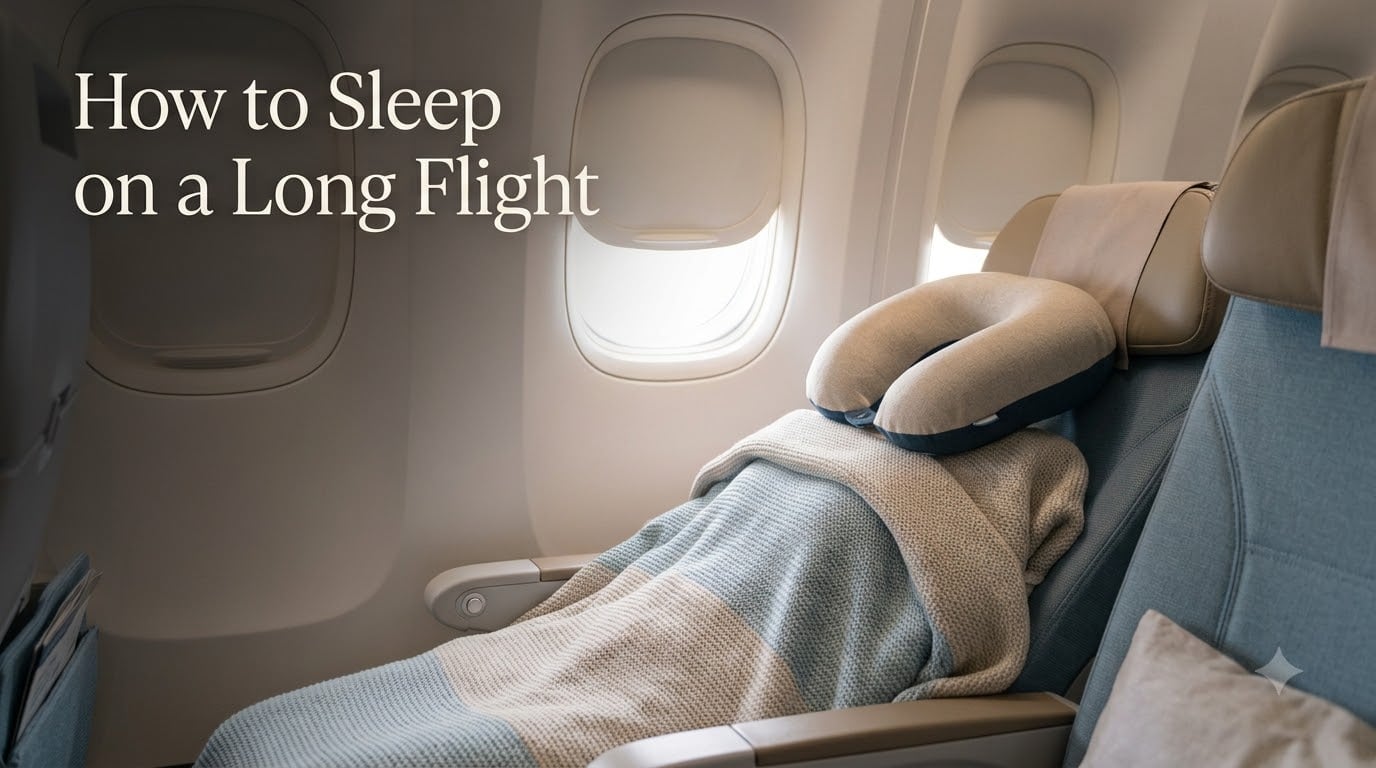
I still remember the 14-hour flight from Los Angeles to Auckland where I slept 8.5 hours straight in economy. The person next to me swore I had taken something. I had not. I had a system.
If you have ever stared at the seatback in front of you for seven hours, unable to sleep while exhausted, you know the specific misery of long-haul flight insomnia. The dry air, the engine noise, the upright seat, and the anxiety of sleeping in public all combine to make airplane sleep feel impossible.
After 60+ flights and far too many brutal red-eyes, I have refined a method that actually works. This guide covers how to sleep on a long flight, including seat selection, sleep gear, clothing, hydration, pre-flight prep, and mental techniques. By the end, you will have a complete playbook for arriving at your destination rested instead of ruined.
Table of Contents
7 Quick Sleep Wins for Any Long Flight
Here are the seven moves that changed everything for me. I share them up front because they are the highest-impact changes you can make.
- Book a window seat. You control the light, the headrest, and you are not bumped by passengers or service carts.
- Block light and noise from minute one. Eye mask and earplugs or noise-canceling headphones go on the moment you board, not when you try to sleep.
- Skip the alcohol. It knocks you out for 90 minutes, then wakes you at 3 a.m. local with a headache and dehydration.
- Dress in layers with soft, breathable fabrics. Cabin temperature swings 10 degrees in an hour. Loose merino or cotton helps you regulate.
- Drink water steadily, not just at meal service. Aim for 250ml every two hours. Add electrolytes if you sweat easily.
- Use a contoured neck pillow or a wraparound style. Inflatable pillows fail. Memory foam and the Trtl-style wrap work.
- Run your wind-down routine before boarding. Dim screens, eat light, and start your sleep audio 30 minutes before takeoff.
Those are the shortcuts. Now let me walk you through the full system, section by section.
Pick the Right Seat Before You Book
Seat selection is the single biggest factor in whether you sleep on a long flight. You have more control here than almost any other variable, and almost no one uses it well.
Why the window seat wins for sleep
The window seat is non-negotiable if sleep is your priority. You can lean against the fuselage wall, which is far more stable than a headrest. You control the window shade and the overhead light. You are not interrupted by seatmates climbing over you or service carts hitting your elbow.
I have tried aisle seats thinking I would prefer the legroom. I was wrong every time. The aisle seat puts you in the path of every passenger and every cart for the entire flight.
Avoid the middle seat at all costs
The middle seat blocks sleep completely. You cannot lean left or right. You are pinned between two strangers. Save the middle seat for short flights under four hours.
Consider bulkhead and exit rows carefully
Bulkhead rows give you extra legroom but no under-seat storage and no armrest adjustment. The tray table is often in the armrest, which interrupts your sleep position. Exit rows have great legroom but seats do not recline fully, and you must be alert to operate the emergency exit.
For pure sleep, I prefer a regular window seat near the front of the cabin. Less engine noise, fewer passenger movements, and quicker exit on arrival.
Use SeatGuru to find the best seat for your aircraft
SeatGuru.com shows you exactly which seats have limited recline, which are near lavatories, and which have extra pitch. I check it for every flight over five hours. It takes 90 seconds and saves hours of misery.
Pack the Right Sleep Gear
Your gear is the difference between dozing for 20 minutes and sleeping for six hours. Here is what I bring and why.
Neck pillow: skip the inflatable, choose contoured or wraparound
The classic U-shaped inflatable pillow is mostly useless. It pushes your head forward, which is the opposite of what you want. After testing 12 pillows over three years, I have seen two types actually work.
The memory foam contoured pillow (like the Cabeau Evolution) cradles your head from the side and supports your chin. The wraparound style (Trtl pillow) uses an internal frame to hold your head upright comfortably. Both keep your neck aligned with your spine, which prevents the dreaded plane-wake-up-with-a-crick.
Eye mask: 100% blackout is the goal
Cabin lighting is unpredictable. People read, screens glow, and the cabin lights cycle. A proper sleep mask blocks all of it. Look for a contoured mask with molded eye cups so your eyelids can fully close. Flat masks let light leak through your eyelids and press on your lashes.
I use the Mavogel or a similar contoured style. The cheap flat masks from the gift shop are not worth packing.
Earplugs or noise-canceling headphones
You have two real options here. Soft foam earplugs (Mack’s Ultra Soft) reduce engine drone by about 30 decibels and cost nothing. Noise-canceling headphones (Sony WH-1000XM5, Bose QuietComfort) actively cancel low-frequency drone and let you play sleep audio.
For long-haul, I wear both. The headphones cancel the engine and play pink noise, then the foam earplugs under them handle the rest. It sounds extreme. It works.
Compression socks are essential, not optional
Cabin pressure at cruising altitude causes fluid to pool in your lower legs. Compression socks (15-20 mmHg) keep blood flowing and prevent the ankle swelling that ruins sleep and puts you at risk for deep vein thrombosis on flights over four hours.
I put them on before boarding and keep them on until I land. They also help me feel less tired when I arrive.
Optional but valuable comfort items
A lightweight travel blanket or large scarf gives you warmth without depending on the thin airline blanket. A foot hammock that hooks onto the tray table lifts your feet slightly, which reduces lower back pressure. A small lavender spray on your pillow can help signal your brain to sleep.
None of these are required, but each one adds a small layer of comfort that compounds over a 10-hour flight.
Dress for Sleep Success
Your clothing choice matters more than most travelers realize. Think of it as part of your sleep gear, not your outfit for the day.
Layering is non-negotiable
Cabin temperature swings dramatically. I have been on flights where the cabin went from 22 degrees to 16 degrees in an hour. Wear a base layer, a mid layer, and a light jacket or hoodie you can remove or add.
Synthetic fabrics like polyester trap sweat and make you clammy. Cotton, merino wool, and bamboo breathe well and stay comfortable across temperature changes.
Skip tight clothing and waistbands
Pressure on your abdomen from jeans or tight waistbands disrupts digestion and makes it harder to fall asleep. I wear joggers or soft travel pants with a drawstring. Tops are loose-fitting and zip up so I can adjust without removing layers.
Wear slip-on shoes or socks with grip
Your feet swell at altitude. I keep my shoes off for the bulk of the flight and wear compression socks or grippy airline socks. Slip-on shoes save you from fumbling at security while also being easy to slip off and on in your seat.
Bring a change of clothes for landing
After 12 hours in travel clothes, you feel grimy. I pack a fresh t-shirt and underwear in my personal item and change about 30 minutes before landing. It sounds excessive. Arriving at your destination feeling human instead of rumpled is worth the small effort.
Hydrate the Right Way Before and During Flight
Hydration is how you sleep on a long flight, even though it sounds counterintuitive. The cabin air has humidity around 10-15%, drier than most deserts. You dehydrate faster than you realize, and dehydration triggers restlessness, headaches, and shallow sleep.
Drink water steadily, not just at meal service
I aim for 250ml of water every two hours. A refillable bottle is essential because flight attendants will not keep topping you up. I fill mine at the airport after security and finish it within an hour, then refill from the lavatory sink or ask for refills.
Skip alcohol completely
Alcohol and plane sleep are a terrible combination. It feels like it helps you fall asleep, but it fragments your sleep cycles, worsens dehydration, and almost always wakes you after 90 minutes. Then you lie awake for hours with a headache and a foggy brain.
Limit caffeine after the first hour
Coffee and tea on flights feel like a comfort ritual, but they stay in your system for six to eight hours. If your flight is overnight and you want to sleep, switch to herbal tea or water after the first hour of flight.
Add electrolytes for long flights
On flights over eight hours, plain water is not enough. Electrolyte tablets or a low-sugar powder (LMNT, Liquid IV) replace the minerals you lose through sweating and cabin dryness. They also help you retain water rather than passing it straight through.
Pre-Flight Prep That Sets You Up for Sleep
What you do in the 24 hours before your flight matters as much as what you do on the plane. If you show up exhausted, dehydrated, and overstimulated, no gear will save you.
Exercise in the morning before your flight
Twenty to thirty minutes of moderate exercise the morning of a long flight does two things. It burns off the nervous energy that keeps you awake, and it ensures you are physically tired by the time you board. I run, swim, or do a strength workout before any flight over six hours.
Skip the heavy session within four hours of takeoff. You want to be tired, not sore and depleted.
Eat light in the six hours before departure
A heavy meal before a flight makes you sluggish and slow to fall asleep. A large meal also means more bathroom trips, which interrupts your sleep window. I eat a moderate protein-rich meal four hours before takeoff and avoid heavy carbs, dairy, and anything spicy.
Limit screens in the two hours before boarding
Blue light from phones and laptops suppresses melatonin production and pushes your sleep clock later. I switch to a blue-light-blocking setting on my devices two hours before flight, then move to audiobooks or sleep podcasts within the hour.
If you must use screens, set them to night mode and hold them below eye level. Or, read a physical book.
Start adjusting to your destination time zone early
For eastbound flights, I start going to bed and waking up 30 minutes earlier three days before departure. For westbound flights, I push everything 30 minutes later. This small shift makes it dramatically easier to fall asleep on the plane and adapt on arrival.
Pre-boarding routine at the gate
While waiting at the gate, I run through a quick wind-down routine. I drink water, do a few breathing exercises, put my hair up if it is long, and put on my eye mask and headphones for the boarding process. By the time I sit down, I am already in sleep mode.
Mental Techniques to Quiet Your Mind
Most guides on how to sleep on a long flight skip this section entirely. That is a mistake. Your brain is the biggest obstacle, and calming it is the difference between three hours of broken sleep and seven hours of real rest.
The 10-5-3-2-1 sleep rule
This is a popular sleep preparation rule that helps you wind down progressively. Here is how it works:
- 10 hours before bed: No more caffeine. Stop drinking coffee or tea after this point.
- 5 hours before bed: No more food or alcohol. Give your body time to digest.
- 3 hours before bed: No more work. Close the laptop and stop answering emails.
- 2 hours before bed: No more screens. Move to audiobooks, gentle stretching, or a shower.
- 1 hour before bed: No more liquids. Avoid waking up to use the bathroom.
On flights, I adapt this rule to start when I want to sleep on the plane. If my sleep window is four hours after takeoff, I run the 10-5-3-2-1 countdown from four hours before that sleep window.
Box breathing for fast calm
Box breathing resets your nervous system in under two minutes. Breathe in through your nose for four counts. Hold for four counts. Exhale through your mouth for four counts. Hold for four counts. Repeat for four cycles.
I practice this both before boarding and whenever I wake up mid-flight. It is the fastest reliable way to drop my heart rate and signal sleep to my body.
Body scan meditation for falling asleep
A body scan walks your attention through your body from toes to head, releasing tension as you go. I mentally say each body part and consciously relax it. Toes, feet, calves, knees, thighs, hips, abs, chest, hands, arms, shoulders, neck, face, scalp.
By the time I reach my scalp, I am usually asleep. If I am not, I start over. It works on planes because it gives your brain a simple task rather than letting it spin on worries.
Handling flying anxiety without medication
If you have anxiety about flying, that anxiety is the main barrier to sleep. Two things help. First, accept the discomfort. Fighting anxiety makes it worse. Instead, remind yourself that turbulence is normal and that millions of people fly safely every day.
Second, use a grounding technique. Name five things you can see, four you can hear, three you can touch, two you can smell, and one you can taste. It pulls your mind out of the worry spiral and into the present moment.
In-Flight Sleep Routine: What to Do Step by Step
Knowing the theory is one thing. Here is the actual sequence I follow once I am in my seat.
During boarding: prep your sleep setup
As soon as I sit down, I put my compression socks on, drape my travel blanket over my lap, set up my neck pillow, and put my eye mask and earplugs in easy reach. I do not open my laptop or take out work. I treat boarding time as the start of my wind-down.
During takeoff and meal service: stay awake
I stay awake through takeoff and the first meal. Forcing sleep before your body is ready leads to fragmented, low-quality rest. Instead, I drink water, listen to a podcast, and watch the sky.
Identify your sleep window and protect it
On long-haul flights, I aim for one solid sleep block of five to seven hours, not scattered naps. I time my sleep window to match the destination’s nighttime. If landing is at 7 a.m. local, I start winding down four hours before, in the middle of the flight.
Set multiple alarms for waking
I set three phone alarms 30 minutes before I want to wake, then one more alarm 15 minutes before landing. Sleep inertia on planes is brutal and you do not want to oversleep through your arrival. I also set a watch alarm on my wrist as a backup.
Waking up: the gentle re-entry
When my alarm goes off, I do not jump up. I take five minutes to wake up slowly. Remove the eye mask first, then sit upright, drink water, and stretch my legs in the aisle. Move my ankles and flex my calves to get blood flowing.
Use the last 30 minutes before landing to change clothes, freshen up, and reset mentally. You will arrive feeling like a different person.
Frequently Asked Questions
What is the 10 5 3 2 1 rule for sleep?
The 10 5 3 2 1 rule is a sleep preparation countdown that helps you wind down progressively. 10 hours before bed: no caffeine. 5 hours before bed: no food or alcohol. 3 hours before bed: no work. 2 hours before bed: no screens. 1 hour before bed: no liquids. On flights, run this countdown from before your planned sleep window so you fall asleep faster and sleep deeper.
How do you survive a 20 hour flight in economy?
To survive a 20 hour flight in economy, book a window seat near the front of the cabin, pack a contoured neck pillow, eye mask, earplugs, and compression socks. Drink 250ml of water every two hours and avoid alcohol completely. Walk the aisle every two to three hours to prevent stiffness and blood pooling. Build a sleep window that matches your destination night, then run a wind-down routine 30 minutes before that window. Break the flight into three phases: stay awake for the first meal, sleep during the longest middle stretch, then wake gently with alarms set 30 minutes before landing.
Why do flight attendants sit on their hands when flying?
Flight attendants sit on their hands to keep blood flowing in their legs during long flights. Sitting on their hands applies gentle pressure to their thighs, which prevents blood from pooling in their lower legs and reduces the risk of deep vein thrombosis. It is a quick trick that frequent flyers can copy by gently pressing their hands into their thighs while sitting, or by using a foot hammock and compression socks for similar circulation benefits.
What pills make you sleep on a plane?
Melatonin is the most common sleep aid used on planes because it helps reset your circadian rhythm and is non-habit-forming at low doses (0.5 to 3 mg taken 30 minutes before your sleep window). Over-the-counter antihistamines like diphenhydramine (Benadryl) make some people drowsy but cause grogginess and dry mouth. Prescription options like zolpidem (Ambien) are used by some travelers but require a doctor consultation and carry risks of side effects. Always talk to your doctor before taking any sleep medication, especially with alcohol or other medications.
Final Thoughts on Sleeping Through Long Flights
Learning how to sleep on a long flight is a skill, and like any skill it gets easier with practice. The first time you run through this full system, it will feel like a lot. By the third or fourth long-haul, it becomes automatic.
Start with the highest-impact moves: window seat, real neck pillow, eye mask, earplugs, and zero alcohol. Add the pre-flight exercise and wind-down routine once those feel natural. Finally, layer in the mental techniques like box breathing and the 10-5-3-2-1 rule when you need to fall asleep faster.
The difference between arriving at your destination wrecked and arriving ready is not luck. It is preparation. Take these steps on your next long flight and see how much better you feel when you land.