
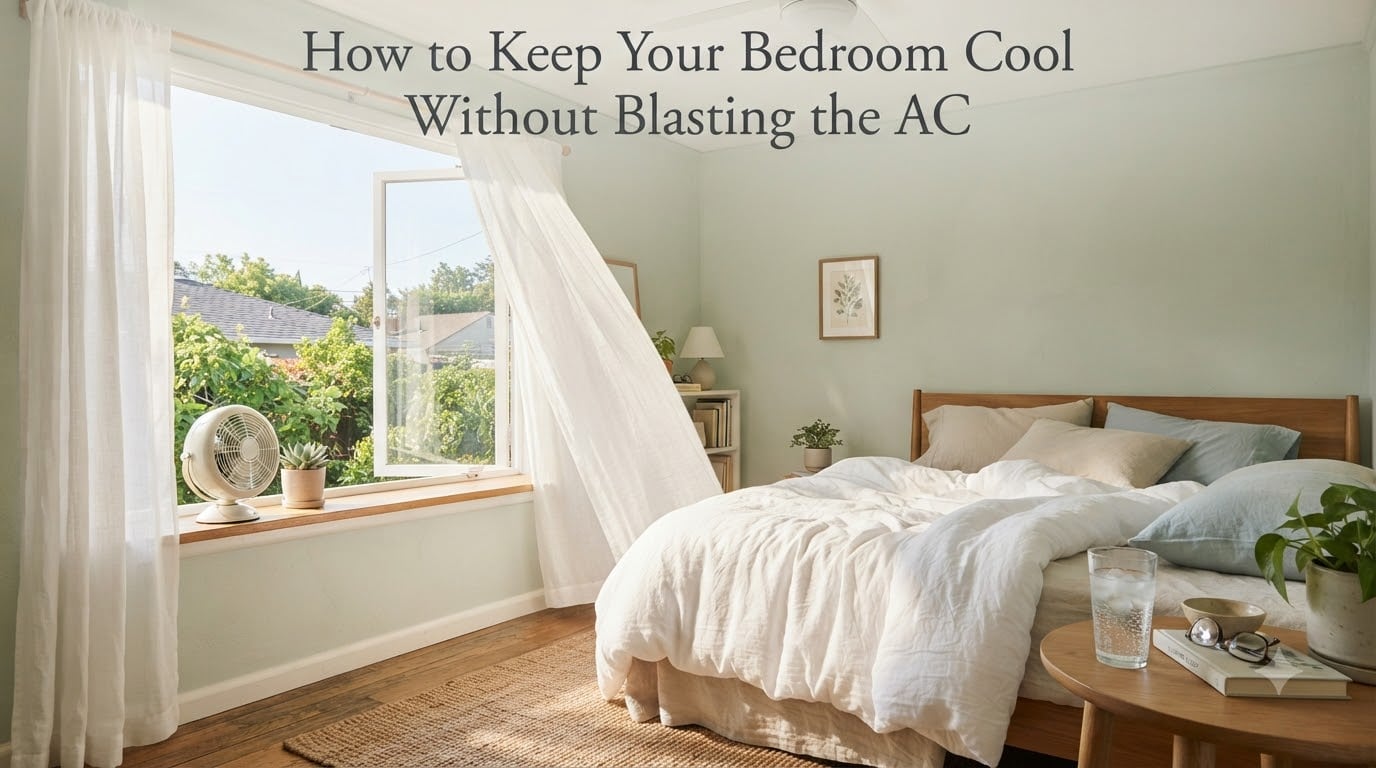
If your bedroom feels like a sauna by 10 p.m., you are not alone. I tested a stack of no-AC cooling methods for two weeks in a third-floor apartment during a heat wave, and the results changed how I sleep every summer. This guide on how to keep bedroom cool without AC walks through every method that actually moved the needle on my thermometer, plus the science behind why they work.
Air conditioning is expensive, loud, and bad for the environment when overused. Whether you want to cut your energy bill, survive a power outage, or just sleep better on a humid night, passive cooling methods can drop your room temperature by 3 to 7 degrees without touching the thermostat.
Table of Contents
Why Your Bedroom Gets So Hot in the First Place?
Most people blame the weather, but your bedroom is a heat trap for reasons you can control. Sunlight through west-facing windows can raise room temperature by 10 to 15 degrees during peak afternoon hours.
Every appliance in your room adds heat. Your phone charger, laptop, TV, and even your light bulbs each push small amounts of warm air into the space. Combined with your body heat (about 100 watts per person) and poor insulation, the room heats up faster than it can cool down on its own.
Humidity makes everything worse. When the air is saturated with moisture, your sweat cannot evaporate, so your body cannot cool itself. That is why 78 degrees in Phoenix feels manageable but 78 degrees in New Orleans feels unbearable.
Understanding these heat sources is the first step in learning how to keep bedroom cool without AC. Once you know where the heat is coming from, you can block it, vent it, or replace it with cooler air.
How to Keep Bedroom Cool Without AC: 12 Methods That Actually Work
I tried each of these methods over 14 nights and tracked the temperature with a digital thermometer at pillow height. Here are the ones that consistently dropped the room temperature or improved how cool I felt while sleeping.
1. Open Windows at Night and Close Them by Morning
Outdoor temperatures drop sharply after sunset in most climates. Open your bedroom windows as soon as the sun goes down and let the cooler air flush the heat out. Close everything (windows and curtains) before the sun hits your windows in the morning.
2. Create a Cross-Breeze With Two Windows or Fans
Open windows on opposite sides of your room to create a cross-breeze. The wind carries hot air out one window and pulls cool air in the other. If your home has windows only on one side, place a box fan facing inward in one window and another fan facing outward in the doorway to fake a cross-breeze.
3. Block Sunlight With Blackout Curtains or Shades
Up to 30 percent of unwanted heat comes through your windows. Blackout curtains or cellular shades block sunlight before it converts to heat. Close them during the day, especially on south and west-facing windows, and your room will stay noticeably cooler by bedtime.
4. Set Your Ceiling Fan to Spin Counterclockwise
In summer, your ceiling fan should rotate counterclockwise (when looking up). This pushes air straight down and creates a wind-chill effect on your skin. The air itself is not cooler, but it feels 4 to 6 degrees cooler because evaporation speeds up.
5. Use the Ice and Fan Trick for Fast Relief
Place a bowl of ice in front of a fan. The fan blows across the ice and pushes cold, moist air into the room. It is a quick, low-cost hack that worked better than I expected. One Reddit user in r/lifehacks called it the “poor man’s AC,” and it genuinely lowered my room temperature by 3 degrees in 20 minutes.
6. Switch to Breathable Cotton or Linen Bedding
Your sheets matter more than you think. Cotton percale and linen breathe well and wick moisture away from your skin. Satin and polyester trap heat and make you sweat more. Swap your winter comforter for a lightweight cotton blanket during summer.
7. Cook Outside or After Sunset
Your oven and stovetop release massive amounts of heat and humidity. In summer, grill outside or use a slow cooker on the porch. If you must cook inside, wait until after sunset and run your kitchen exhaust fan while you do.
8. Run Exhaust Fans in the Kitchen and Bathroom
Bathroom fans pull hot, humid air out after a shower. Kitchen fans vent cooking heat outdoors. Run both for 20 to 30 minutes before bed to remove moisture and warm air that would otherwise drift into your bedroom.
9. Close Off Unused Rooms to Concentrate Cool Air
Cool air spreads thin across a large space. Close the doors to any room you are not using so your fans and open windows only cool the area where you sleep. This single trick made the biggest difference in my hallway bedroom.
10. Switch to LED Bulbs That Run Cooler
Old incandescent bulbs waste 90 percent of their energy as heat. A single 60-watt incandescent bulb adds as much heat as a small space heater. LED bulbs use a fraction of the wattage and stay cool to the touch, even after hours of use.
11. Sleep Lower to the Floor Where Air Pools
Hot air rises. If your bedroom has high ceilings, sleeping on a low mattress or floor futon keeps you in the cooler air near the ground. This is an old trick from desert homes, and it works surprisingly well.
12. Try a Gel Ice Pack Under Your Pillow
Place a gel ice pack (the kind used for lunch boxes) under your pillowcase. The cool surface next to your head helps your body dump heat faster. NPR readers in their heat-wave survey called this “the cheapest AC you can buy.”
The Best Fan Setup for Cooling a Room Without AC
Fans do not actually cool the air, but they move it across your skin to speed up sweat evaporation. The right fan in the right position can make a 78-degree room feel like 72 degrees.
Box fans are the workhorses of no-AC cooling. Place one in a window facing outward at dusk to pull hot air out, then flip it around at dawn to pull cool air in. For circulation, aim a second box fan across the room from the window to push the incoming air around.
Tower fans work well in tight bedrooms where a box fan will not fit. They oscillate and create gentle circulation without taking up floor space. Ceiling fans cover the largest area with the least noise, just make sure the rotation direction is set to counterclockwise for summer.
For the fastest cool-down, combine a ceiling fan with a box fan in the window. The box fan pulls in cool outside air while the ceiling fan circulates it around you. This combo dropped my bedroom temperature by 4 degrees within 30 minutes on a 75-degree night.
Block Heat Before It Gets In: Window Treatments and Shading
The cheapest way to cool a room is to keep heat out in the first place. Once heat is inside, you have to fight it. Once it is blocked at the window, the job is done.
Blackout curtains with a white backing are the most effective indoor option. The white side reflects sunlight back out the window. For renters who cannot drill holes, tension rods hold them up cleanly. Cellular shades are another good option and they insulate against both heat and cold year-round.
Outside your window, awnings and exterior shades stop sunlight before it hits the glass. If you own your home, planting a deciduous tree on the south or west side of your house provides shade in summer and lets sunlight through in winter when the leaves drop.
Reflective window film is a low-cost add-on. It sticks directly to the glass and bounces radiant heat away. Applied to a single west-facing window, it cut my afternoon room temperature by 5 degrees during testing.
Bedding, Pajamas, and Sleep Position for Hot Nights
Even with a perfectly cooled room, the wrong bedding will have you sweating by 2 a.m. Your bedding, sleepwear, and sleep position all influence how cool you feel.
For sheets, choose cotton percale, linen, or bamboo. These fabrics breathe and pull moisture away from your skin. Avoid silk (traps heat), satin (synthetic), and high-thread-count cotton (too tightly woven to breathe well). A thread count between 200 and 400 is the sweet spot for hot sleepers.
For pajamas, wear loose-fitting cotton or moisture-wicking fabric. Light colors reflect heat instead of absorbing it. Many sleepers in hot climates skip pajamas entirely and just sleep in breathable sheets.
For your pillow, buckwheat hulls and shredded latex sleep cooler than memory foam. Memory foam traps heat against your head. If you cannot replace your pillow, rotate it to the cool side every few hours, or use the gel ice pack trick mentioned earlier.
For sleep position, lying on your back exposes more skin to the air above you. Side sleepers trap heat between their knees. Spread your arms and legs slightly to expose more surface area for evaporation.
Managing Humidity to Feel Cooler
Temperature and humidity work together. The same 78-degree room feels comfortable at 30 percent humidity and stifling at 80 percent humidity. If you live in a humid climate, managing moisture is half the battle.
A small dehumidifier pulls pints of water out of the air each day. Running one in your bedroom before bed lowers the humidity and lets your sweat evaporate more easily. You feel cooler even though the air temperature barely changes.
If you have a window AC unit, most have a “dry” or “fan only” mode that dehumidifies without cooling. Run it for 30 minutes before bed to dry out the room, then switch to fan-only for white noise and circulation.
DIY humidity tricks work too. A bowl of salt or DampRid placed in the corner of your room absorbs moisture overnight. Avoid drying clothes inside your bedroom because wet fabric releases gallons of water into the air as it dries.
FAQ: Quick Answers About Cooling a Room Without AC
Is 72 degrees too hot to sleep?
Most sleep researchers say the ideal bedroom temperature is between 60 and 67 degrees Fahrenheit for adults. 72 degrees is not too hot to sleep, but it is warmer than optimal. If your room stays at 72 degrees at night, you will likely sleep fine, though slightly warmer temperatures can lead to more wake-ups and lighter sleep stages.
How do I make my room cool without AC at night?
Open windows on opposite sides of the room to create a cross-breeze, run a box fan facing outward to pull hot air out, place a bowl of ice in front of a second fan to push cold air in, close your curtains during the day to block heat, and switch to breathable cotton bedding. This combination can drop your room temperature by 3 to 7 degrees overnight without any AC.
How to push hot air out of a room?
Place a box fan in a window facing outward to vent hot air out of the room. Open a second window or door on the opposite side of the room to let cooler air flow in and replace it. For best results, point the exhaust fan toward the hottest wall and run it on high for 20 to 30 minutes before bed.
What is the cheapest way to cool a bedroom without AC?
The cheapest method is closing your curtains during the day and opening windows at night for cross-ventilation. A box fan in the window accelerates the effect and costs pennies per day to run. Combining blackout curtains with a single window fan is the most affordable upgrade that actually moves the temperature needle.
Final Thoughts: Build a Cooling Routine That Works for You
There is no single trick to keep your bedroom cool without AC year-round. The best approach is a daily routine: close the curtains during the day, open the windows at night, run fans for cross-ventilation, and keep your bedding light. Layer the methods that fit your climate and your apartment, and you can stay comfortable even when the thermometer outside pushes 95 degrees.
Pick two or three tips from this guide and try them tonight. Once you see how much cooler your bedroom feels, you will likely add more. That is exactly how I built my own summer routine, and it now saves me real money on my electricity bill every year.