
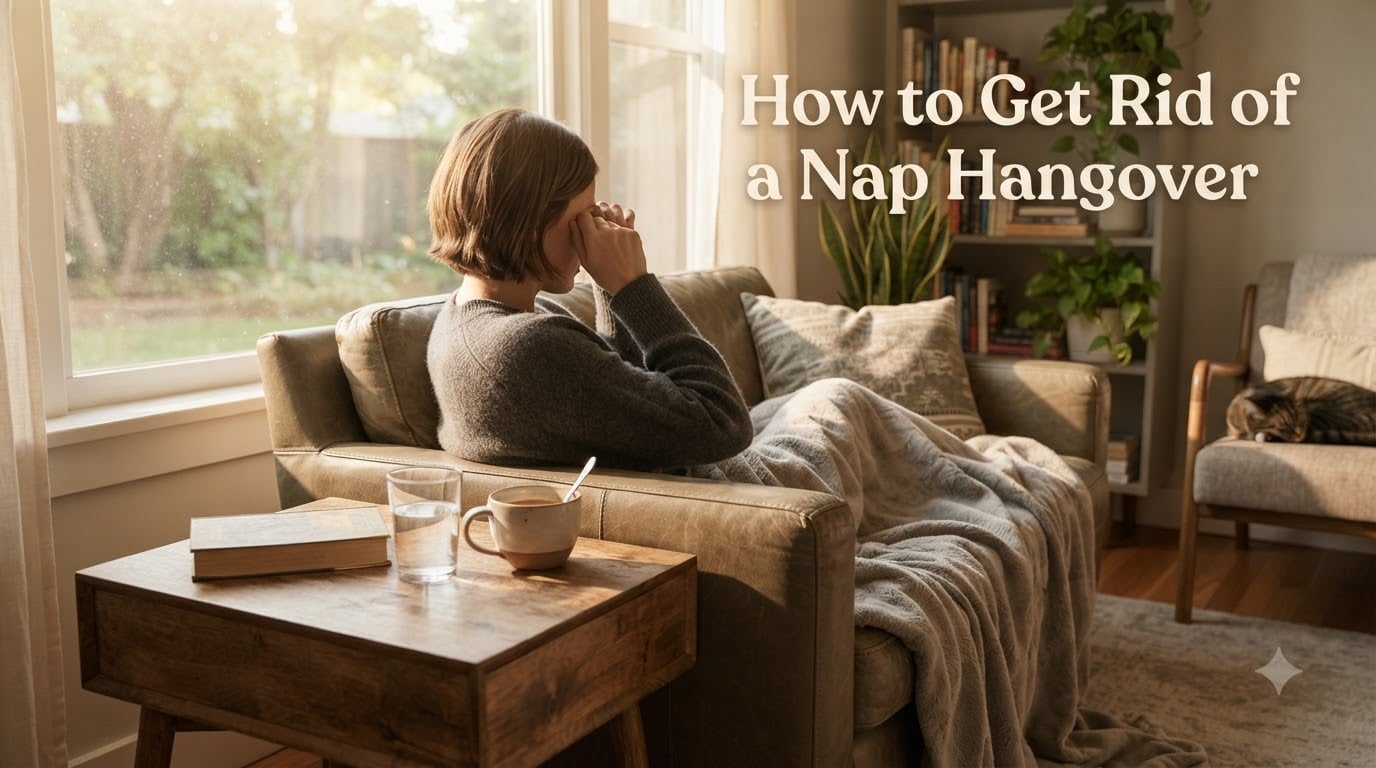
You set an alarm, closed your eyes for what was supposed to be a quick 20-minute reset, and woke up an hour later feeling like you got hit by a truck. Your mouth is dry, your head feels fuzzy, and somehow you are more tired than before you lay down. That groggy, disoriented, “I think I forgot my own name” feeling is what people call a nap hangover.
If this sounds familiar, you are not alone. Our team has been there plenty of times, and so have thousands of people on Reddit who ask the same question: why does a nap meant to recharge me leave me feeling worse? The answer comes down to sleep science, and once you understand what happens in your brain during a nap, fixing the problem becomes surprisingly straightforward.
In this guide, we will walk through exactly how to get rid of a nap hangover using proven strategies backed by sleep research. We will cover the 30-60-90 nap rule, why sleep inertia happens, how to prevent grogginess before it starts, and what to do the moment you wake up feeling like a zombie. We will also share the coffee nap technique that most people have never heard of but swear by once they try it.
Table of Contents
What Is a Nap Hangover?
A nap hangover, clinically known as sleep inertia, is the groggy and disoriented feeling you get after waking from a daytime nap. It can leave you struggling to string a sentence together, reach for the wrong words, or wonder what day it is for a few embarrassing seconds.
Sleep inertia typically lasts anywhere from 15 minutes to an hour, but in some cases the fog can linger for up to two hours. During that window your reaction time slows, your decision-making gets sloppy, and your brain feels like it is running on dial-up internet. Research shows that the deeper the sleep stage you wake from, the worse and longer-lasting the inertia.
The good news is that a nap hangover is not a sign that something is wrong with you. It is a normal physiological response to being pulled out of deep sleep too quickly. The trick is learning how to nap in a way that keeps you in the lighter sleep stages or times your wake-up so you surface naturally.
What Is Sleep Drunkenness?
Sleep drunkenness is a more extreme form of sleep inertia that goes beyond ordinary grogginess. People experiencing it may answer questions incoherently, perform complex actions with no memory of doing so, or become confused and agitated upon waking. Think of it as your brain being half-asleep and half-awake at the same time.
This condition tends to happen when you are woken abruptly from slow-wave sleep, especially if you are already sleep-deprived. It can also be triggered by stress, irregular sleep schedules, or certain medications. If you regularly wake up confused, aggressive, or doing things you do not remember, that goes beyond a typical nap hangover and is worth mentioning to your doctor.
How to Get Rid of a Nap Hangover: The 30-60-90 Rule
The single most effective way to avoid nap hangovers is following the 30-60-90 nap rule. This simple framework is your featured-snippet cheat sheet for napping without the misery.
The 30-60-90 rule explained:
- Under 30 minutes (power nap): A 10 to 20-minute nap keeps you in light sleep stages. You wake up refreshed with minimal to no grogginess. This is the sweet spot.
- 30 to 60 minutes (danger zone): This range pulls you into deep slow-wave sleep. Waking up here causes the worst sleep inertia. Avoid it unless you have time to recover.
- 90 minutes (full cycle): A 90-minute nap completes one full sleep cycle, including REM. You wake up at a natural transition point, which means little to no grogginess.
The rule is simple. Either keep it short at 20 minutes, or commit to a full 90 minutes. Anything in between is a recipe for a nap hangover.
Why Do Nap Hangovers Happen?
Nap hangovers happen because of how your brain cycles through sleep stages. When you fall asleep, your brain moves through stages N1 (light sleep), N2 (deeper light sleep), and N3 (slow-wave deep sleep), before entering REM sleep. A full cycle takes roughly 90 minutes.
Here is where the problem starts. After about 20 to 30 minutes of sleeping, your brain begins producing delta waves, the hallmark of slow-wave deep sleep. If your alarm goes off at the 40 or 50-minute mark, you are yanked out of the deepest stage of sleep. Your prefrontal cortex, the part of the brain responsible for alertness and clear thinking, has not had time to transition back to wakefulness.
The result is a brain caught between sleep mode and awake mode. Studies show that during sleep inertia, your cognitive performance can drop to the equivalent of being legally drunk. Reaction times slow dramatically, short-term memory falters, and you may feel physically heavy and sluggish.
Several factors make nap hangovers worse. Sleep deprivation is the biggest one. If you are already running on five hours of sleep, your body crashes into deep sleep faster and harder during a nap, making the wake-up even rougher. Circadian rhythm timing also plays a role. Napping during your natural afternoon energy dip, typically between 1 and 3 PM, means your body is already primed for deep sleep.
Other contributors include dehydration, sleeping in a dark room that confuses your brain about what time it is, and napping too late in the day. A nap that starts after 4 PM is more likely to leave you groggy because it overlaps with the early wind-down phase of your circadian rhythm.
How to Prevent a Nap Hangover
Prevention is always easier than recovery. Here are the steps to take before and during your nap to minimize the chance of waking up foggy.
1. Set an alarm for 20 minutes. This is your non-negotiable rule for power naps. The 20-minute window keeps you in light sleep stages N1 and N2, where waking up feels easy and natural. Factor in about 5 minutes to fall asleep, so set the alarm for 25 minutes if you tend to drift off slowly.
2. Time your nap for early afternoon. The ideal nap window is between 1 and 3 PM, when most people experience a natural post-lunch dip in alertness. Napping during this window works with your circadian rhythm rather than against it. Avoid napping after 4 PM, which can interfere with nighttime sleep and increase grogginess.
3. Nap slightly upright. Lying completely flat signals your brain that it is time for a full night of sleep, which can accelerate the dive into deep sleep. Napping in a recliner or propped up with pillows keeps the transition shallower and makes waking easier.
4. Keep the room cool but not pitch black. A slightly lit room or cracked blind helps your brain maintain a sense of daytime. Complete darkness triggers melatonin production and pulls you deeper into sleep faster, making the wake-up harder.
5. Avoid napping on a full stomach. Digesting a heavy meal while sleeping can cause acid reflux, nausea, and that sick feeling some people get after naps. Wait at least 30 minutes after eating before lying down.
Countermeasures: How to Get Rid of a Nap Hangover Fast
Okay, so you already overslept your nap and now you are deep in the fog. Here is exactly how to get rid of a nap hangover using fast countermeasures that sleep researchers recommend.
Get into bright light immediately. Light is the single fastest way to signal your brain that it is time to be alert. Step outside into sunlight for 2 to 3 minutes, or turn on bright indoor lights. Light suppresses melatonin and activates alerting centers in your brainstem.
Splash cold water on your face. Cold water on your face triggers the mammalian dive reflex, which increases blood flow to your brain and jolts your nervous system into a more alert state. It sounds simple, but it works fast.
Drink a large glass of water. Dehydration amplifies grogginess and brain fog. Many people nap without realizing they are already mildly dehydrated, which makes the post-nap crash feel worse. Drink a full glass of water as soon as you wake up.
Get moving. Light physical activity increases blood circulation and helps clear the fog faster. Try 2 minutes of stretching, a brisk walk around the house, or a few jumping jacks. You do not need a full workout, just enough to get your heart rate slightly elevated.
Have a protein-rich snack. Reddit users dealing with post-nap fatigue consistently mention that a protein snack helps. A handful of nuts, a hard-boiled egg, or some Greek cheese gives your brain steady fuel without the sugar crash that comes from reaching for a donut.
Give it 15 to 30 minutes. Sleep inertia naturally fades on its own as your brain completes the sleep-wake transition. If you can, sit quietly and let the fog lift rather than forcing yourself to do complex tasks. Most people report that the worst of it passes within 15 to 45 minutes.
The Coffee Nap Strategy
The coffee nap is one of the most effective yet underused techniques for avoiding grogginess. Here is how it works: drink a cup of coffee quickly, then immediately lie down for a 20-minute nap.
Caffeine takes about 20 minutes to reach your bloodstream and block adenosine, the brain chemical that makes you feel sleepy. By the time your alarm goes off, the caffeine is kicking in at the exact moment you are waking up. You get the refreshing benefits of a power nap plus the alertness boost of caffeine, hitting your brain simultaneously.
Studies show that coffee naps produce better alertness and cognitive performance than either coffee or a nap alone. The key is keeping the nap to 20 minutes so you stay in light sleep, and drinking the coffee fast so it hits right on schedule.
When a Nap Hangover Is a Red Flag
Most nap hangovers are harmless and fade on their own. But there are situations where post-nap grogginess points to something deeper that needs medical attention.
Talk to a doctor if you experience any of the following:
- You consistently feel groggy for more than 2 hours after waking from a nap, even after using countermeasures.
- You wake up confused, aggressive, or performing actions you do not remember, which may indicate severe sleep drunkenness or a parasomnia.
- You experience severe nausea, dizziness, or heart palpitations after napping, especially if you have a condition like dysautonomia.
- Your partner tells you that you snore loudly, gasp, or stop breathing during sleep, which are signs of sleep apnea.
- You feel exhausted all day no matter how much you sleep, which could indicate an underlying sleep disorder, thyroid issue, or vitamin deficiency.
Sleep apnea deserves special mention. People with untreated sleep apnea wake up from every sleep, including naps, feeling terrible because their breathing has been repeatedly interrupted all night. If naps consistently make you feel worse rather than better, and you have other risk factors like loud snoring or being overweight, ask your doctor about a sleep study.
Frequently Asked Questions
Will a 20 minute nap help a hangover?
A 20-minute nap can help you feel more alert if you are sleep-deprived, but it will not cure a real alcohol hangover. For everyday fatigue, a 20-minute power nap keeps you in light sleep and reduces grogginess. For an alcohol hangover, hydration and time are more effective than napping.
How to get rid of grogginess after a long nap?
To get rid of grogginess after a long nap, immediately expose yourself to bright light, splash cold water on your face, drink a large glass of water, and do light physical activity like stretching or a short walk. Caffeine can also help. The fog typically fades within 15 to 45 minutes on its own.
What is the 30 90 rule for naps?
The 30-90 rule says to either nap for under 30 minutes (a power nap in light sleep) or for a full 90 minutes (one complete sleep cycle). Napping between 30 and 90 minutes pulls you into deep slow-wave sleep, which causes the worst sleep inertia when you wake up.
Why do nap hangovers happen?
Nap hangovers happen because of sleep inertia. When you nap longer than 20 to 30 minutes, your brain enters deep slow-wave sleep. Waking up from deep sleep means your brain has not fully transitioned to wakefulness, causing grogginess, confusion, and sluggish thinking that can last up to an hour or more.
Conclusion
Learning how to get rid of a nap hangover comes down to two things: understanding your sleep cycles and having a plan for when you wake up. Stick to the 30-60-90 rule by napping for either 20 minutes or a full 90 minutes, avoid the danger zone in between, and time your naps for the early afternoon. If you do oversleep, bright light, cold water, movement, and hydration will get you back to alert faster than waiting it out.
The coffee nap technique is worth trying if you have never done it. And if your nap hangovers are severe, persistent, or accompanied by red flag symptoms, talk to your doctor about possible underlying sleep disorders. Naps should make you feel better, not worse. Use these strategies and they will.