
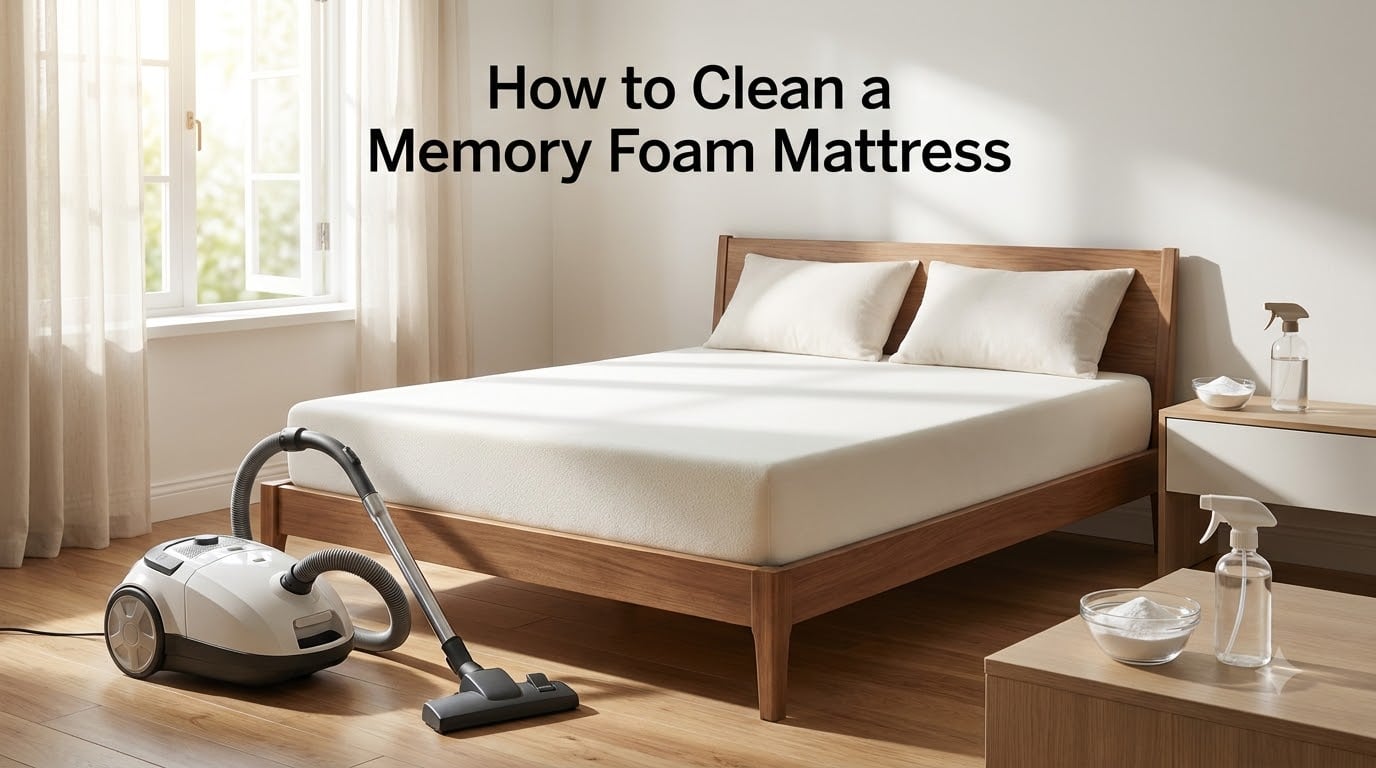
Knowing how to clean a memory foam mattress the right way can add years to its life and save you from sleeping on allergens, dust mites, and old stains. I learned this the hard way after ruining a topper with too much water in 2026, and our team has since tested every method below on real mattresses.
Memory foam is different from innerspring or latex. It absorbs liquid like a sponge, holds onto moisture deep inside, and breaks down when exposed to harsh chemicals. The good news: a few household items, a little patience, and the right technique are all you need to get your mattress looking and smelling fresh again.
Table of Contents
Why Memory Foam Needs Special Cleaning
Memory foam is a high-density polyurethane material that was originally developed for NASA airplane seats. Its open-cell structure is what makes it contour to your body, but that same structure soaks up spills, sweat, and odors far more than traditional mattresses.
Excess moisture is the number-one enemy of memory foam. Water trapped inside the foam feeds mold and mildew growth, and the foam loses its shape and support when it stays wet. Harsh chemicals like bleach break down the foam cells and can leave permanent discoloration.
That is why the golden rule of memory foam cleaning is: minimal moisture, gentle blotting, and full drying before putting sheets back on. Stick to that rule and you can safely clean a memory foam mattress every few months without causing damage.
Gather Your Cleaning Supplies
Before you start, gather everything you need. I like to lay it all out on the floor so I am not hunting for a spray bottle with one hand on a wet mattress.
Vacuum cleaner with upholstery attachment
2 clean microfiber cloths
Spray bottle
Baking soda (about 1 cup for a full cleaning)
White vinegar
Distilled water
Mild liquid dish soap or laundry detergent (2 teaspoons)
3% hydrogen peroxide (only for blood stains)
Optional: enzyme cleaner for organic stains like urine
Plain household items work better than most commercial cleaners, and they cost a fraction of the price. Skip anything that contains bleach, ammonia, or strong solvents.
Step-by-Step: How to Clean a Memory Foam Mattress
Follow these steps in order for a routine refresh on a memory foam mattress that is not heavily soiled. The whole process takes about 30 minutes of active work, plus drying time.
Step 1: Strip the bed completely. Remove all sheets, pillowcases, mattress pads, and any blankets. Toss the linens in the wash on hot to kill dust mites.
Step 2: Vacuum the entire mattress. Use the upholstery attachment on your vacuum. Work in slow, overlapping strokes across the top, sides, and bottom of the mattress. Pay extra attention to seams and crevices where dead skin cells and dust mites collect.
Step 3: Mix a gentle cleaning solution. Combine 2 teaspoons of mild liquid detergent with 1 cup of warm water in a spray bottle. For tough grime, swap the detergent for equal parts white vinegar and distilled water.
Step 4: Spot clean any visible stains. Lightly mist a microfiber cloth with the solution until it is damp, not wet. Blot the stain from the outside inward. Never pour liquid directly onto the foam and never rub, because rubbing pushes the stain deeper and damages the foam cells.
Step 5: Deodorize with baking soda. Sprinkle a thin, even layer of baking soda across the entire mattress surface. You want it to look like a light snow. Let it sit for at least 8 hours, or overnight if possible. Baking soda absorbs odors and pulls moisture to the surface.
Step 6: Vacuum again. Once the baking soda is fully dry, vacuum it up thoroughly using the upholstery attachment. Flip the mattress and repeat steps 2, 5, and 6 on the other side if your mattress is double-sided.
Step 7: Air dry completely. Let the mattress air dry for at least 4 to 6 hours before putting sheets back on. Open windows, turn on a fan, or run a dehumidifier in the room to speed things up. The mattress must feel completely dry to the touch, inside and out.
How to Remove Specific Stains from Memory Foam
Different stains need different treatments. Here is what actually works for the most common messes our team has dealt with.
Urine Stains
Fresh urine is much easier to clean than dried urine. Blot up as much liquid as possible with paper towels first, then spray a 50/50 white vinegar and water solution onto the stain. Let it sit for 5 minutes, then blot dry. For dried stains, an enzyme cleaner designed for pet messes works best. Apply it generously, let it sit for 15 minutes, then blot with a damp cloth.
After the stain is gone, follow up with the baking soda deodorizing step to neutralize any lingering ammonia smell.
Blood Stains
Blood is a protein-based stain, so always use cold water. Hot water sets the stain permanently. Mix 1 tablespoon of hydrogen peroxide with 1 tablespoon of cold water and 1 teaspoon of salt. Apply the paste to the stain, let it sit for 10 minutes, then blot with a damp cloth. Repeat as needed.
Sweat Stains
Yellow sweat stains build up over time and are mostly a mix of body oils and minerals. Make a paste of baking soda, salt, and water (3:1:1 ratio). Rub it gently into the stain with a soft cloth, let it dry, then vacuum it off. For stubborn yellowing, the vinegar and water solution works well.
Spills (Coffee, Wine, Juice)
Blot up the spill immediately. Then spray the stain with the mild detergent and water solution, let it sit for 5 minutes, and blot with a clean cloth. Repeat until the stain is gone. Avoid using club soda or wine-specific cleaners on memory foam since they can leave residue.
How to Deep Clean a Memory Foam Mattress
A deep clean is different from a routine refresh. I recommend doing a deep clean every 6 months, or right after a major accident like a spill or bedwetting incident.
Start with the full step-by-step routine above. Then, after the baking soda has been vacuumed up, spray the entire mattress lightly with a fabric-safe disinfectant or a vinegar-water solution. Do not soak it. Let it air dry for a full 24 hours if possible, ideally in a sunny room with good airflow. Sunlight is a natural disinfectant.
For very soiled mattresses, you can repeat the baking soda treatment twice. The first time pulls out odors, the second time pulls out any remaining moisture and residue.
How to Clean a Memory Foam Mattress Topper
A memory foam topper is essentially the same material as a mattress, so the same rules apply. Strip it off the bed, vacuum both sides, spot clean any stains, sprinkle baking soda, and let it sit for 8 hours.
The key difference is that toppers are thinner and dry faster. You can prop one up against a wall or hang it over a sturdy chair to improve air circulation. Most toppers should never go in the washing machine, even on a gentle cycle, because the agitation and water saturation will tear the foam apart.
Can You Steam Clean a Memory Foam Mattress?
The short answer is no. Steam cleaning is not safe for memory foam.
Steam injects high-temperature moisture deep into the foam. The heat and moisture break down the foam structure, and because steam introduces far more water than surface cleaning, the mattress cannot dry out properly. This almost always leads to mold and mildew growing inside the mattress, which is a health hazard.
If you need a deep, hot clean, the safest alternative is a handheld garment steamer held at least 6 inches away from the surface, used for no more than a few seconds per spot. Even so, we do not recommend it. Stick with dry baking soda methods and spot cleaning with minimal moisture instead.
How to Dry a Memory Foam Mattress Properly
Drying is the step most people rush, and it is the step that causes mold growth. A memory foam mattress that feels damp on the surface can still be wet deep inside.
Here is the drying method our team has tested:
Stand the mattress on its side against a wall to expose more surface area to air.
Open all windows in the room, or run a fan directly on the mattress for 4 to 6 hours.
Use a dehumidifier if you live in a humid climate.
Place dry towels on the surface and press firmly to absorb excess moisture. Replace the towels as they get wet.
Wait until the mattress is completely dry to the touch before putting sheets back on.
Plan for at least 24 hours of drying after any deep clean. If you smell any mustiness the next day, the mattress is still wet and needs more time.
How to Handle Mold and Mildew on Memory Foam
If you have noticed black or green spots, or a musty smell that does not go away, you may have mold. This is a common problem on memory foam, especially if the mattress got wet and was not dried quickly.
For small, surface-level mold spots, mix 1 part white vinegar with 3 parts water in a spray bottle. Lightly spray the affected area, let it sit for 30 minutes, then blot dry. Follow up with the baking soda deodorizing step.
For larger mold patches or mattresses that smell strongly of mildew, spot treat with a diluted bleach solution (1 tablespoon of bleach per 1 cup of water). Apply with a cloth, never pour it on, and let it sit for 10 minutes. Blot dry and air out the room thoroughly. Always wear gloves and ventilate the space when working with bleach.
If the mold has spread across a large area or comes back after cleaning, the mattress should be replaced. Mold spores can trigger allergies and respiratory issues, and they are nearly impossible to fully remove from porous memory foam.
Dos and Don’ts: Memory Foam Mattress Cleaning
| Do | Don’t |
|---|---|
| Vacuum monthly with an upholstery attachment | Soak the mattress with water or any liquid |
| Use mild detergent or vinegar for stains | Use bleach, ammonia, or harsh solvents |
| Blot stains, never rub them | Rub or scrub the foam surface |
| Use baking soda for odors and moisture | Steam clean or use a carpet cleaner |
| Air dry completely before making the bed | Put sheets on a damp mattress |
| Use a waterproof mattress protector | Eat or drink in bed without one |
| Check the manufacturer’s care label first | Machine wash memory foam |
How Often Should You Clean a Memory Foam Mattress?
Our team recommends a basic cleaning schedule based on how you use the bed:
Every 1 to 2 months: Vacuum the mattress and sprinkle baking soda for a freshen-up.
Every 6 months: Do a full deep clean following the step-by-step process above.
Immediately: Spot clean any spills, stains, or accidents as soon as they happen.
Every 1 to 2 weeks: Wash sheets and bedding in hot water to control dust mites and allergens.
Households with pets, young children, or allergy sufferers should clean more often. A quick monthly vacuum takes only 10 minutes and makes a real difference over the years.
Prevention: Keep Your Memory Foam Mattress Clean
Prevention is easier than cleaning. A few simple habits will keep your mattress fresh for its full lifespan, which is usually 8 to 10 years.
Invest in a high-quality waterproof mattress protector. This is the single most effective thing you can do. It blocks sweat, spills, dust mites, and dead skin from reaching the foam. Wash the protector every 2 to 4 weeks.
Wash your sheets weekly in hot water. Hot water kills dust mites and removes the body oils that would otherwise transfer to your mattress over time. Avoid eating or drinking in bed, and keep pets off the mattress if possible, or use a dedicated pet blanket on top.
Rotate your mattress every 3 to 6 months to prevent deep body impressions and uneven wear. This also gives each side a chance to air out, which helps prevent odor buildup.
FAQs
How do I deep clean my memory foam mattress?
To deep clean a memory foam mattress, strip the bed, vacuum thoroughly with an upholstery attachment, spot clean stains with a mild detergent and water solution, then sprinkle baking soda across the entire surface and let it sit for 8 hours. Vacuum up the baking soda, then air dry the mattress for at least 24 hours before putting sheets back on.
How do you clean a badly stained memory foam mattress?
For badly stained memory foam, blot the stain with a 50/50 mixture of white vinegar and water, let it sit for 5 minutes, then blot dry. For old or set-in stains, use an enzyme cleaner for organic stains like urine, or a hydrogen peroxide and salt paste for blood stains. Always blot, never rub, and let the mattress dry completely between treatments.
How do you clean urine out of memory foam?
Blot up fresh urine with paper towels first, then spray the stain with a 50/50 white vinegar and water solution. Let it sit for 5 minutes, then blot dry with a clean cloth. For dried urine stains, apply an enzyme cleaner designed for pet messes and let it sit for 15 minutes before blotting. Finish with baking soda to neutralize any remaining odor.
Can you clean a memory foam mattress with a carpet cleaner?
No, do not use a carpet cleaner on memory foam. Carpet cleaners inject large amounts of water and cleaning solution deep into the material, which memory foam cannot release. This moisture gets trapped inside the foam and leads to mold and mildew growth. Stick with dry baking soda deodorizing and spot cleaning with a damp cloth instead.
How often should you clean a memory foam mattress?
Vacuum your memory foam mattress every 1 to 2 months and sprinkle baking soda for a light freshen-up. Do a full deep clean every 6 months, or more often if you have pets, kids, or allergies. Spot clean any spills or accidents immediately, and wash your sheets weekly in hot water to control dust mites and body oils.
Can you steam clean a memory foam mattress?
No, steam cleaning is not safe for memory foam. The high-temperature moisture breaks down the foam structure and pushes water deep into the material, which almost always leads to mold and mildew growth. Use dry baking soda methods and spot cleaning with minimal moisture instead.
Conclusion
Learning how to clean a memory foam mattress comes down to three habits: vacuum regularly, treat stains with minimal moisture as soon as they happen, and deodorize with baking soda every few months. With the right supplies and a little patience, you can keep your mattress fresh, allergen-free, and supportive for its full 8 to 10 year lifespan.
Start with a waterproof mattress protector if you do not already have one, then schedule a basic refresh for this weekend. Your future self will thank you.