
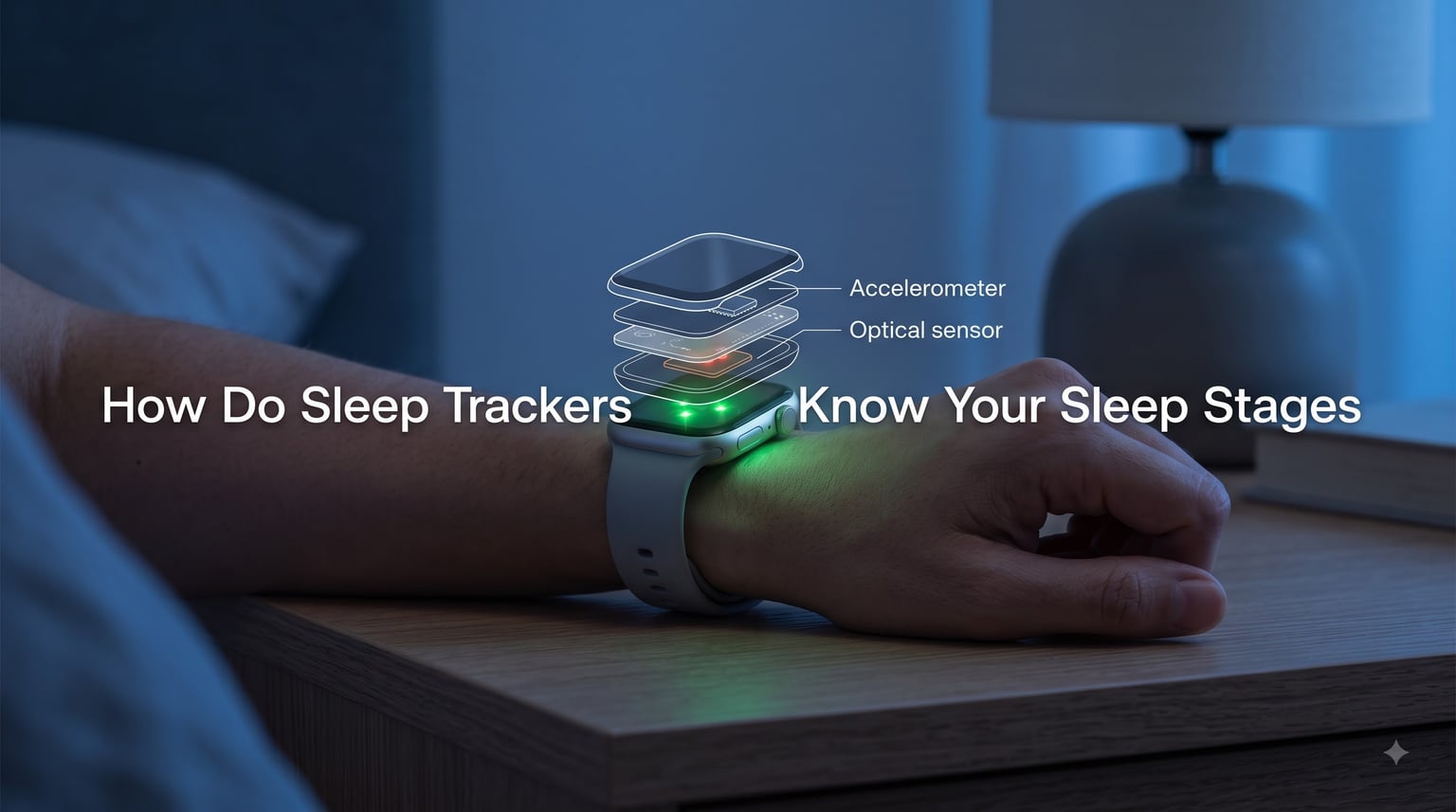
Your watch does not have a brain scanner strapped to your forehead, so how do sleep trackers know your sleep stages? After spending three months testing devices and digging into the research, I can give you a clear answer.
Sleep trackers estimate your sleep stages using a combination of three core technologies: an accelerometer that measures movement, an optical sensor using green light (called photoplethysmography, or PPG) that measures blood flow and heart rate, and software that analyzes heart rate variability (HRV). The device then runs that data through an algorithm trained to recognize the patterns linked to wake, light, deep, and REM sleep.
That is the short version. The longer version is genuinely fascinating, and it explains why your tracker can tell when you drifted off but still gets your deep sleep minutes wrong on a bad night. Let me walk you through exactly what each sensor does, how the algorithms work, and where the science runs out of road.
Table of Contents
What Are Sleep Stages and Why Trackers Try to Detect Them
Sleep is not one uniform state. Your brain cycles through distinct stages about every 90 minutes, and each stage looks different on a brain scan, a heart monitor, and an eye-tracker.
The two main families are NREM (non-rapid eye movement) sleep and REM (rapid eye movement) sleep. NREM is divided into three sub-stages: N1 and N2, which trackers usually group together as “light sleep,” and N3, which is “deep sleep” or slow-wave sleep. REM is the dream-heavy stage where your eyes move under your eyelids and your brain is almost as active as when you are awake.
Healthy adults spend roughly 50% of the night in light sleep, 13 to 23% in deep sleep, and 20 to 25% in REM. The remaining time is split between falling asleep and brief awakenings you usually do not remember.
Trackers care about these stages because they serve different restorative jobs. Deep sleep handles physical recovery, tissue repair, and immune function. REM sleep supports memory consolidation, emotional processing, and learning. Light sleep acts as the transition zone between them.
Gold-standard clinical sleep labs measure these stages with polysomnography (PSG), which uses EEG electrodes on your scalp, eye-movement sensors, muscle tone monitors, and a chest strap for heart activity. Your wrist-worn tracker has none of that, so it has to estimate. The way it estimates is the whole story.
How Accelerometers Detect Movement During Sleep
The oldest and simplest sensor in a sleep tracker is the accelerometer, a tiny motion detector that reports which direction your wrist is moving and how fast.
An accelerometer works using a small mass on a microscopic spring. When your wrist moves, the mass shifts. The distance and speed of that shift generate an electrical signal that the tracker turns into numbers like “moved at 0.3 m/s² along the x-axis.” Tens to hundreds of these data points arrive every second.
The classic approach uses a simple rule: lots of movement equals awake, very little movement equals asleep. That is how the first-generation actigraphy devices and even basic fitness bands decided whether you were sleeping at all.
Modern trackers go further. They look at the pattern of movement, not just the amount. A large, sustained burst of motion usually means you rolled over or got up. Tiny twitches at regular intervals may indicate the small muscle activations that occur during REM. The absence of motion over many minutes is a strong hint that you are in deep sleep, when your body is most physically still.
Motion alone cannot reliably distinguish light sleep from REM, because both are relatively still. That is why every modern sleep tracker (from Fitbit to Apple Watch to Oura) layers additional sensors on top of the accelerometer.
How PPG Heart Rate Sensors Work in Sleep Trackers
Flip over your watch or fitness band and you will see a cluster of small green LEDs pressed against your skin. Those LEDs are the heart of a measurement technique called photoplethysmography, or PPG.
PPG works by shining light into your skin and measuring how much of that light bounces back. Your blood absorbs more light than the surrounding tissue, so each time your heart pumps, a pulse of blood flows through the capillaries in your wrist, and the reflected light signal briefly dips. The sensor records this dip more than 100 times per second, and the time between dips is your heart rate.
Why green light? Green wavelengths sit in a sweet spot where they are absorbed strongly by red blood cells but also penetrate about 1 to 2 millimeters into the skin, deep enough to reach capillaries. Infrared light goes deeper but gives a weaker signal at the surface, while red light is good for spot readings but scatters too much for continuous use during sleep.
During sleep, PPG is actually easier than during the day. Your wrist is still, the watch is snug, and the surrounding light is consistent, so the tracker can lock onto a clean pulse signal and track heart rate continuously through the night.
From a continuous heart rate signal, the tracker derives several numbers used later in sleep staging: average beats per minute, the smallest and largest heart rate during the night, and most importantly, the time between individual beats.
Why Heart Rate Variability Signals Different Sleep Stages
Heart rate variability (HRV) is the millisecond-level variation in the time between consecutive heartbeats. Two people can both have a heart rate of 60 bpm, but if one has a steady spacing of exactly 1.000 seconds between beats and the other jumps between 0.900 and 1.100 seconds, their autonomic nervous systems are doing very different things.
This is the key insight that makes sleep staging possible. Your autonomic nervous system has two branches: the sympathetic (“fight or flight”) and the parasympathetic (“rest and digest”). During different sleep stages, these branches take turns dominating.
During deep sleep, the parasympathetic system runs the show. Your heart rate drops, your breathing slows, and the time between beats becomes regular and slightly longer. HRV rises but in a calm, low-frequency pattern.
During REM sleep, the situation flips. Your brain is highly active, your eyes dart under your lids, and your sympathetic nervous system revs up, even though your body is paralyzed. Heart rate climbs, becomes irregular, and HRV shifts toward a higher-frequency, less predictable pattern that looks similar to waking.
During light sleep, you sit somewhere in between, with autonomic activity that gradually shifts as you drift toward deeper stages or toward REM. By tracking how HRV and heart rate change over time, the tracker can infer which stage you are likely in.
This is also why trackers get confused when you wake up briefly but stay still. Your heart rate and HRV look almost identical to light sleep, and the algorithm has to guess.
How Algorithms Combine Sensor Data to Estimate Sleep Stages
Now we get to the part where the magic, and the guesswork, happens. Trackers follow a roughly four-step process to turn raw sensors into a sleep stage chart.
Step 1, epoch segmentation. The algorithm chops the night into 30-second chunks called epochs, the same length of time a clinician scoring a PSG study would use.
Step 2, feature extraction. For each epoch, it calculates a bundle of features: average heart rate, HRV metrics, movement intensity, breathing rate derived from the PPG signal, and sometimes skin temperature and ambient noise from a microphone.
Step 3, pattern matching. A pre-trained machine-learning model compares each epoch’s feature bundle against the patterns it learned from thousands of nights of paired tracker-plus-PSG data. The model assigns a probability that the epoch is wake, light, deep, or REM.
Step 4, smoothing. Because jumping straight from deep to wake to REM and back looks biologically impossible, the algorithm applies rules that force stage transitions to follow realistic sequences. A few minutes of “deep” surrounded by “light” usually gets reclassified as light sleep with a glitch.
This is different from how PSG works. PSG scores stages from EEG brain waves, which are the actual physiological signature of sleep. Your tracker is inferring stages from heart rate and movement, which are downstream effects of those brain states. The inference is usually good enough to spot trends across weeks, but it is not the same as measuring sleep directly.
Apple Watch uses a similar multi-sensor approach. Fitbit uses accelerometer plus PPG plus occasionally a microphone. Oura Ring relies on the same sensors but reads them from a finger, where blood flow is stronger. Garmin leans heavily on HRV and respiration from the optical sensor. Different brands, same underlying science.
Sleep Tracker Accuracy vs Clinical Polysomnography
Here is the honest number: peer-reviewed studies show consumer sleep trackers correctly identify the right sleep stage in about 53% to 60% of 30-second epochs when compared against polysomnography. That sounds low, but it is similar to the agreement between two human sleep technicians scoring the same PSG study, who usually agree on about 80% of epochs.
The accuracy is not even across stages. Trackers tend to be quite good at detecting sleep versus wake, often reaching 80% to 90% accuracy for that binary decision. They are moderate at detecting light sleep and REM. They are weakest at detecting deep sleep, often missing short deep sleep bouts and confusing them with light sleep.
There are good reasons for this. The deep sleep signature in heart rate and movement is subtle, deep sleep is shorter and less frequent than light sleep, and the algorithm has fewer examples to learn from. REM is also tricky because it can look like quiet wakefulness on a wrist sensor.
A 2023 study in the journal Sleep compared 11 consumer sleep trackers against PSG and found that no single device was clearly best across all stages. Some overestimated total sleep time, others underestimated deep sleep, and most had trouble on nights with fragmented sleep.
The bottom line: your tracker is a useful trend-spotting tool, not a clinical instrument. If you want to compare your sleep this week to last week, the data is reliable enough. If you want a diagnosis of sleep apnea or narcolepsy, you still need a proper sleep study.
Limitations: Skin Tone, Tattoos, and Placement Factors
PPG accuracy depends on how much light reaches your blood and bounces back. Anything that changes that path reduces signal quality.
Darker skin tones absorb more green light at the surface, which can lower the signal-to-noise ratio for some PPG sensors. Recent studies have shown that pulse oximeters, which use a similar technology, can overestimate oxygen levels in patients with darker skin, and researchers are now investigating whether the same applies to wrist PPG. If your night readings seem jumpy, this may be one factor.
Tattoos, especially dark ones, block the light entirely. A tattooed wrist can give your tracker almost no usable PPG signal, forcing it to fall back on accelerometer-only sleep detection, which is far less accurate.
Placement matters too. A watch worn too loosely slides around and loses skin contact. A ring worn on a cold finger constricts blood flow. Sleeping with your wrist under your pillow or twisted under your body cuts off the optical sensor.
Medications that affect heart rate (beta blockers, stimulants, some antidepressants) can distort the heart-rate-driven stage detection. So can alcohol, which suppresses REM sleep in ways the algorithm may not anticipate.
How to Read Your Sleep Tracker Data Wisely
Treat your tracker as a pattern spotter, not a score keeper. Trends over weeks tell you more than any single night. If your deep sleep is consistently low for a month, that is worth investigating. If it dips one night after a stressful day, that is just life.
Compare your stages to your behaviors. Did REM go up after you cut off screens an hour earlier? Did deep sleep drop when you drank wine with dinner? These are the questions your tracker can help answer.
Ignore the sleep score during weeks of illness, jet lag, or major life stress. The algorithm assumes a steady-state adult, and you are not one.
And if you suspect something serious, like loud snoring, gasping at night, or feeling exhausted despite long sleep, talk to a doctor. A consumer tracker is a starting point, not a substitute for a real sleep study.
Frequently Asked Questions About Sleep Tracking
Are sleep trackers actually accurate?
Consumer sleep trackers are 53% to 60% accurate at identifying the correct sleep stage in any given 30-second window compared with polysomnography. They are better at detecting sleep versus wake (80% to 90% accuracy) than at distinguishing deep from light sleep. They are reliable for spotting trends but not for clinical diagnosis.
How does a smartwatch know when you are in REM sleep?
During REM sleep, your heart rate rises and becomes irregular because your sympathetic nervous system activates. The watch’s PPG sensor detects these heart rate changes and the accelerometer notes the small muscle twitches that occur in REM. The algorithm matches these patterns to REM signatures learned from training data.
What does the green light on the back of my watch do?
The green LEDs are part of a photoplethysmography (PPG) sensor. They shine green light into your skin, and the sensor measures how much light bounces back. Each pulse of blood absorbs more light, so the reflected signal dips with every heartbeat This lets the watch track your heart rate continuously during sleep.
Is 40 minutes of deep sleep per night enough?
Most healthy adults get 60 to 110 minutes of deep sleep per night, so 40 minutes is on the low end. However, deep sleep needs vary by age, and individual genetics play a big role. If you feel rested and function well during the day, your deep sleep total is probably fine for you.
Final Thoughts on How Sleep Trackers Know Your Sleep Stages
Sleep trackers know your sleep stages by combining motion data from an accelerometer, heart rate data from a PPG optical sensor, and HRV analysis run through a machine-learning model trained on real sleep lab data. The science is real, but the result is an estimate, not a measurement.
Use your tracker to spot patterns, learn what helps your sleep, and stay curious about the science. If something feels off, trust your body and talk to a clinician. Your watch is a great starting point, but it is not the final word.