
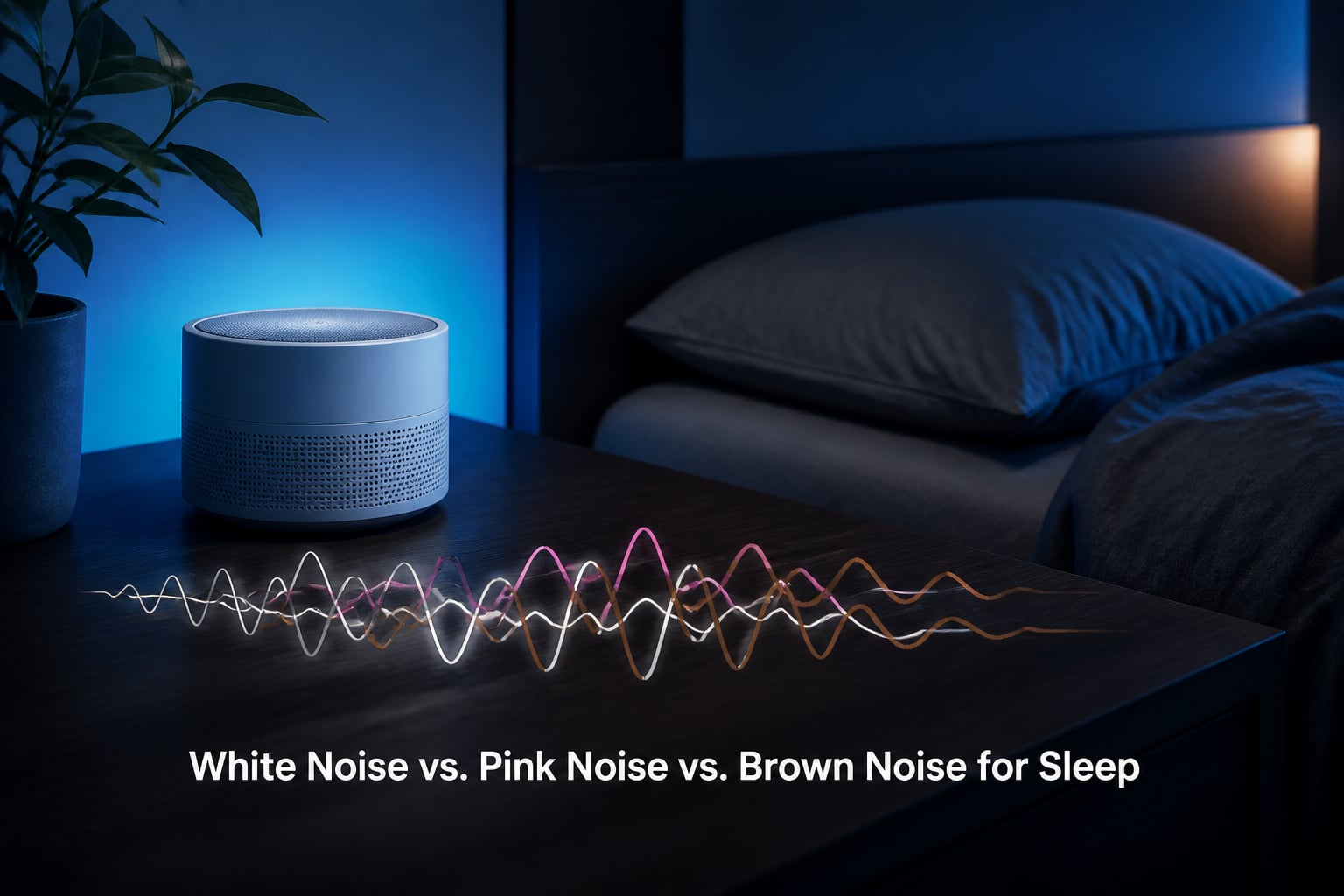
If you have ever stared at the ceiling at 3 a.m. while a dog barks three houses down, you already know why people turn to sound for sleep. The right kind of background noise can mask those jarring interruptions and help your brain settle. But when you start exploring options, you run into a confusing question: white noise vs. pink noise vs. brown noise for sleep, which one actually works?
Our team spent weeks digging through sleep research, Reddit threads, and expert recommendations to break down the differences. Each type of colored noise has its own frequency pattern, its own sound character, and its own group of devoted fans. The right pick depends on how your brain responds to sound, what kind of noise you are trying to block, and your personal comfort.
In this guide, you will learn exactly what white, pink, and brown noise are, how each one affects sleep, and which type fits your specific situation. We will also cover volume safety, because blasting any sound too loud all night can damage your hearing over time. By the end, you will have a clear answer for your own sleep setup.
Table of Contents
What Is Colored Noise?
Colored noise refers to sound signals that contain many frequencies at once, but with different levels of intensity across the frequency spectrum. The “color” metaphor comes from how white light contains all visible colors mixed together. Just as a prism can split white light into a rainbow, you can think of noise as having different shades based on which frequencies dominate.
All sound travels in waves measured in hertz (Hz), and humans can hear frequencies from about 20 Hz to 20,000 Hz. White noise distributes equal power across all those audible frequencies. Pink and brown noise progressively reduce the higher frequencies, which changes how each one sounds to your ear.
So why does this matter for sleep? Your brain does not process all frequencies equally. High-frequency sounds tend to feel more alerting and even irritating, while low-frequency sounds feel calmer and more grounding. That is why a deep rumble feels soothing but a high-pitched beep feels alarming. The color of noise you choose shifts where the acoustic energy sits, and that shift changes how relaxed or focused you feel.
Think of colored noise as a sound blanket. It fills the quiet gaps in your room so sudden noises, like a slamming door or a snoring partner, do not stand out against silence. The question is which thickness and texture of blanket works best for your brain.
White Noise for Sleep: The Classic Sound Masker
White noise contains every audible frequency from 20 Hz to 20,000 Hz played at equal intensity. That even distribution makes it the most aggressive sound masker of the three colors. If you need to completely drown out a noisy environment, white noise does the heaviest lifting.
To your ear, white noise sounds like TV or radio static, a hissing air compressor, or the steady roar of an airplane cabin. It is bright, intense, and continuous. Many people describe it as harsh or grating, especially at higher volumes, and some find it actually keeps them awake rather than helping them drift off.
Where white noise shines is sound masking. Because it fills every frequency band evenly, sudden sounds across the spectrum have a harder time breaking through. This makes it popular for people in noisy apartments, parents trying to mask household sounds for a sleeping baby, or anyone dealing with loud neighbors and traffic.
White noise has been used for decades in sleep studies and clinical settings. Research suggests it can help shorten the time it takes to fall asleep, particularly for people in noisy hospital environments. However, more recent studies have started to question whether white noise is truly the best option, since the high-frequency content may be stimulating for some sleepers.
Here is what Reddit users consistently report: white noise works great for blocking sounds but takes getting used to. People who grew up with a fan running in their bedroom tend to find white noise comforting. Those sensitive to high-pitched sounds often find it unbearable.
Best for: People in loud environments, apartment dwellers, parents masking household noise, and anyone who already finds fan sounds or static soothing.
Drawbacks: The high-frequency content can feel harsh, grating, or even anxiety-inducing for some listeners. It may be too intense for people with misophonia or sound sensitivity.
Pink Noise for Sleep: The Balanced Sound
Pink noise takes white noise and reduces the higher frequencies while keeping the lower ones more prominent. Technically, the power decreases by 3 decibels per octave as frequency increases. The result is a sound that feels more balanced and natural to the human ear.
If white noise sounds like static, pink noise sounds like steady rainfall, leaves rustling in wind, or waves rolling onto a beach. It has a softer, warmer character that most people find immediately pleasant. This is why many sleep apps and sound machines default to pink noise or pink-noise-based presets.
The science behind pink noise and sleep is promising. A 2017 study published in Frontiers in Human Neuroscience found that pink noise synced to brainwave patterns during slow-wave sleep improved memory consolidation in older adults. Other research suggests pink noise may help people fall asleep faster and spend more time in deep, restorative sleep stages.
Pink noise works for sleep because it provides solid sound masking without the harsh edge of white noise. It fills enough of the frequency spectrum to cover sudden noises, but the reduced highs make it feel calmer and less fatiguing over an entire night. For light sleepers who find white noise too aggressive, pink noise is often the sweet spot.
Forum discussions back this up. Many users on Reddit’s sleep and ADHD communities say pink noise is their go-to because it masks well without feeling intrusive. People who tried white noise and hated it often switch to pink and never look back.
Best for: Light sleepers, people who find white noise too harsh, those who enjoy nature sounds like rain or wind, and anyone looking for a balance between masking power and comfort.
Drawbacks: Because the higher frequencies are reduced, pink noise may not mask sharp, high-pitched sounds as effectively as white noise. A smoke alarm beep or a dog whistle might still cut through.
Brown Noise for Sleep: The Deep Rumble
Brown noise, sometimes called red noise, emphasizes low frequencies even more aggressively than pink noise. The power drops by 6 decibels per octave as frequency rises. This creates a deep, bass-heavy rumble that sounds like a distant waterfall, ocean currents, or low thunder.
To picture the sound, imagine standing near a large waterfall or feeling the low rumble of a heavy truck idling outside. Brown noise has almost no high-frequency content, which gives it a warm, enveloping quality. Many people describe it as feeling like a weighted blanket for your ears.
Brown noise surged in popularity on social media in 2022 and 2023, particularly among people with ADHD. The deep, steady rumble seems to help quiet racing thoughts without demanding attention. Many users in Reddit’s ADHD communities report that brown noise helps them focus during the day and wind down at night in a way white and pink noise never could.
For sleep, brown noise excels at creating a cocoon of low-frequency sound that feels grounding and calming. People with anxiety, racing minds, or sensory processing sensitivities often find it the most relaxing of the three. The deep frequencies seem to encourage a settled, drowsy state rather than alertness.
However, brown noise has limitations for sound masking. Because it concentrates energy in the low frequencies, it may not block high-pitched sounds well at all. If your sleep problem is a neighbor’s alarm clock or a crying baby, brown noise alone might not cover those sharp sounds.
Some users also find brown noise too rumbly or even physically uncomfortable at higher volumes. The deep bass can feel heavy or oppressive, particularly on high-quality speakers or subwoofers. Starting at a low volume and adjusting is the way to go.
Best for: People with ADHD or racing thoughts, anxiety sufferers, those who enjoy deep bass sounds, and anyone who finds both white and pink noise too bright.
Drawbacks: Weak at masking high-frequency sounds, can feel too bass-heavy for some, and the deep rumble may be uncomfortable on speakers with strong low-end output.
White Noise vs. Pink Noise vs. Brown Noise for Sleep: Direct Comparison
The question we hear most is simple: which color noise is most effective for sleep? The honest answer is that it depends on your specific situation. Each type has distinct strengths, and the best choice depends on what problem you are trying to solve.
Here is how the three compare across the categories that matter most for sleep:
Sound character: White noise is bright static, pink noise is balanced like rainfall, brown noise is a deep rumble like a waterfall.
Masking power: White noise masks the widest range of frequencies. Pink noise covers most sounds but loses some highs. Brown noise is weakest for sharp, high-pitched sounds.
Comfort level: Brown noise is generally the most soothing. Pink noise is comfortable for most people. White noise can be harsh and takes adjustment.
Sleep research: Pink noise has the strongest emerging evidence for improving deep sleep and memory. White noise has older studies supporting it. Brown noise research is still limited but growing.
For ADHD and focus: Brown noise is the community favorite. Pink noise helps some users. White noise can be too distracting.
For anxiety: Brown noise tends to win for calming racing thoughts. Pink noise is a close second.
For blocking loud environmental noise, white noise is usually the strongest choice. For improving sleep quality and comfort, pink noise has the best combination of evidence and listener preference. For quieting a racing mind or sensory overload, brown noise is the go-to.
Personal preference varies significantly, and there is no universal winner. The Reddit users we surveyed overwhelmingly said the same thing: try each one for a few nights and pay attention to how you feel in the morning. Your brain will tell you which one works.
Quick Decision Guide by Use Case
You live in a noisy apartment: Start with white noise for maximum masking.
You are a light sleeper who finds static annoying: Try pink noise.
You have ADHD or racing thoughts at night: Brown noise is worth a serious try.
You want something that feels natural: Pink noise mimics rain and wind.
You need help for a baby’s room: White noise is the traditional choice and has the longest track record with infants.
You have anxiety or stress: Brown noise’s deep rumble tends to be the most calming.
You have tinnitus: White noise is commonly recommended by audiologists for masking ringing.
How Loud Should Color Noise Be? Volume Safety Guidelines
This section matters more than most people realize. Listening to any sound all night at the wrong volume can cause hearing damage over time. The general rule from audiologists and sleep specialists is to keep your color noise below 60 decibels (dBA), and ideally between 40 and 50 dBA for overnight use.
For reference, 60 dBA is about the level of normal conversation. A sound machine on a medium setting usually lands in this range. Anything above 70 dBA sustained over long periods begins to risk cumulative hearing damage, especially for infants and young children whose ears are more sensitive.
Here is how to find a safe, effective volume. Start with the sound low enough that it is just barely audible from your pillow. Slowly raise it until sudden background noises are masked but the colored noise itself does not feel intrusive. If you wake up with your ears ringing or feeling full, your volume is too high.
If you use a phone app or speaker right next to your bed, measure the output with a free decibel meter app. Place your phone where your head rests on the pillow and check the reading. Aim for 45 to 50 dBA at that distance for adults, and 50 dBA maximum for a nursery.
One more safety note: taking breaks helps. If you listen to color noise every night, consider nights off or lower volumes to give your auditory system a rest. There is no evidence that moderate levels of colored noise cause harm, but researchers are still studying the long-term effects of continuous overnight exposure.
FAQs
Which color noise is most effective for sleep?
Pink noise currently has the strongest scientific backing for sleep improvement, with studies showing it can enhance deep sleep and memory consolidation. However, effectiveness is highly individual. Light sleepers often prefer pink noise, people in noisy environments benefit most from white noise, and those with racing thoughts or anxiety frequently find brown noise the most calming. Try each for a few nights to find your best match.
What is the healthiest sound to sleep to?
The healthiest sleep sound is one that masks disruptive noises without being too loud or stimulating. Pink noise, steady rainfall, and gentle ocean waves are widely recommended because they feel natural and sit in a comfortable frequency range. Keep volume below 60 dBA and avoid anything that feels harsh or grating to your ears.
Is it bad to sleep with brown noise every night?
There is no evidence that sleeping with brown noise at a moderate volume is harmful. As long as you keep the volume below 60 dBA and take occasional breaks, nightly use appears safe. If you wake up with ear fatigue or ringing, lower the volume or skip a night. Researchers are still studying very long-term nightly exposure.
Is it better to sleep with white noise or brown noise?
It depends on your needs. White noise is better for masking a wide range of sounds, especially in noisy environments. Brown noise is better for calming racing thoughts and feels less harsh. If you find white noise grating, brown noise is the better choice. If you need maximum sound blocking, white noise wins.
Finding Your Best Sleep Sound
When it comes to white noise vs. pink noise vs. brown noise for sleep, there is no single winner. White noise offers the strongest sound masking for noisy environments. Pink noise delivers the best balance of comfort, masking, and research-backed sleep benefits. Brown noise provides a deep, calming rumble that quiets racing minds and eases anxiety.
Our recommendation is to spend three nights with each type before deciding. Use the same volume level, the same speaker or headphones, and the same sleep environment. Note how quickly you fall asleep, how often you wake during the night, and how rested you feel each morning. Your own experience is more reliable than any general guideline.
Remember to keep your volume under 60 dBA, take occasional breaks, and trust what your ears and body tell you. The best sleep sound is the one that helps you drift off, stay asleep, and wake up refreshed. Everything else is just noise.