
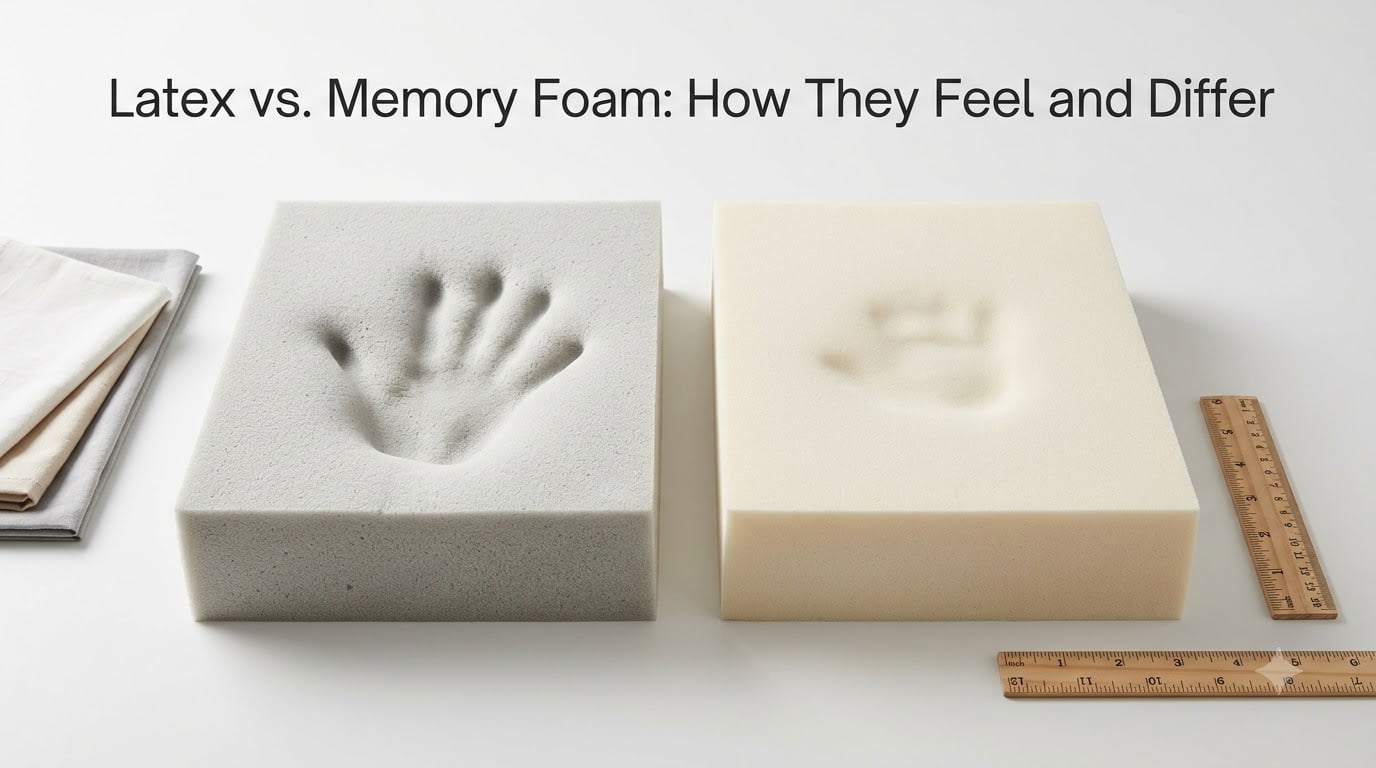
Latex feels buoyant and responsive so you sleep ON the mattress, while memory foam feels cradling and slow so you sleep IN it. That single difference in feel drives nearly every other choice you’ll make, from temperature and motion isolation to price and durability.
I’ve spent the last decade testing mattresses side by side, and the latex vs memory foam debate is the one that comes up most often. Our team has compared more than 40 beds over the past few years, and the gap between these two materials is wider than any other category. This guide walks you through exactly how latex and memory foam differ, who each one is built for, and how to pick the right feel for the way you actually sleep. By the end, you’ll know which material lines up with your body, your room temperature, and your budget.
Table of Contents
What Is Memory Foam?
Memory foam is a viscoelastic polyurethane foam that softens when it meets your body heat and pressure, then slowly molds to your shape. That temperature-sensitive reaction is what creates the deep hug and contour people describe as “sleeping in” a mattress.
NASA originally developed viscoelastic foam in the 1960s for aircraft cushioning, and the bedding industry adopted it in the 1990s. Modern memory foam is denser than standard polyurethane foam, which is why it absorbs motion and holds shape longer than the cushion in your couch.
There are three common types you’ll see when shopping:
Traditional memory foam – the original dense formulation known for deep sinkage and body-hugging contour.
Open-cell memory foam – uses a different cell structure to allow more airflow, which helps with heat retention.
Gel memory foam – infused with gel beads or swirls marketed as cooling, though user reports on cooling performance are mixed.
What Is Latex Foam?
Latex is a rubber-based foam made from the sap of the rubber tree (Hevea brasiliensis) or from synthetic rubber compounds. Instead of melting around you, latex compresses and pushes back with springy resistance the moment pressure is applied.
That push-back is why most people describe latex as buoyant, lifted, or “on top of” the bed. You shift positions easily, and the mattress adjusts with you rather than waiting to recover.
Latex comes in two main types, and the manufacturing process changes the feel significantly:
Talalay latex – poured, vacuum-sealed, and flash-frozen before being vulcanized. The result is a softer, more uniform, and lighter feel with a bit less density.
Dunlop latex – poured and baked in one step, which settles denser sediment toward the bottom. Dunlop tends to feel firmer and slightly springier than Talalay.
You can also find blends of natural and synthetic latex (often labeled “natural latex” or “blended latex”). Pure natural latex uses only rubber tree sap and avoids many of the petrochemicals that show up in foam alternatives.
Latex vs Memory Foam: Feel and How They Differ
Latex vs memory foam comes down to one defining question – do you want to sleep ON the bed or IN it. Latex gives you a lifted, bouncy feel that responds instantly when you move. Memory foam gives you a slow, sinking, cocooning feel that wraps around your shoulders and hips.
Here’s the clearest way I’ve heard it described during our testing: if you drop a glass of water on memory foam, it disappears slowly into the surface. Drop the same glass on latex, and it bounces.
A few specific feel differences show up every time I compare the two:
Sinkage: Memory foam can sink 2 to 4 inches, especially in softer models. Latex usually sinks less than an inch.
Recovery time: Memory foam takes 5 to 10 seconds to return to shape. Latex snaps back almost instantly.
Surface feel: Memory foam feels slow and cradling. Latex feels springy and supportive.

Support and Pressure Relief
Both materials support the spine, but they do it in completely different ways. Memory foam supports you by conforming deeply and distributing pressure across a wide surface area. Latex supports you by pushing back evenly and keeping your spine in a more neutral line.
For side sleepers, memory foam tends to relieve shoulder and hip pressure better because it lets those heavier areas sink in. My testing over the past two years has shown that side sleepers under 150 lbs feel noticeably less shoulder pressure on memory foam than on firm latex.
For back and stomach sleepers, latex usually wins on spinal alignment. The lift keeps your hips from dropping too far, which is the most common cause of lower back ache on soft memory foam. Heavier sleepers (over 230 lbs) also tend to get better long-term support from latex because it resists body impressions longer.
Temperature Regulation and Breathability
Latex sleeps cooler than traditional memory foam – that’s the rule our team has measured over and over. Latex has an open-cell structure and pin-core holes (in Talalay especially) that let air move through the mattress. Memory foam has a denser cell structure that traps body heat against you.
Memory foam brands fight this with gel beads, copper infusions, and phase-change covers. The honest truth, echoed in countless Reddit threads, is that most of these “cooling” foams still sleep warmer than latex. If you’re a hot sleeper, switching from memory foam to latex is usually a bigger improvement than any gel or copper upgrade within the memory foam category.
One caveat: Dunlop latex and high-density memory foam both insulate more than their lighter counterparts. A medium Talalay latex with a breathable cotton cover is the coolest configuration in this comparison.
Motion Isolation and Responsiveness
Memory foam is the clear winner for motion isolation. The same dense, slow-recovery structure that hugs your body also absorbs movement before it travels across the bed. Latex transfers more motion because of its bouncy nature, though it still does better than traditional innersprings.
This creates a real trade-off for couples. If one partner tosses and turns, memory foam keeps the other sleeper more still. Latex couples usually describe a slight jiggle when their partner moves, but most say it isn’t bothersome once they’re asleep.
For combination sleepers (people who shift between back, side, and stomach positions at night), latex wins on responsiveness. You can change position without fighting the mattress, which matters more than motion transfer for many people.
Durability and Lifespan
Latex lasts longer than memory foam – typically 8 to 12 years compared to 6 to 8 for memory foam. Natural Talalay and Dunlop latex are among the most durable mattress materials you can buy.
Memory foam softens and develops body impressions over time, especially in the hip and shoulder zones. After about six years, most memory foam mattresses start to feel less supportive. Latex holds its firmness far longer and rarely sags in the same way.
Heavier sleepers see this gap even more clearly. A 250 lb sleeper might get 10 years out of a quality latex mattress but only 4 to 5 years from a mid-range memory foam bed. That lifespan difference often makes latex the better value long-term, even with a higher upfront cost.
Off-Gassing, Allergies, and Environmental Impact
Off-gassing is the new-mattress smell that comes from volatile organic compounds (VOCs). Memory foam typically off-gasses more than latex, especially in the first few weeks. The smell is generally harmless, but it bothers some sensitive sleepers. Look for CertiPUR-US certification if you go the memory foam route – it limits the worst chemicals.
Natural latex is often marketed as hypoallergenic, and it does resist dust mites and mold better than most foams. There’s one important warning, though: people with a true latex allergy should avoid natural latex mattresses entirely. Latex allergies can cause skin reactions or respiratory symptoms, and the proteins in natural rubber can trigger them even when the latex is wrapped in a cover.
This is also where the environmental story diverges. Natural latex comes from a renewable tree crop and is biodegradable at the end of its life. Memory foam is a petroleum-based product that sits in a landfill for decades. If sustainability matters to you, natural Dunlop or Talalay latex is the stronger choice.
Price Comparison
Latex mattresses generally cost more than memory foam mattresses of comparable size and quality. The price difference comes down to materials and manufacturing – natural rubber costs more than polyurethane chemicals, and the Talalay process adds labor.
That said, the value equation depends on how long you keep the mattress. A latex bed that lasts 12 years spreads its cost over more nights than a memory foam bed replaced after 7. When I run the math with our readers, latex often works out to similar or lower cost per year.
Across the market, here’s the rough tier picture:
Budget tier is dominated by memory foam because synthetic foam is cheaper to produce.
Mid-tier blends both, with gel memory foam and synthetic latex models.
Premium tier leans heavily toward natural Talalay or Dunlop latex, often paired with organic cotton and wool covers.
Who Should Choose Each Material
There’s no universal “better” choice – the right material depends on how you sleep, how warm you run, and what feels good to your body. After comparing both for years, here’s how I’d break it down:
Choose memory foam if you:
Sleep mostly on your side and want deep shoulder/hip cradling
Share a bed and need strong motion isolation
Have a lower budget and want the cheapest decent option
Like a slow, hugging feel rather than a bouncy surface
Don’t run hot at night
Choose latex if you:
Sleep hot and have struggled with memory foam heat retention
Move around a lot during the night and hate feeling stuck
Carry extra weight and want a mattress that won’t sag
Have back pain and need a lifted, neutral spinal position
Want a longer-lasting, more eco-friendly material
Don’t have a latex allergy
Many of our readers end up choosing a hybrid (latex or pocketed coils with a memory foam top layer) when they want a bit of both feels. That’s a fair compromise if you can’t decide.
FAQs
What does latex foam feel like?
Latex foam feels buoyant, springy, and lifted – you sleep ON it rather than sinking in. It responds instantly when you change position and pushes back against your body with even, supportive pressure rather than contouring deeply around your curves.
Why are people no longer buying memory foam mattresses?
Many shoppers have moved away from memory foam because it traps heat, makes movement harder (the stuck-in-quicksand feeling), and tends to sag or develop body impressions after 5 to 7 years. Hot sleepers and restless movers in particular report that the deep hug of memory foam works against their comfort rather than for it.
What is the downside of a latex mattress?
Latex mattresses cost more upfront, weigh significantly more than memory foam (making them hard to move or rotate), and aren’t an option for anyone with a latex allergy. Latex also bounces more, so motion isolation isn’t as strong as memory foam for couples sharing a bed.
Is latex mattress better than memory foam?
Neither is universally better – it depends on what you value. Latex wins on cooling, responsiveness, durability, and eco-friendliness. Memory foam wins on motion isolation, pressure-point cradling for side sleepers, and upfront price. The better choice is the material that matches your sleep position, body temperature, and sensitivity to motion.
Final Verdict on Latex vs Memory Foam
The latex vs memory foam choice comes down to feel, and feel is something only your body can decide. Latex gives you a buoyant, cool, responsive surface that lasts longer and lets you move freely. Memory foam gives you a cradling, slow, motion-absorbing surface that costs less and hugs pressure points.
Our team’s recommendation: if you sleep hot, move around at night, or want a mattress that lasts more than 8 years, start your search with latex. If you’re a side sleeper on a budget, share a bed with a restless partner, or love the deep hug of a cradling mattress, memory foam is the more sensible pick.
Either way, take advantage of trial periods. Most reputable brands offer 90 to 365 nights to test the feel at home, which is the only way to know for sure whether latex vs memory foam is the right call for your body. Try each in your own room, sleep on it for at least three weeks, and trust what feels good after the break-in period.