
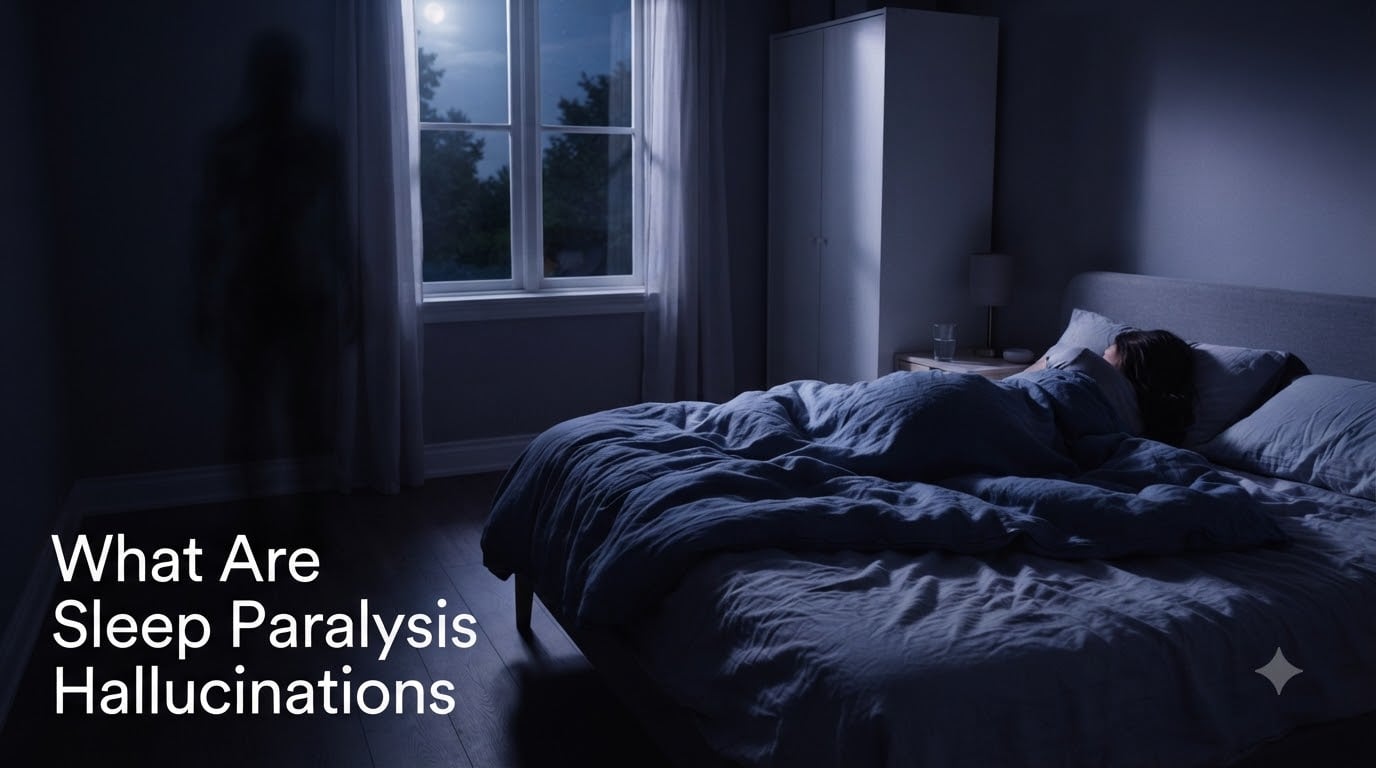
Sleep paralysis hallucinations are vivid, often frightening sensory experiences that happen when your mind wakes up but your body remains temporarily paralyzed during REM sleep. You become aware while still trapped in the dream state, so dream imagery appears as real sights, sounds, touches, and movement sensations layered over your actual bedroom. In this guide, I walk you through exactly what these hallucinations are, the three main types, why they happen, and what you can do to stop them.
I have spent weeks reading sleep researchers, clinician guides, and thousands of forum posts from people who live with these episodes. The goal here is simple: turn a terrifying experience into something you understand and can manage.
Table of Contents
What Are Sleep Paralysis Hallucinations?
Sleep paralysis hallucinations are the sensory experiences that occur during an episode of sleep paralysis, a state in which you are conscious but unable to move your body. The experience is classified as a parasomnia, an unwanted event that happens while you are falling asleep, sleeping, or waking up.
During REM sleep, your brain normally paralyzes your muscles to stop you from acting out your dreams. This natural muscle paralysis is called REM atonia. In sleep paralysis, your mind wakes up before the atonia switches off, leaving you consciously aware inside a body that will not respond.
Because your brain is still partly in REM, the dream imagery, sounds, and physical sensations of that stage spill into your waking awareness. Result: you see, hear, or feel things that are not physically there, even though your eyes are open and your room is exactly as you left it.
Yes, it is possible to have sleep paralysis without hallucinations. Some people only experience the inability to move and a vague sense of pressure, with no vivid imagery at all. The hallucinations are the most reported component, but they are not required for a diagnosis.
The Three Types of Sleep Paralysis Hallucinations
Researchers, most notably Baland Jalal and colleagues at Harvard, have grouped sleep paralysis hallucinations into three distinct categories. Each type maps to a different part of the brain that remains active during the episode.
Intruder Hallucinations
Intruder hallucinations involve a sudden sense of a threatening presence in the room. You may hear footsteps, the door creaking, breathing, or feel that someone is standing right next to the bed. Visually, this often appears as a shadow figure, a dark human-shaped silhouette, or what people commonly call the sleep paralysis demon.
Many people describe seeing a dark figure at the foot of the bed or in the doorway. Others report feeling touched, having their arm pulled, or sensing something sit on their chest. Everything feels completely real, which is what makes these episodes so distressing.
Chest Pressure Hallucinations
Chest pressure hallucinations, sometimes called incubus attacks, make you feel like something heavy is sitting on your chest, smothering you, or pressing down on your throat. You may feel you cannot breathe, even though your lungs are working normally.
This sensation is intensified by the physical paralysis. Your chest muscles are temporarily locked by REM atonia, so each breath feels shallow and difficult. The brain interprets this restricted breathing as external pressure, and dream imagery layers on top to complete the illusion.
Vestibular-Motor Hallucinations
Vestibular-motor hallucinations create out-of-body sensations. You may feel like you are floating above your bed, falling, spinning, or flying. Some people report feeling their body shift, roll, or levitate while the room stays still.
These hallucinations explain the long history of so-called astral projection and out-of-body experiences. They are thought to come from the brain’s vestibular system, which controls balance and spatial awareness, mixing dream data with conscious awareness.
Why Sleep Paralysis Hallucinations Happen
Sleep paralysis hallucinations are not random. They are the predictable result of two parts of your brain getting out of sync: the system that keeps you paralyzed during REM and the system that controls your conscious awareness.
The Role of REM Atonia
REM atonia is the natural paralysis of your major muscle groups that occurs during REM sleep. It is a safety feature that prevents you from physically acting out your dreams. When you wake up, the brain releases a set of neurotransmitters that switch off this paralysis.
Sometimes this switch is delayed. Your awareness returns first, but the chemical signal to unlock your muscles has not arrived yet. You are awake, your eyes are open, and you are still locked in.
Brain State Mismatch
Your brain is not fully in one state. The prefrontal cortex, the part responsible for logical thinking, is sluggish. The amygdala, the fear center, is in overdrive. The visual system is still generating dream imagery.
This mix is why hallucinations during sleep paralysis are so vivid and so scary. You cannot reason your way out of them in the moment because the part of your brain that says “this is fake” is offline. The amygdala fills the gap with fear, which is why nearly every episode feels terrifying.
How Long Sleep Paralysis Episodes Last and What They Feel Like
Most sleep paralysis episodes last between a few seconds and 2 minutes, though subjective experience can stretch them out so much that they feel like 10 minutes or longer. Once the atonia lifts, you can move again immediately.
During an episode, the sensory experience often follows a predictable pattern. First, you may notice an inability to move. Then a sense of presence or pressure develops. Visual hallucinations come next, often a shadow figure or distorted room. Sound is layered on, such as buzzing, whispers, or footsteps. Finally, you snap out of it, sometimes with a jolt, gasp, or sudden full-body twitch.
One user on Reddit’s r/Sleepparalysis described it this way: “I see a tall shadow man in the corner, the walls start breathing, and I can hear my own name being whispered. I know none of it is real, but my body refuses to move.” This combination of knowing and being unable to act is what makes episodes so uniquely distressing.
Sleep Paralysis Hallucinations vs Normal Dreams
Normal dreams happen entirely during REM sleep while you are unconscious. You cannot consciously observe them, and you almost never remember them as being “real” while they happen, even during lucid dreams.
Sleep paralysis hallucinations are different because you are semiconscious or fully conscious while they occur. You see your real bedroom. You see the dream figure standing in your real doorway. You feel your real blanket on your legs while a dream weight presses on your chest. The hallucination is overlaid on reality, not replacing it.
That overlap is what makes these experiences so much more frightening than an ordinary nightmare. You wake up inside the dream rather than waking up from it.
Who Experiences Sleep Paralysis Hallucinations?
About 8% of people experience sleep paralysis at some point, and roughly 30% of those report clear hallucinations. Episodes are most common in people aged 20 to 40, but they can occur at any age.
Risk Factors and Triggers
Several factors raise the odds of having an episode. Sleep deprivation is the single biggest trigger. Irregular sleep schedules, jet lag, and shift work all increase frequency. Stress and anxiety are close behind.
Sleep position matters too. More than 60% of episodes happen when sleeping on your back, a finding replicated in multiple studies. Sleep disorders like narcolepsy, obstructive sleep apnea, and anxiety disorders including PTSD are strongly linked to recurring episodes.
Other reported triggers include caffeine late in the day, sleeping in a new environment, and going to bed with a full or empty stomach. Identifying your personal trigger is one of the most useful things you can do.
Cultural and Historical Perspectives on Sleep Paralysis
Sleep paralysis hallucinations are not a modern phenomenon. They appear in folklore across nearly every culture, usually as a malevolent nighttime visitor.
In Newfoundland, the “Old Hag” sits on the sleeper’s chest. In Japanese tradition, the “Kanashibari” binds the sleeper in place. In Middle Eastern cultures, the “Jinn” visits at night. In Turkish and Persian folklore, “Karabasan” (the dark presser) smothers the sleeper. European folklore gave us the incubus and succubus.
What is striking is how consistent the descriptions are. Across continents and centuries, people describe the same three elements: a presence, chest pressure, and the inability to move. This consistency is itself evidence that the experience is neurological, not supernatural.
How to Stop and Prevent Sleep Paralysis Hallucinations
Treating sleep paralysis hallucinations has two parts: managing the episode as it happens and reducing the chance of future episodes. Both work best when combined.
Stopping an Episode in the Moment
The first rule is to remind yourself, even mid-episode, that the experience is not dangerous. You are not dying, you are not being attacked, and you will wake up fully in seconds.
Try to move a small part of your body first. Wiggling a toe, twisting a finger, or coughing can break the paralysis faster than trying to move everything at once. Some people find that focusing on moving their eyes side-to-side helps. Others force themselves to attempt a grimace or a small exhale.
Many sufferers report that the episode ends more quickly if they resist the urge to fight. Mental acceptance, even just acknowledging “this is happening again,” can shorten the duration and reduce fear.
Long-Term Prevention Strategies
Consistent sleep is the foundation. Going to bed and waking up at the same time every day, including weekends, reduces episodes dramatically in most people. Aim for 7 to 9 hours of sleep.
Practice good sleep hygiene. Keep your bedroom cool, dark, and quiet. Avoid screens for the hour before bed. Skip caffeine after early afternoon and alcohol close to bedtime. If you snore heavily or wake gasping, ask a doctor about sleep apnea.
Manage stress through daily exercise, breathing exercises, or brief meditation. Many people find that journaling before bed reduces the frequency of episodes, especially during stressful life periods.
For recurring episodes, cognitive-behavioral therapy for sleep paralysis (CBT-SP) has shown strong results. It teaches you to reframe the experience as harmless, which reduces the fear response that often extends episodes and feeds recurring ones.
When to See a Doctor About Sleep Paralysis Hallucinations
Isolated sleep paralysis episodes are not dangerous and do not require medical treatment. However, you should see a doctor if episodes happen more than once a week, if they cause severe anxiety, if you fall asleep suddenly during the day, or if you have ongoing sleep problems.
Frequent episodes can be a symptom of narcolepsy, which requires a sleep study (polysomnography) and a multiple sleep latency test to diagnose. Your doctor may also screen for anxiety disorders, PTSD, and sleep apnea, all of which can drive recurring episodes.
A sleep specialist can also prescribe short-term medication in severe cases, though lifestyle changes are usually enough for most people.
FAQs
Is it normal to hear ringing in your ears during sleep paralysis?
Yes, ringing, buzzing, humming, or high-pitched tones are common auditory hallucinations during sleep paralysis. They happen because the auditory cortex is still active in REM while you are conscious, so dream sounds mix with real silence. The ringing is harmless and ends when the episode does.
Is it normal to feel someone touching me when you have sleep paralysis?
Yes, tactile hallucinations are part of the intruder category. Feeling a hand on your chest, fingers on your arm, or someone sitting on the bed is a well-documented part of sleep paralysis. The sensation comes from REM-related body-map signals mixing with conscious awareness, not from any real contact.
What is the spiritual meaning of sleep paralysis?
Cultures worldwide have interpreted sleep paralysis as spiritual for centuries. The Old Hag, Jinn, Kanashibari, and incubus traditions all describe the same three elements: a presence, chest pressure, and inability to move. Modern neuroscience explains these as intruder, chest pressure, and vestibular-motor hallucinations caused by REM atonia persisting into wakefulness. The spiritual meaning is cultural, while the experience itself is neurological.
Is it possible to have sleep paralysis without experiencing hallucinations?
Yes. Sleep paralysis is defined by the inability to move while conscious, not by hallucinations. Some people only experience the paralysis and a vague pressure or presence, with no vivid visual, auditory, or tactile imagery. Hallucinations are the most reported component but are not required for an episode.
Sleep paralysis hallucinations are one of the most vivid experiences the human brain can produce while you are still conscious. They feel dangerous, but they are not. They are a small mismatch between REM atonia and wakefulness, layered with the dream imagery that REM normally gives you.
If you take one thing from this guide, let it be this: the shadow figure, the chest pressure, the floating sensation, and the whispers are all explainable. They are your brain doing exactly what it does during REM, just while your eyes are open. With consistent sleep, stress management, and a few anchoring techniques, most people see episodes drop in frequency or stop entirely. If they do not, a sleep specialist can help you rule out narcolepsy, sleep apnea, and other treatable conditions.