
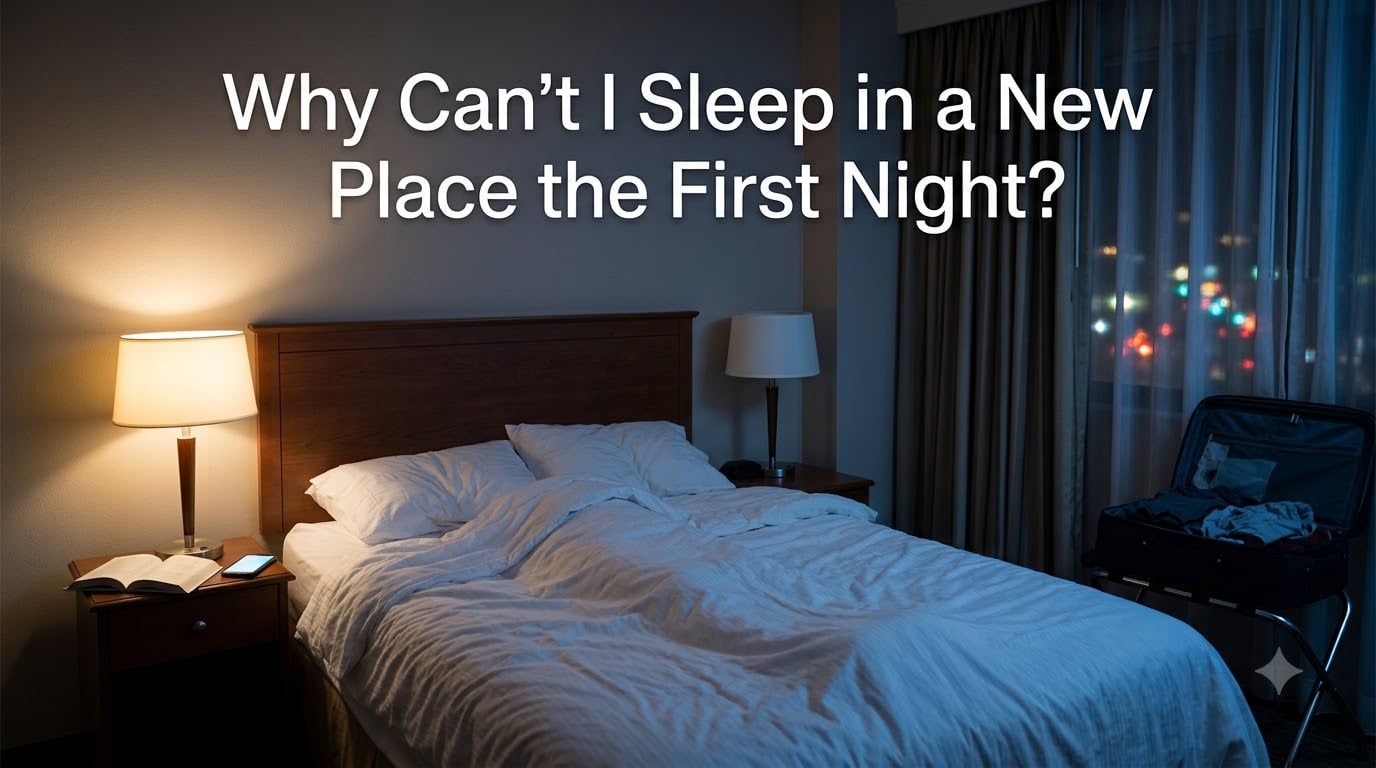
You lie down in a hotel bed, exhausted from a long day of travel, and your eyes refuse to stay shut. The room is quiet, the mattress is fine, but your brain refuses to power down. If this sounds familiar, you are far from alone. Roughly 60% of people report poor sleep on their first night in a new place.
Scientists call this the first-night effect, and it is one of the most well-documented phenomena in sleep research. It is not a flaw in your body or a sign of a sleep disorder. Your brain is actually doing exactly what it evolved to do: keeping you safe in unfamiliar territory.
In this guide, I will walk you through exactly why you can’t sleep in a new place the first night, what happens inside your brain, how long the effect lasts, and the practical steps you can take to reduce it. Whether you are staying in a hotel, moving into a new apartment, or crashing at a friend’s place, understanding the science behind this experience can help you sleep better starting tonight.
Table of Contents
What Is the First-Night Effect?
The first-night effect is a well-documented sleep phenomenon where your brain stays partially alert during sleep in a new or unfamiliar environment, resulting in lighter sleep, more frequent awakenings, and reduced deep sleep. It is completely normal and affects the majority of people who sleep somewhere new.
Researchers first observed this pattern decades ago during polysomnography studies (overnight sleep tests that measure brain waves, eye movements, and muscle activity). When participants slept in a lab for the first time, their sleep was measurably worse than on subsequent nights. The data was so consistent that sleep researchers eventually made it standard practice to discard the first night of data from any sleep study.
This is not just about feeling a little restless. Sleep architecture, the structured pattern of sleep stages your body cycles through each night, shifts noticeably. You spend less time in restorative deep sleep, take longer to fall asleep, and wake up more often without remembering it.
Why Can’t I Sleep in a New Place the First Night? The Brain’s Night Watch
The short answer is that one half of your brain stays on guard when you sleep somewhere unfamiliar. This is not a metaphor. It is a measurable neurological response.
In 2016, researchers at Brown University published a landmark study in the journal Current Biology that changed how we understand the first-night effect. Using advanced brain imaging, they found that the left hemisphere of the brain remains more active during the first night in a new place compared to the right hemisphere. This asymmetry means part of your brain is essentially standing watch while the rest sleeps.
The Brown University team, led by sleep researcher Masako Tamaki, discovered that the left hemisphere showed significantly less slow-wave (deep) sleep activity than the right. Slow-wave sleep is the deepest, most restorative stage of sleep. When one hemisphere gets less of it, that side stays lighter and more responsive.
To understand this, think about how dolphins sleep. Dolphins and some other marine mammals sleep with one brain hemisphere at a time, a process called unihemispheric slow-wave sleep. One half of the brain stays awake enough to keep the animal breathing and alert to predators while the other half rests. Your brain does something remarkably similar on your first night in a new place.
The researchers tested this by playing sounds near sleeping participants. On the first night, the vigilant left hemisphere responded much more strongly to sounds than the right hemisphere. By the second night, this asymmetry disappeared and both hemispheres responded equally. Your brain had decided the environment was safe, and the night watch was stood down.
This is why you might jolt awake at every small creak, hum, or footstep on the first night in a hotel. Your brain has not yet learned which sounds are harmless background noise and which might signal danger. So it treats everything as potentially significant.
How Sleep Architecture Changes on the First Night?
When you sleep in a new place, your sleep architecture shifts in ways that are measurable and significant. Understanding these changes helps explain why the first night feels so rough even when you are dead tired.
Deep sleep, also called slow-wave sleep or N3, drops noticeably on the first night. This is the stage where your body repairs tissue, consolidates memories, and performs essential maintenance. Less deep sleep means you wake up feeling less rested, even if you were in bed for eight hours.
Sleep latency, the time it takes to fall asleep, also increases. You may toss and turn for longer because your brain is not yet ready to let its guard down. Combined with more frequent micro-awakenings throughout the night, your overall sleep efficiency (the percentage of time in bed actually spent sleeping) drops significantly.
REM sleep can also be affected. REM, the stage associated with vivid dreaming and emotional processing, tends to be more fragmented when your brain is in vigilance mode. Instead of long, uninterrupted REM cycles, you get shorter bursts interrupted by brief awakenings.
The Evolutionary Purpose: Your Brain Is Protecting You
From an evolutionary standpoint, the first-night effect makes perfect sense. For most of human history, sleeping in an unfamiliar place meant real danger. Predators, rival groups, and environmental hazards were all genuine threats that a sleeping human could not detect.
A brain that stayed partially alert in new surroundings gave our ancestors a survival advantage. The individuals who could respond quickly to a strange noise or a change in air pressure were more likely to survive and pass on their genes. Those who slept deeply on the first night anywhere new did not.
Modern humans inherited this protective mechanism. Even though your hotel room or new apartment is almost certainly safe, your brain does not know that yet. It needs evidence, specifically one full night of uneventful sleep, before it is willing to fully power down.
Reframing the experience this way can actually reduce the anxiety that comes with it. You are not broken. Your brain is doing exactly what millions of years of evolution designed it to do: keeping you alive through the night so you can wake up ready for whatever comes next.
Factors That Make the First-Night Effect Worse
While the underlying brain mechanism is universal, several factors can amplify the first-night effect and make it significantly harder to sleep. Being aware of these can help you anticipate and manage them.
Noise is one of the biggest culprits. An unfamiliar HVAC hum, traffic sounds, hallway voices, or a neighbor’s television all register as potentially significant to a vigilant brain. Even sounds that would not wake you at home can trigger micro-awakenings in a new place because your brain has not yet categorized them as safe background noise.
Light exposure also plays a role. A room with thinner curtains, different street lighting, or LED indicators on electronics can suppress melatonin production. Melatonin is the hormone that signals to your body that it is time to sleep, and even small amounts of unexpected light can disrupt its release.
Temperature matters more than most people realize. If the new room is too warm or too cold compared to what your body expects, you may struggle to reach deep sleep. The ideal sleeping temperature is typically between 60 and 67 degrees Fahrenheit.
Anxiety and racing thoughts are major amplifiers. Forum discussions on Reddit’s r/sleep and r/CasualConversation reveal that many people experience physical symptoms like a racing heart, hyperawareness, and an inability to mentally switch off. One user described lying awake “feeling wide awake despite being absolutely exhausted.” These symptoms stem from elevated cortisol and adrenaline, your body’s stress response kicking in because it perceives the unfamiliar environment as a threat.
Jet lag and circadian disruption pile on top of everything else. If you have crossed time zones, your internal clock is fighting the local time while your brain is also on high alert. This double hit can make the first night particularly brutal for international travelers.
Why Some People Sleep Better Away From Home
Not everyone struggles. Some people actually sleep better on the first night in a new place, which can feel confusing if you are someone who always suffers. Research suggests this comes down to individual variation in brain asymmetry and personal circumstances.
For some, a new environment is a relief from home stressors. If your bedroom at home is associated with work anxiety, relationship tension, or poor sleep habits, a fresh hotel room can actually feel safer and more relaxing. The brain’s vigilance response is outweighed by the reduction in psychological stress.
Others simply have a less reactive vigilance system. Just as some people startle easily and others do not, the intensity of the first-night effect varies from person to person. If you are someone who sleeps well anywhere, count yourself lucky. Your brain’s threat-assessment system simply runs a little cooler than average.
How to Reduce the First-Night Effect: Practical Tips
You cannot fully switch off your brain’s vigilance system, but you can reduce its intensity. Here are the strategies that sleep researchers and frequent travelers recommend most.
1. Arrive early and give yourself time to acclimate. If possible, arrive at your destination several hours before bedtime. This gives your brain time to process the new sights, sounds, and smells while you are still awake. By the time you lie down, the environment will feel slightly less novel, which reduces the vigilance response.
2. Bring familiar items from home. Your own pillow is the single most effective item you can bring. It carries the scent, texture, and physical support your brain associates with safe sleep. A familiar blanket, sleep mask, or even a small pillowcase sprayed with a scent from home can all help trick your brain into feeling like it is in known territory.
3. Replicate your home bedtime routine as closely as possible. If you read for 20 minutes before bed at home, do the same in the hotel. If you brush your teeth, wash your face, and listen to a specific podcast, keep that sequence intact. Routines are powerful sleep cues that signal safety and predictability to your brain, even in a new location.
4. Control light and temperature. Close curtains fully, turn off or cover LED indicators, and set the thermostat to your usual sleeping temperature. If the room is too bright, use a sleep mask. If it is too warm, crack a window or lower the thermostat before you start getting ready for bed so the room has time to cool.
5. Use white noise or earplugs to manage unfamiliar sounds. A white noise app or portable sound machine creates a consistent audio backdrop that masks sudden, startling sounds. Earplugs are an effective alternative if you prefer silence. Both options reduce the number of sounds your vigilant brain has to process, which means fewer micro-awakenings.
6. Be mindful of caffeine, alcohol, and heavy meals. Avoid caffeine within 8 hours of bedtime, as its stimulating effects compound with your brain’s natural vigilance. Alcohol may help you fall asleep faster but it fragments sleep and suppresses REM, making the first-night effect worse. Heavy meals close to bedtime can cause discomfort that further disrupts already fragile sleep.
7. Manage pre-sleep anxiety directly. If your mind is racing and your heart is pounding, try a simple breathing technique before bed. Box breathing (inhale for 4 counts, hold for 4, exhale for 4, hold for 4) activates your parasympathetic nervous system and lowers cortisol. Remind yourself that what you are experiencing is a normal, protective response that will resolve by the second night.
8. Get sunlight exposure the next morning. If you wake up after a rough first night, getting bright natural light within an hour of waking helps reset your circadian rhythm to the local time. This signals to your brain that the environment is predictable and safe, which helps reduce the vigilance response the following night.
Frequently Asked Questions
How to fix the first night effect?
To reduce the first-night effect, arrive early to acclimate, bring familiar items like your own pillow, replicate your bedtime routine, control light and temperature, use white noise or earplugs, limit caffeine and alcohol, and practice relaxation techniques before bed. These strategies reduce your brain’s vigilance response and help you fall asleep faster in a new environment.
Why am I unable to sleep in a new place?
You cannot sleep in a new place because your brain stays partially alert as a protective mechanism. Research from Brown University shows that the left hemisphere of your brain remains more vigilant during the first night in an unfamiliar environment, resulting in lighter sleep and more frequent awakenings. This is a normal evolutionary response, not a sleep disorder.
Is sleeping at a different place difficult the first night?
Yes, sleeping at a different place is difficult for most people on the first night. Approximately 60% of people report poor sleep quality when sleeping somewhere new. This is due to the first-night effect, where your brain maintains partial vigilance in unfamiliar surroundings, reducing deep sleep and increasing awakenings throughout the night.
How long does the first night effect last?
The first-night effect typically lasts only one night. By the second night in a new place, most people’s brain asymmetry disappears and sleep quality returns to near-normal levels. Your brain uses the first uneventful night to confirm the environment is safe, then stands down its vigilance response for subsequent nights.
The Bottom Line on the First-Night Effect
If you have ever found yourself staring at an unfamiliar ceiling wondering why you can’t sleep in a new place the first night, now you know. Your brain is running an ancient safety program, keeping one hemisphere partially awake to protect you in unfamiliar surroundings. It is uncomfortable, but it is also temporary and completely normal.
The effect almost always resolves by the second night as your brain confirms the environment is safe. In the meantime, bringing familiar items, controlling noise and light, and sticking to your routine can all soften the impact. The next time you check into a hotel or move into a new place, give yourself some grace. Your brain is just doing its job, and tomorrow night you will likely sleep like you never left home.