
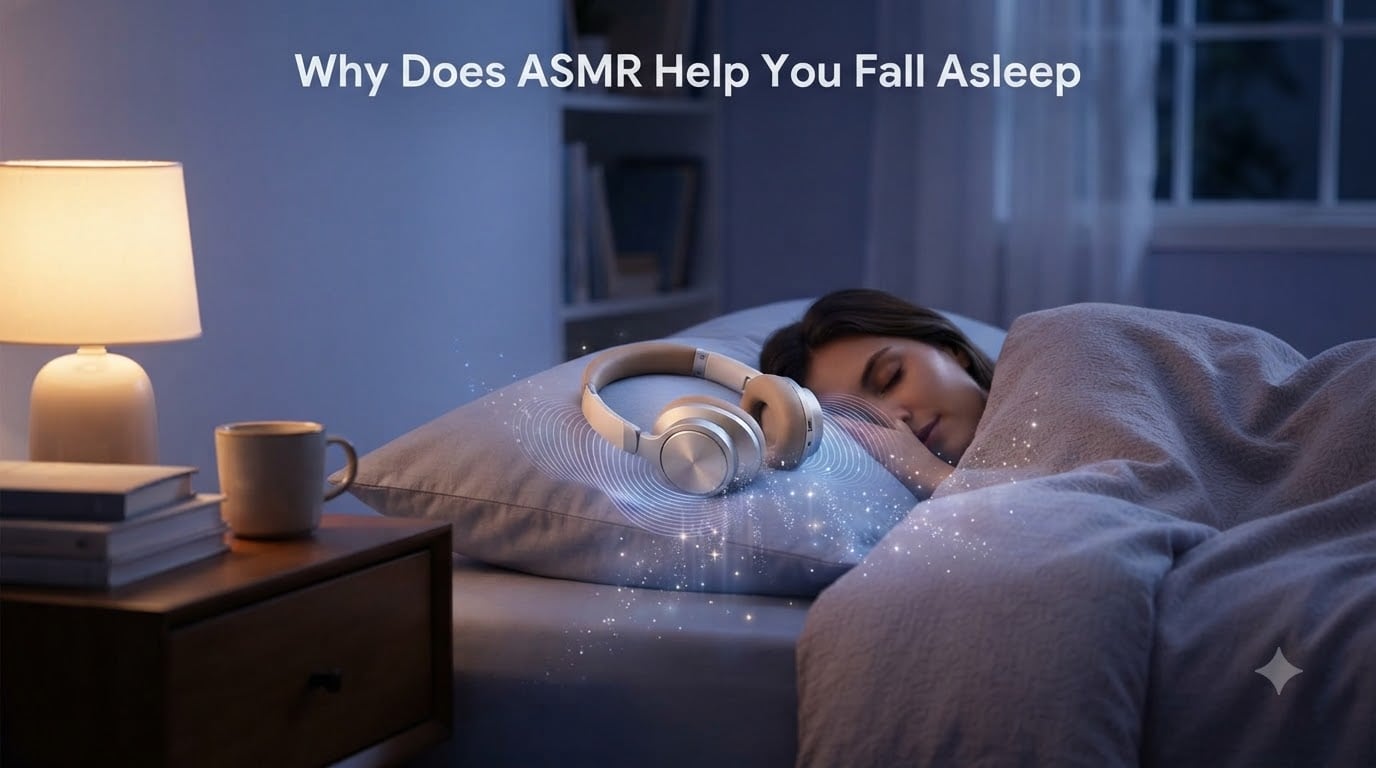
It is 1 a.m. and your mind will not stop racing. You have tried counting sheep, breathing exercises, and warm milk. Nothing works. Then you put on a quiet ASMR video, and within minutes, your eyelids grow heavy.
If this sounds familiar, you are not alone. Millions of people now use ASMR as a nightly sleep aid, and there is real science behind why it works. Understanding why does ASMR help you fall asleep can transform your bedtime routine and give you a drug-free tool for better rest.
In this guide, we will break down what ASMR is, what happens in your brain when you experience it, and which triggers work best for sleep. We will also look at the research, share practical tips, and answer the most common questions people ask about using ASMR at bedtime.
Table of Contents
What Is ASMR (Autonomous Sensory Meridian Response)?
ASMR stands for Autonomous Sensory Meridian Response. It refers to a tingling, relaxing sensation that typically starts at the top of your scalp and travels down your neck and spine. Some people describe it as a warm wave of calm washing over their body.
This sensation is triggered by specific gentle stimuli, such as whispering, soft tapping, or slow hand movements. The term was coined in 2010 by a woman named Jennifer Allen, who wanted to give a scientific-sounding name to something she had experienced since childhood but could never properly describe.
The key word here is “autonomous.” The response happens on its own, without conscious effort. You cannot force yourself to feel ASMR. It either happens in response to a trigger or it does not.
Not everyone can experience ASMR. Research suggests that roughly 20% of people reliably feel the tingles. For everyone else, ASMR videos may still feel relaxing, but they will not produce that signature head-to-toe sensation. Scientists are still studying why some brains respond this way and others do not, but early evidence points to differences in how certain people process sensory input and regulate emotional responses.
People who do experience ASMR often describe it as deeply soothing. Some say it feels like a natural sedative. That calming effect is exactly what makes ASMR such a popular sleep aid, and it sets the stage for understanding the science behind why it works.
Why Does ASMR Help You Fall Asleep: The Science
ASMR helps you fall asleep through a combination of biological and neurological responses. When you listen to ASMR triggers, your body undergoes measurable changes that prepare you for rest. Here is what happens step by step.
1. Your Parasympathetic Nervous System Activates
Your autonomic nervous system has two main branches: the sympathetic (fight-or-flight) and the parasympathetic (rest-and-digest). ASMR appears to switch on the parasympathetic system, which is responsible for calming your body down. When this system takes over, your muscles relax, your breathing slows, and your body gets the signal that it is safe to let go and drift off.
2. Stress Hormones Drop
One of the biggest barriers to falling asleep is elevated cortisol, your body’s primary stress hormone. Racing thoughts at bedtime are often a sign that cortisol levels are too high. ASMR has been shown to reduce cortisol production, which helps quiet the mental chatter that keeps you staring at the ceiling.
3. Feel-Good Hormones Increase
Research indicates that ASMR triggers the release of dopamine and oxytocin. Dopamine is your brain’s reward chemical, producing feelings of pleasure and satisfaction. Oxytocin, often called the “bonding hormone,” promotes feelings of trust, comfort, and emotional warmth. Together, these two hormones create a sense of deep contentment that makes falling asleep feel natural rather than forced.
4. Your Heart Rate Slows
A 2018 study published in the journal PLOS ONE found that people who experienced ASMR showed significant increases in positive emotions and measurable changes in heart rate and skin conductance. Their heart rates dropped by an average of about two beats per minute. While that may sound small, even a slight reduction in heart rate signals to your body that it is time to wind down. This is the same physiological shift that happens during meditation or deep breathing exercises.
5. Distracting Thoughts Get Replaced
For many people, the reason they cannot fall asleep is simple: their brain will not stop talking. ASMR works partly by occupying your attention with something gentle and predictable. Instead of replaying an awkward conversation from three years ago, your brain focuses on the soft sound of pages turning or a whispering voice. This gentle focus crowds out anxious thoughts without requiring the mental effort of active meditation.
This combination of hormonal shifts, nervous system regulation, and mental distraction is why ASMR can feel like it works almost instantly. Your body is being guided into a sleep-ready state through multiple pathways at once.
Common ASMR Triggers for Sleep
Not all ASMR triggers are equally effective for sleep. Some are too stimulating, while others are perfectly designed to lull you into unconsciousness. Here are the most popular categories that people rely on at bedtime.
Whispering and Soft Speaking
Whispering is probably the most iconic ASMR trigger. A softly spoken voice, especially when close to the microphone, creates a sense of personal attention and intimacy that many people find deeply comforting. For sleep, slow-paced whispering with long pauses tends to work best because it gives your mind space to relax between words.
Tapping and Scratching
Gentle tapping on surfaces like wood, glass, or plastic creates rhythmic, repetitive sounds that can be hypnotic. Many people find that the predictability of tapping helps their brain settle into a calm rhythm. Scratching sounds, especially on textured surfaces, produce a similar effect with a slightly different texture.
Brushing and Crinkling
Makeup brushes sweeping across a surface, paper crinkling, or fabric rustling are all popular sleep triggers. These sounds are soft and texturally rich without being jarring. Forum users consistently report that brushing sounds, in particular, have an almost massage-like quality that helps release physical tension.
Nature and Ambient Sounds
Rain falling, pages turning, tea being poured, or a fire crackling are all examples of ASMR that overlap with ambient soundscapes. These triggers work well for sleep because they create a cozy, immersive environment without demanding your attention. Many listeners prefer these over voice-based ASMR because there is no language to process.
Personal Attention Roleplays
In these videos, the creator simulates a personal experience such as a haircut, a medical exam, or a spa visit. The combination of soft sounds and the illusion of someone caring for you can trigger strong feelings of comfort and safety. However, for sleep specifically, many forum users say they prefer audio-only versions because visual elements can sometimes keep them awake.
Finding your ideal trigger is a process of trial and error. Most ASMR regulars eventually settle on two or three go-to triggers that reliably put them to sleep, and they rotate between them to prevent habituation.
What Research Says About ASMR and Sleep
The scientific study of ASMR is still in its early stages, but the research that does exist is encouraging. A landmark 2018 study by Poerio and colleagues, published in PLOS ONE, remains one of the most frequently cited papers on the topic. It measured physiological responses in people who experience ASMR and found that watching ASMR videos consistently increased positive emotions, reduced sadness, and lowered heart rate.
A separate 2015 study by Fredborg and colleagues surveyed over 300 ASMR viewers about their sleep habits. They found that a significant majority reported using ASMR specifically to help with sleep, and many said it was effective. Respondents also noted improvements in their ability to fall asleep faster and stay asleep longer when using ASMR regularly.
A 2021 study published in PLOS ONE by Smith and colleagues examined the relationship between ASMR and background noise. Researchers found that ASMR-sensitive participants experienced decreased heart rate and increased skin conductance, providing objective physiological evidence that ASMR produces real bodily changes, not just a placebo effect.
Researchers have also explored why ASMR works from a neurobiological perspective. Some theorize that ASMR shares similarities with mindfulness practices. Both involve focusing attention on present-moment sensations, which can reduce rumination and anxiety. Others note parallels between ASMR and affiliative behaviors in mammals, where gentle touch and grooming trigger calming responses through oxytocin release.
It is worth noting that most existing studies rely on self-reported data and small sample sizes. The field needs larger, controlled trials before any definitive medical claims can be made. However, the consistent pattern across studies is that ASMR reliably produces relaxation and may serve as a useful non-pharmacological tool for people struggling with mild sleep difficulties.
How to Use ASMR for Better Sleep
Getting the most out of ASMR for sleep comes down to setup, selection, and routine. Here are practical tips drawn from both research and real user experiences.
Use headphones or earbuds. ASMR is recorded with specialized microphones that capture spatial audio. Headphones preserve that 3D effect, which significantly enhances the tingling response. Many users find that sleeping headphones or a sleep headband with flat speakers are the most comfortable option.
Choose audio-only or dim-screen videos. Forum users consistently recommend turning your screen face-down or using audio-only content. Visual ASMR can keep your brain engaged and counteract the sleep-inducing effects of the audio. If you do watch, set a sleep timer so the video does not run all night.
Start with longer videos. Users on ASMR forums strongly prefer videos that are at least one hour long for sleep. Shorter videos force you to wake up and find another one, which defeats the purpose. Many popular sleep ASMR creators publish extended sessions specifically designed for uninterrupted rest.
Find the right volume. ASMR should be soft enough that it feels like a background presence, not a performance. If the volume is too high, it can become stimulating rather than relaxing. Start low and adjust upward only if you cannot hear the details.
Make it part of your routine. Your brain responds well to patterns. If you listen to ASMR at the same time each night, in the same position, your body will start to associate those sounds with sleep onset. Over time, just putting on your preferred trigger can become a cue that it is time to wind down.
Rotate triggers to avoid habituation. One of the most common complaints on ASMR forums is that a favorite trigger stops working after a while. This is called habituation, and it is a normal neurological response to repeated stimuli. Rotating between different triggers every few days can keep your response fresh.
Prioritize quality over quantity. Forum users warn that much of the ASMR content online is low-quality clickbait that is not actually effective for sleep. Look for creators who understand sleep needs, use high-quality microphones, and produce content specifically designed for relaxation rather than entertainment.
When ASMR Might Not Work?
ASMR is not a universal solution, and there are legitimate reasons it might not help you. Some people have a condition called misophonia, where certain sounds, especially mouth noises or chewing, trigger intense irritation or anger rather than relaxation. If you find that ASMR makes you uncomfortable, your brain may be reacting negatively to specific sounds, and you should stop using them.
ASMR also cannot fix serious sleep disorders like chronic insomnia or sleep apnea. If you have persistent trouble falling or staying asleep for more than a few weeks, talk to a doctor. ASMR can be a helpful complement to good sleep hygiene, but it is not a substitute for medical treatment.
Finally, if you find yourself needing to listen at progressively louder volumes or for longer periods to get the same effect, you may be over-relying on ASMR. Taking a break for a few days can reset your sensitivity and restore its effectiveness.
FAQs
Is it healthy to fall asleep to ASMR?
For most people, yes. ASMR promotes relaxation by lowering heart rate, reducing stress hormones, and releasing calming hormones like dopamine and oxytocin. It is a drug-free approach to winding down that does not carry the risks associated with sleep medications. However, if you rely on ASMR every single night and cannot sleep without it, consider taking occasional breaks to maintain its effectiveness.
Does ASMR actually improve sleep?
Research and user reports suggest it can. A 2015 survey study found that the majority of ASMR users who listened for sleep reported falling asleep faster and experiencing better sleep quality. While large-scale clinical trials are still needed, the existing evidence shows that ASMR produces measurable physiological changes consistent with relaxation and sleep readiness.
Is there a downside to ASMR?
The main downsides are habituation, where ASMR stops working after repeated use, and misophonia, where certain sounds cause irritation instead of relaxation. Additionally, sleeping with earbuds in all night can cause ear discomfort over time. Some users also become psychologically dependent on ASMR and struggle to sleep without it.
Is ASMR an ADHD thing?
There is no proven link between ASMR and ADHD, but many people with ADHD report that ASMR helps them. The reason may be that ASMR provides a single, predictable focus point, which can calm a racing mind. People with ADHD often struggle with falling asleep because of mental hyperactivity, and ASMR gives the brain something gentle to lock onto instead of spiraling into anxious thoughts.
Why does ASMR instantly make me sleepy?
ASMR triggers multiple relaxation responses simultaneously. It activates your parasympathetic nervous system, releases calming hormones like oxytocin, lowers your heart rate, and occupies your attention with soothing stimuli. This combination can shift your body into a sleep-ready state within minutes, which is why many people feel drowsy almost immediately.
Is it okay to listen to ASMR every night?
Yes, but with a caveat. Using ASMR nightly as part of your bedtime routine is generally safe and can even strengthen the association between those sounds and sleep. However, if you notice the tingles fading or you need louder volume to get the same effect, take a break for a few days. Rotating between different triggers can also help prevent habituation.
Conclusion
ASMR helps you fall asleep by tapping into your body’s natural relaxation systems. It activates your parasympathetic nervous system, releases calming hormones like dopamine and oxytocin, slows your heart rate, and quiets a racing mind with gentle, predictable stimuli. For the roughly 20% of people who experience ASMR tingles, these effects can be especially powerful.
The beauty of ASMR is that it is free, accessible, and completely drug-free. Whether whispering, tapping, or ambient rain sounds work best for you, the key is experimenting until you find your ideal trigger. Start tonight with headphones, a long audio-only video, and an open mind. Better sleep might be just a whisper away.