
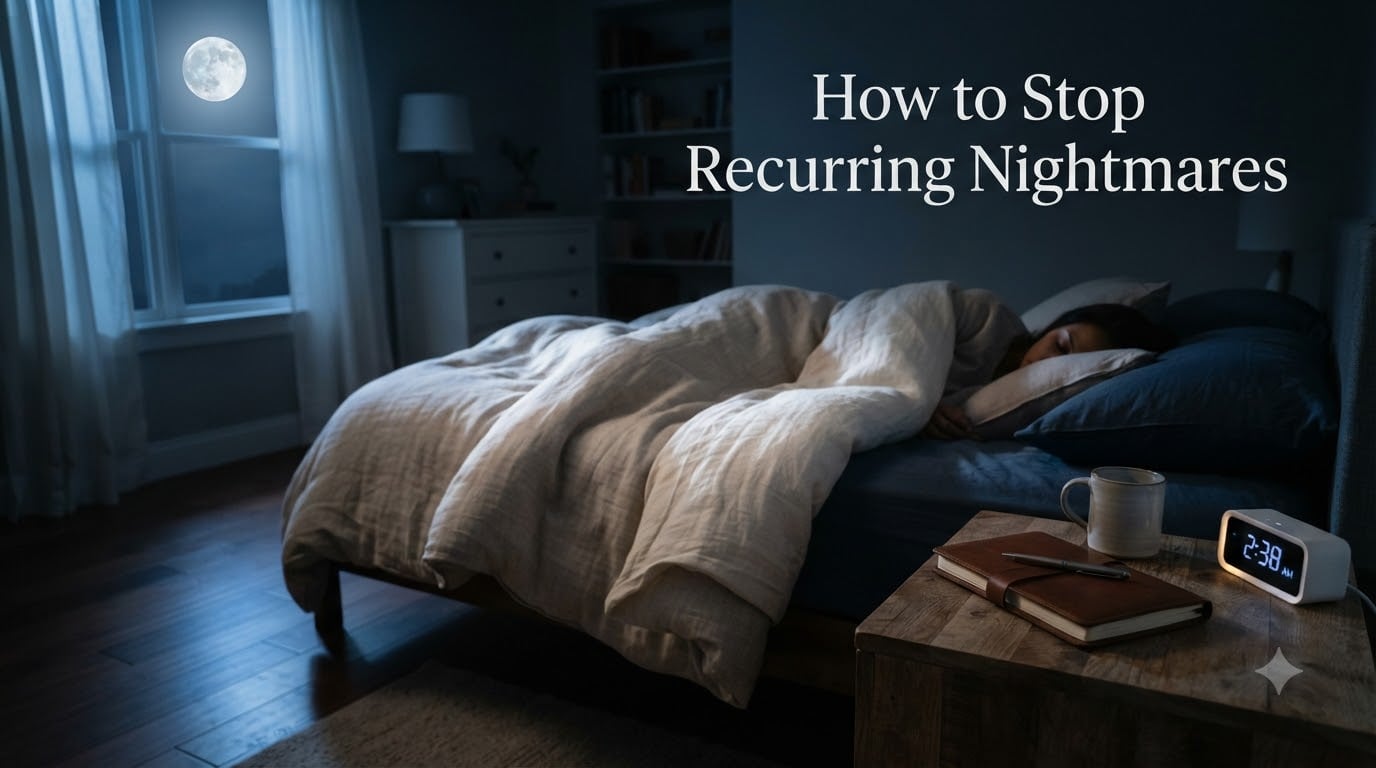
Recurring nightmares are exhausting. You finally fall asleep, then jerk awake at 3 AM with your heart pounding, replaying the same frightening scene for what feels like the hundredth time.
I have talked with people who describe waking five or six nights a week in sheer panic, dreading bedtime, and dragging themselves through the next day in a fog. If that sounds familiar, this guide on how to stop recurring nightmares will walk you through what actually works, from the gold-standard therapy to quick relief when you wake up terrified.
Table of Contents
What Are Recurring Nightmares and Why Do They Happen
Recurring nightmares are disturbing dreams that repeat with similar themes, often featuring threats, falls, being chased, or losing a loved one. When they happen frequently enough to disrupt your sleep and mood, doctors call it nightmare disorder.
I learned this distinction matters because it changes the solution. An occasional bad dream after a stressful week is normal. Nightmares that repeat multiple times a week, that make you dread sleep, that leave you depressed the next morning, that is a condition with real treatments.
Nightmares happen during REM (rapid eye movement) sleep, the phase where your brain is highly active and dreaming. During REM, your amygdala, which handles fear and emotional memory, is firing hard, while your prefrontal cortex, which handles logic and reality-testing, is mostly offline.
This is why dreams feel so real and so sticky. Your brain cannot easily defuse the threat it just staged. When something stressful or traumatic happens during the day, or when certain medications alter brain chemistry, those emotional memories can loop into your REM dreams over and over.
The most common triggers I see in the research include:
- Stress and anxiety: Work pressure, financial worries, or relationship conflict frequently show up as chasing, failing, or losing dreams.
- Trauma: PTSD-related nightmares are especially vivid and can replay the actual event.
- Medications: SSRIs, beta-blockers, and some sleep aids list nightmares as a known side effect.
- Sleep deprivation: When you finally sleep deeply, REM rebounds and intensifies.
- Substance use: Alcohol and recreational drugs disrupt REM architecture.
- Late, heavy meals: Eating close to bedtime raises metabolism and body temperature, fueling vivid dreams.
If you have been searching for how to stop recurring nightmares, knowing your trigger is the first step. Removing or managing it often cuts the cycle in half.
Nightmares vs Night Terrors: What’s the Difference
Nightmares and night terrors are not the same thing, and the distinction matters for treatment. I want to clear this up because it confused me for years.
Nightmares happen during REM sleep in the second half of the night. You wake up, you remember the dream, and you can usually describe it in detail. You feel scared, sad, or anxious, and you are aware of where you are.
Night terrors happen during non-REM sleep, usually in the first few hours of the night. The person may scream, thrash, or sit up with wide eyes, but they are not fully awake and typically have no memory of the event in the morning. Night terrors are more common in children and often resolve on their own.
The treatment approach is also different. Night terrors usually respond to calming bedtime routines and, in some cases, scheduled awakenings. Nightmares respond to imagery rehearsal therapy and stress reduction, which I will cover next.
Imagery Rehearsal Therapy: The Gold Standard Treatment
If you take one thing from this guide, take this: Imagery Rehearsal Therapy (IRT) is the most researched and most effective non-medication treatment for recurring nightmares. It is recommended by the American Academy of Sleep Medicine and it works.
IRT was originally developed for PTSD nightmares and works on any recurring nightmare, not just trauma-related ones. The idea is simple: you rewrite the nightmare while awake, then mentally rehearse the new version until it replaces the old one.
Here is how to do it, step by step:
Step 1: Write down your nightmare. As soon as you wake up, grab a notebook and jot down the key images, characters, and plot points. Do this even if it is 2 AM. The earlier you capture it, the easier it is to rewrite.
Step 2: Pick one scene. You only need to rewrite one vivid scene, not the whole dream. Most recurring nightmares have a single moment that drives all the fear, like the doorway where something appears, the fall, the chase ending.
Step 3: Change it however you want. This is the fun part. You are the director. Maybe in the new version you turn around and the monster turns out to be a friendly dragon. Maybe you grow wings and fly away. Maybe you wake up and realize it was a prank. Anything that makes you feel safe works.
Step 4: Rehearse it for 5 to 20 minutes daily. Sit somewhere calm and run the new scene through your mind, like watching a short film. Visualize it vividly, including how you feel at the end, which should be calm, capable, or even amused.
Step 5: Repeat for two to four weeks. Most people see a meaningful drop in nightmare frequency within two weeks. Studies show 70 to 90 percent of participants report improvement.
I practiced this myself during a stressful period and found the worst dream faded after about ten days of rehearsal. It felt strange at first, like daydreaming for homework, but the science is solid. You are teaching your sleeping brain a new script for that REM sequence.
Sleep Hygiene Essentials for Preventing Nightmares
Sleep hygiene sounds boring, but it is the foundation everything else sits on. Sloppy sleep habits feed nightmares. Consistent habits starve them. These are the changes that move the needle most:
- Keep a fixed wake-up time, even on weekends. Your circadian rhythm locks to your morning light, not your bedtime. Waking at the same time every day is more stabilizing than any bedtime routine.
- Aim for 7 to 9 hours in bed. Both sleep deprivation and oversleeping increase REM intensity.
- Skip alcohol 3 to 4 hours before bed. Alcohol fragments REM sleep and reliably worsens nightmares in the second half of the night.
- Put screens away 60 minutes before bed. Blue light suppresses melatonin and pushes bedtime later into deeper REM rebound territory.
- Keep the bedroom cool, dark, and quiet. Around 65 degrees Fahrenheit is the sweet spot for most adults.
- Avoid large meals within 2 to 3 hours of sleep. A light snack is fine, but a heavy dinner raises metabolism and heart rate during REM.
- Do not lie in bed awake for more than 20 minutes. Get up, do something boring under dim light, and return when sleepy. You want your brain to associate bed with sleep, not with fear.
One forum user told me their nightmares almost disappeared once they stopped doom-scrolling in bed. That tracks with the science. Bright screens plus stressful content right before REM is a recipe for vivid nightmares.
Quick Relief: What to Do When You Wake From a Nightmare
This section is the one most articles skip, and I think it is the most important for the moments that matter. Here is what to do in the first ten minutes after you wake up terrified.
1. Ground yourself in the present. Say out loud, “I am in my bedroom. The date is today. I am safe.” Repeat it until your breathing slows. Speaking engages your rational brain and pulls you out of the dream loop.
2. Run the 5-4-3-2-1 sensory scan. Name 5 things you can see, 4 you can touch, 3 you can hear, 2 you can smell, and 1 you can taste. This pulls your nervous system out of flashback mode.
3. Try the 4-7-8 breathing technique. Inhale through your nose for 4 counts. Hold for 7. Exhale through pursed lips for 8. Repeat 4 times. The long exhale activates your vagus nerve and drops your heart rate fast.
4. Get out of bed briefly if you cannot settle within 20 minutes. Move to a couch or chair, keep the light dim, and do something repetitive like folding laundry. Do not check your phone. You want to reset the brain-to-bed association.
5. Say a comforting phrase. Many people repeat a phrase like, “That was a dream, it is over, I am safe now.” Stock phrases give your brain something concrete to grab onto when it wants to chase the fear.
One reader I heard from said step 5 alone cut their time awake from over an hour to under ten minutes. The trick is repetition. Pick one phrase and make it automatic.
Stress, Anxiety, and Trauma as Nightmare Triggers
Even with perfect sleep hygiene, recurring nightmares usually have an emotional root. Daytime stress gets processed during REM, and unprocessed stress tends to loop. The most common culprits I see are:
- Work burnout. Recurring dreams of missing deadlines, exams, or being chased often map to work overload.
- Relationship conflict. Arguments, infidelity fears, or loss dreams frequently point to strained relationships.
- Unprocessed grief. Dreams of losing loved ones are a classic grief sign.
- Past trauma. PTSD dreams replay the event itself and benefit most from IRT plus trauma therapy.
- Anxiety disorders. Generalized anxiety and panic disorder both amplify nightmare frequency.
The fix is not to eliminate all stress, which is impossible, but to give your nervous system a daily release valve. A 20-minute walk, journaling, talking with a friend, or a session with a therapist all count.
I noticed my own recurring dreams spiked during a stretch of 60-hour work weeks and disappeared almost completely once I instituted a hard cutoff on evening emails. Sometimes the intervention is not exotic. It is just removing the constant low-grade pressure.
Relaxation Techniques That Calm Your Nervous System
Relaxation skills are a long-term investment in nightmare-free sleep. They reduce the adrenaline load that fuels vivid REM dreams. Here are three techniques I teach readers and clients.
Box breathing. Inhale for 4 counts, hold for 4, exhale for 4, hold for 4. Repeat 6 to 8 cycles. Navy SEALs use this before high-stakes missions. It works for racing midnight thoughts too.
Progressive muscle relaxation. Starting at your toes, tense each muscle group for 5 seconds, then release. Move slowly up to your forehead. The contrast between tension and release signals safety to your nervous system.
Body scan meditation. Lie down and mentally walk through your body, noticing each part without judgment. Guided versions are available free on YouTube and run 10 to 20 minutes. Pair this with your wind-down routine and you will likely fall asleep faster.
Practice during the day first. A relaxation skill you have only ever used in bed has a high learning curve. Use it while watching TV or commuting, and your body will recognize it at 2 AM.
How to Start a Dream Journal to Break the Cycle
A dream journal is the first half of IRT and a powerful standalone tool. Writing down dreams reduces their emotional charge and helps you spot patterns you would otherwise miss.
Here is how to start one that you will actually keep:
- Keep it by your bed. A notebook or phone works. The point is to write within minutes of waking, before the dream fades.
- Write in fragments. Full sentences are optional. “Chase, dark hallway, door locked, fell” is enough.
- Note the feeling, not just the story. Capture whether you felt terror, sadness, anger, or shame. Emotions are reliable triggers worth tracking.
- Look for themes weekly. Skim the entries on Sunday morning. You will often see a single worry dominating: a project, a relationship, a fear of failure.
- Rewrite the worst ones. For your most vivid recurring dream, apply the IRT rewrite step from earlier in this article.
After a few weeks, your journal becomes a map of what is bothering you. That map often points to a fix you can act on, which is the real goal of all this work: fewer open problems for your sleeping brain to chew on.
Medications, Vitamins, and When to See a Doctor
I am not a doctor and this is not medical advice, but the research is clear on a few points worth knowing.
Is there a pill to stop nightmares? In some cases, yes. The most commonly prescribed option is prazosin, a blood pressure medication that reduces nightmares in PTSD. Some doctors prescribe trazodone or certain antidepressants off-label. Medication is usually reserved for severe or trauma-related nightmares and works best alongside therapy.
Which vitamin deficiency causes nightmares? Low B6 and low B12 have both been linked to disturbing dreams in small studies. Iron deficiency can also worsen restless sleep. Getting bloodwork to check these is reasonable if your nightmares came on suddenly with no clear trigger.
When should I see a doctor? Make an appointment if nightmares happen more than once a week, if they cause significant daytime distress, if you have symptoms of PTSD, if they started after a new medication, or if fear of sleep is affecting your daily life. A sleep specialist or therapist trained in IRT is the right call.
A mental health professional can also screen for related conditions like sleep apnea, which fragments REM and can amplify nightmares without you realizing it.
Frequently Asked Questions
How do I get rid of repeating nightmares?
The most effective treatment is Imagery Rehearsal Therapy. Write down a recurring nightmare, pick one scene, rewrite it so you feel safe, then mentally rehearse the new version for 5 to 20 minutes daily. Most people see improvement within two to four weeks. Combine IRT with consistent sleep hygiene and stress reduction for best results.
Why am I having a recurring nightmare?
Recurring nightmares are usually triggered by unresolved stress, anxiety, trauma, recent life changes, or medication side effects. They happen during REM sleep when your brain processes emotional memories. Identifying and addressing the underlying trigger is just as important as treating the dream itself.
Which vitamin deficiency causes nightmares?
Low levels of vitamin B6, vitamin B12, and iron have each been linked to more vivid or disturbing dreams in clinical research. A simple blood test can check for deficiencies, and supplementation or dietary changes often reduce nightmare frequency.
Is there a pill to stop nightmares?
There is no single pill approved for general nightmares. For trauma-related nightmares, doctors sometimes prescribe prazosin, and certain antidepressants are used off-label. Medication works best combined with therapy like IRT. Talk to a doctor if nightmares are severe or persistent.
How long does it take to stop recurring nightmares?
With consistent daily practice of Imagery Rehearsal Therapy and good sleep habits, most people notice meaningful improvement within 2 to 4 weeks. Severe or trauma-related nightmares may take several months of combined therapy and support.
Can children use these nightmare techniques?
Yes. Imagery Rehearsal Therapy has been adapted for children as young as 7, and a simplified version works for younger kids with parental help. A calm bedtime routine, a comfort object, and avoiding scary media before bed are especially effective for children.
Final Thoughts on Stopping Recurring Nightmares
Recurring nightmares are treatable. Most people see a real drop in frequency within a few weeks of using Imagery Rehearsal Therapy, tightening sleep hygiene, and addressing the daytime stress that fuels the dreams.
Start with one small change tonight. Pick the easiest item from this guide, whether that is a fixed wake-up time, a 10-minute body scan, or rewriting the worst scene from last night’s dream. Stack a second habit next week. In a month, you will likely be sleeping in a way that feels unfamiliar, in a good way.
And if your nightmares are tied to trauma or have been happening for months, please talk to a clinician. There is no medal for handling it alone, and the right therapist can shorten the timeline dramatically.