
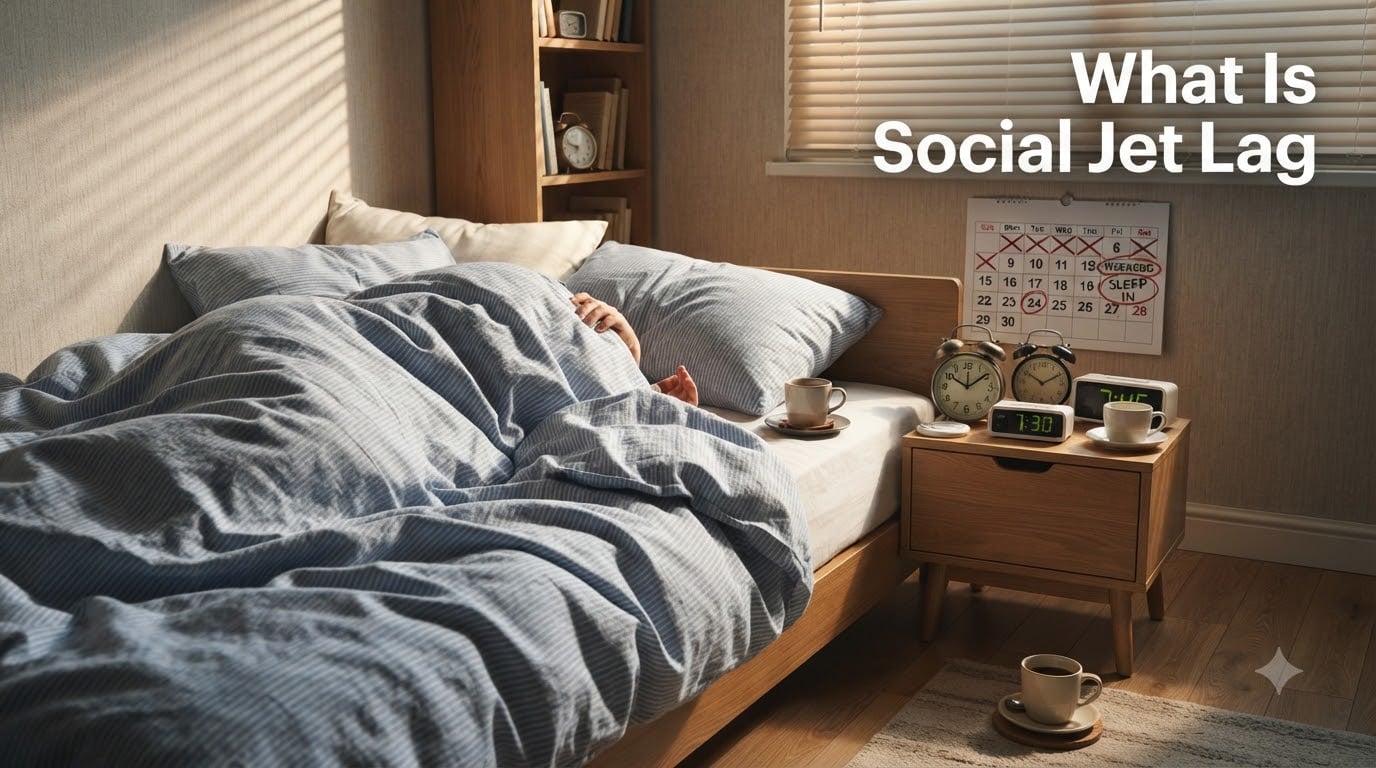
You wake up on Monday feeling like you just flew across three time zones. Your alarm goes off at 6:30 AM, but your body thinks it is 9:30 AM or later. That groggy, disoriented feeling is not in your head. It has a name: social jet lag.
Social jet lag is the mismatch between your body’s internal biological clock and the sleep schedule your social life demands. If you sleep at 11 PM on weeknights but stay out until 2 AM on Saturday, you are giving your body a mini time-zone shift every single weekend. Over time, that weekly whiplash takes a real toll on your health.
Our team dug into peer-reviewed research from the National Institutes of Health, sleep science journals, and real-world forum discussions to break this down. In this guide, you will learn what social jet lag is, how it differs from travel jet lag, who is most at risk, and practical steps to fix it.
Whether you are a student struggling with 8 AM classes, a shift worker on rotating schedules, or a self-described night owl forced into an early-bird world, this article will help you understand why you feel exhausted and what to do about it.
Table of Contents
What Is Social Jet Lag? A Clear Definition
Social jet lag is the gap between your biological clock, which tells your body when to sleep and wake naturally, and the social clock, which dictates when work, school, and obligations require you to be active. The term was coined in 2006 by German chronobiologist Till Roennenberg, one of the leading researchers in circadian rhythm science.
Think of it this way: your body runs on an internal 24-hour cycle governed by light exposure, melatonin production, and genetic programming. But modern life rarely respects that cycle. Alarm clocks, late-night social events, screen time, and work schedules all push and pull your sleep in directions your biology did not intend.
The result is a recurring circadian misalignment. On weekdays, you wake up before your body is ready. On weekends, you stay up late and sleep in, shifting your internal clock forward. Then Monday arrives, and your body has to snap back. That back-and-forth is social jet lag, and it affects an estimated two-thirds of the population to some degree.
One Reddit user in the r/sleep community described it perfectly: it feels like a mini time-zone change every week. Another user on r/Biohackers called it disrupting your circadian clock through inconsistent sleep schedules. These everyday experiences match exactly what the research describes.
How Social Jet Lag Differs From Travel Jet Lag
Travel jet lag happens when you cross physical time zones. Your body expects daylight at one time, but the local sun rises and sets on a different schedule. The mismatch is temporary, and your body adjusts within a few days as it syncs to the new time zone.
Social jet lag is different. You are not crossing any time zones. Instead, you are creating an artificial time-zone shift within your own life by maintaining two different sleep schedules. Weekdays force one rhythm, weekends create another, and your body never gets a chance to fully settle into either one.
Here is a direct comparison to make the distinction clear:
Social Jet Lag vs Travel Jet Lag:
Cause: Social jet lag comes from inconsistent daily schedules; travel jet lag comes from crossing physical time zones.
Duration: Social jet lag recurs every week indefinitely; travel jet lag typically resolves in a few days.
Direction: Social jet lag pulls your body back and forth repeatedly; travel jet lag shifts it once and then stabilizes.
Who experiences it: Social jet lag affects anyone with a social or work schedule that conflicts with their biological preferences; travel jet lag only affects travelers.
Key difference: You do not need to travel anywhere to get social jet lag. It happens at home, every week.
The key takeaway is that social jet lag is chronic and cyclical. Travel jet lag is acute and temporary. Both stem from circadian misalignment, but only social jet lag keeps happening week after week without a clear endpoint.
The Circadian Rhythm and Biological Clock Connection
To understand social jet lag, you need to understand the machinery behind it. Your circadian rhythm is the internal 24-hour cycle that regulates sleepiness, alertness, hormone release, body temperature, and dozens of other biological processes. It is controlled by a tiny cluster of cells in your brain called the suprachiasmatic nucleus, often called the master biological clock.
This master clock takes its cues primarily from light. When morning light hits your eyes, it signals the brain to suppress melatonin, the hormone that makes you sleepy, and ramp up cortisol, which promotes alertness. As darkness falls in the evening, melatonin rises again and your body prepares for sleep. This is the light exposure response that has governed human biology for millennia.
Your chronotype is your personal version of this rhythm. Some people are early birds whose bodies naturally wake up at dawn and wind down by 9 PM. Others are night owls whose peak alertness comes in the late evening and whose bodies resist waking before 9 or 10 AM. Chronotype is largely genetic, meaning it is not a choice or a habit you can easily override.
This is where social jet lag enters the picture. If you are a night owl but your job starts at 7 AM, you are fighting your biology every single day. On weekdays, you force yourself to sleep and wake hours before your body wants to. On weekends, you revert to your natural rhythm, staying up late and sleeping in.
Each shift resets your biological clock slightly. Monday morning, your body is effectively in a different time zone than the one your alarm clock insists on. That gap between where your body thinks it is and where your schedule puts you is the core of social jet lag.
Teenagers deserve a special mention here. During adolescence, the biological clock naturally shifts later. Teens genuinely feel sleepy later at night and need to wake later in the morning. Yet most high schools start before 8 AM, creating massive social jet lag for an entire age group.
Signs and Symptoms of Social Jet Lag
Social jet lag shows up in ways that are easy to dismiss as just being tired or having a busy week. But the symptoms follow a recognizable pattern tied directly to the weekday-weekend sleep gap.
The most common signs include:
Morning grogginess: Waking up feeling like you could sleep for three more hours, even after a full night’s rest.
Sleep inertia: That sluggish, foggy state that lingers for an hour or more after waking, especially on Mondays.
Daytime sleepiness: A persistent crash in energy during the afternoon, often between 2 PM and 4 PM.
Difficulty concentrating: Trouble focusing on tasks, making decisions, or retaining new information.
Irritability and mood swings: Feeling short-tempered, anxious, or emotionally flat without a clear cause.
Difficulty falling asleep on Sunday night: Your body is still on weekend time, so bedtime feels hours too early.
Needing an alarm to wake up: If you never wake naturally and always need an alarm, your schedule likely fights your biology.
Sleeping in significantly on weekends: If you sleep two or more hours later on days off, that gap is social jet lag at work.
Forum users on Reddit describe this vividly. One person on r/productivity wrote about the constant exhaustion every Monday morning. Another on r/sleep mentioned not understanding why they felt tired despite technically getting enough total sleep. The answer is that total sleep hours matter, but consistency of timing matters just as much. Your body cares about when you sleep, not just how long.
If three or more of these symptoms sound familiar, social jet lag is likely part of the picture.
Who Is Most Affected by Social Jet Lag
Social jet lag does not affect everyone equally. Some groups face significantly larger gaps between their biological preferences and their social obligations.
Night owls are the most affected. Their bodies naturally prefer late bedtimes and late wake times, but most of society runs on an early-bird schedule. Every weekday morning is a battle against their own biology. Research shows evening chronotypes average two or more hours of social jet lag, compared to under an hour for most morning types.
Teenagers and college students face a double burden. Their biological clocks naturally shift later during adolescence, yet school and class schedules demand early starts. A teen whose body wants to sleep at midnight but has to wake at 6 AM for school accumulates serious social jet lag over the school year. Studies from the NIH link this mismatch to lower academic performance and higher rates of depression in student populations.
Shift workers experience extreme social jet lag because their schedules rotate. A nurse working night shifts one week and day shifts the next never gives their body a consistent rhythm to anchor to. Shift work disorder is closely related to social jet lag, and the health consequences are well-documented.
Working parents often develop social jet lag too. Between early school drop-offs, late work hours, and using the weekend to catch up on sleep, their schedules swing wildly between weekdays and weekends.
Frequent socializers round out the list. If your weekends involve late nights out, parties, or events that push bedtime well past your weekday norm, you are voluntarily introducing social jet lag into your life. The fun is real, but so is the Monday crash.
Health Risks Linked to Chronic Social Jet Lag
This is where social jet lag stops being an inconvenience and becomes a genuine health concern. Peer-reviewed research, particularly the comprehensive NIH review published in PMC (PMC8707256), links chronic social jet lag to a wide range of health problems.
Obesity and weight gain: Studies consistently show that people with higher social jet lag scores have higher body mass index (BMI). Just two hours of weekly social jet lag is associated with increased risk of obesity. The mechanism involves disrupted hormone regulation. When your circadian rhythm is misaligned, your body produces more ghrelin, the hunger hormone, and less leptin, the fullness signal. You eat more, crave high-calorie foods, and your metabolism is less efficient.
Cardiovascular disease: Chronic circadian misalignment stresses the cardiovascular system. Research links social jet lag to higher blood pressure, elevated cholesterol, and increased risk of heart disease. Shift workers, who experience the most extreme form of social jet lag, have significantly higher rates of cardiac events.
Type 2 diabetes and metabolic disruption: Your body’s ability to regulate blood sugar follows a circadian pattern. When that pattern is disrupted, insulin sensitivity drops. Multiple studies have found that social jet lag is an independent risk factor for metabolic syndrome and type 2 diabetes, separate from diet and exercise.
Mental health issues: Social jet lag is linked to higher rates of depression, anxiety, and mood disorders. The connection runs both ways. Poor sleep worsens mood, and mood problems disrupt sleep, creating a vicious cycle. Night owls with high social jet lag report the lowest mood scores in chronotype studies.
Cognitive and academic performance: Students with high social jet lag score lower on tests, have poorer memory consolidation, and struggle more with attention-based tasks. The brain does its memory processing and learning consolidation during sleep, and inconsistent sleep timing degrades that process.
Immune function: Emerging research suggests that circadian disruption weakens immune response, making you more susceptible to infections and slower to recover from illness.
The key message from the research is that these risks are dose-dependent. More social jet lag means more risk. Even reducing your weekday-weekend gap by one hour can meaningfully lower your health risks.
How to Calculate Your Social Jet Lag
You can actually put a number on your social jet lag. The calculation is straightforward and uses the concept of sleep midpoint, which is the halfway point between when you fall asleep and when you wake up.
Step 1: Find your weekday sleep midpoint. If you sleep from 11 PM to 6 AM on weekdays, your sleep duration is 7 hours. The midpoint is 3.5 hours after 11 PM, which is 2:30 AM.
Step 2: Find your weekend sleep midpoint. If you sleep from 1 AM to 10 AM on weekends, your sleep duration is 9 hours. The midpoint is 4.5 hours after 1 AM, which is 5:30 AM.
Step 3: Subtract the weekday midpoint from the weekend midpoint. In this example, 5:30 AM minus 2:30 AM equals 3 hours. Your social jet lag is 3 hours.
Here is what the numbers mean:
0 to 1 hour: Minimal social jet lag. Your schedule aligns well with your biology.
1 to 2 hours: Moderate social jet lag. Some health risks begin to appear.
2 hours or more: Significant social jet lag. Research links this level to increased obesity, cardiovascular risk, and metabolic problems.
This is the same method researchers use in published studies. Till Roennenberg’s original 2006 paper, and the Munich Chronotype Questionnaire that grew from it, rely on this exact calculation. If your number is above 2 hours, it is worth making changes.
How to Reduce Social Jet Lag: Practical Steps
Reducing social jet lag comes down to one core principle: narrowing the gap between your weekday and weekend sleep schedules. Here are the steps that work, backed by sleep science.
Step 1: Set a consistent wake time. This is the single most effective change you can make. Wake up at the same time every day, including weekends, within a 30-minute window. Your biological clock locks onto your wake time more than your bedtime. Consistency here anchors everything else.
Step 2: Limit the weekend shift. If you want to sleep in on Saturday, keep it to an hour past your weekday wake time at most. Sleeping until noon on weekends erases any weekday consistency you built. You are not catching up on sleep so much as resetting your clock backward.
Step 3: Get morning light exposure. Sunlight is the strongest signal for your biological clock. Within 30 minutes of waking, get outside for 10 to 15 minutes of natural light. This suppresses lingering melatonin and tells your brain the day has started. On weekends, do this at the same time as weekdays.
Step 4: Dim lights in the evening. Start reducing light exposure 2 hours before bed. Turn overhead lights down, switch to warm-toned lamps, and put away bright screens or use blue-light filters. This allows melatonin to rise naturally and helps you fall asleep at a consistent time.
Step 5: Avoid long daytime naps. Naps longer than 20 to 30 minutes eat into your nighttime sleep drive and make it harder to fall asleep on schedule. If you need a nap, keep it short and before 3 PM.
Step 6: Be strategic about caffeine and alcohol. Stop caffeine intake at least 8 hours before bed. Alcohol may help you fall asleep faster, but it fragments sleep and disrupts REM cycles, worsening sleep quality.
Step 7: Shift gradually if needed. If your schedule needs a major change, do not go cold turkey. Shift your wake time and bedtime by 15 minutes per day until you reach your target schedule. Your body adapts more smoothly to gradual changes.
Step 8: Consider your chronotype honestly. If you are a true night owl, a 6 AM wake time may never feel natural. Look for ways to align your life with your biology where possible. Flexible work hours, later start times, or restructuring your day can make a bigger difference than willpower alone.
Forum users who successfully reduced their social jet lag consistently mention two things: the morning wake-time consistency made the biggest difference, and morning light exposure was the change they underestimated most.
When to Talk to a Doctor About Social Jet Lag
Most social jet lag improves with schedule consistency and good sleep hygiene. But some situations warrant professional help.
If you have maintained a consistent sleep schedule for several weeks and still feel exhausted during the day, something else may be going on. Sleep apnea, insomnia, restless leg syndrome, and other sleep disorders can mimic or worsen social jet lag.
If you experience loud snoring, gasping during sleep, persistent difficulty falling or staying asleep, or extreme daytime drowsiness that affects your ability to function, talk to a doctor or a sleep specialist. A sleep study can identify underlying issues that schedule changes alone will not fix.
Mental health symptoms that persist beyond a few weeks are also worth discussing with a professional. Depression and anxiety can both disrupt sleep patterns and create a cycle that looks like social jet lag but has a different root cause.
FAQs
How to fix social jet lag?
Fix social jet lag by waking up at the same time every day, including weekends, within a 30-minute window. Get morning sunlight within 30 minutes of waking, dim lights in the evening, limit weekend sleep-ins to one hour past your weekday wake time, and avoid caffeine 8 hours before bed. The most effective change is consistent wake timing, which anchors your biological clock.
What are the common symptoms of social jet lag?
Common symptoms include morning grogginess, sleep inertia lasting an hour after waking, daytime sleepiness especially in the afternoon, difficulty concentrating, irritability, trouble falling asleep on Sunday nights, needing an alarm to wake up, and sleeping significantly later on weekends than weekdays.
What is the difference between jet lag and social jet lag?
Travel jet lag happens when you cross physical time zones and resolves within a few days as your body adjusts. Social jet lag happens without any travel and is caused by the mismatch between your biological clock and your social schedule. It recurs every week because your weekday and weekend sleep schedules keep pulling your body in different directions.
What does social jet lag mean?
Social jet lag means the gap between your body’s natural biological clock and the schedule your social life requires. It was coined in 2006 by German researcher Till Roennenberg. When your weekday wake time, weekend sleep-ins, and social obligations push your sleep around, your body experiences a recurring circadian misalignment similar to jet lag but without any travel.
How long does social jet lag last?
Social jet lag lasts as long as you maintain inconsistent sleep schedules between weekdays and weekends. It is not a one-time event but a recurring weekly cycle. Once you adopt a consistent wake and sleep time across all seven days, most people see improvement within one to two weeks as their biological clock stabilizes.
Can social jet lag cause weight gain?
Yes. Research from the NIH links social jet lag to higher body mass index and increased obesity risk. Just two hours of weekly social jet lag is associated with weight gain. The mechanism involves disrupted hormone regulation, specifically higher ghrelin, which increases hunger, and lower leptin, which reduces fullness signals.
Conclusion
Social jet lag is the hidden cost of living in a world that runs on social clocks instead of biological ones. The mismatch between when your body wants to sleep and when your schedule demands you wake up creates a weekly cycle of circadian disruption that affects your energy, mood, weight, heart health, and cognitive performance.
The good news is that the fix is simple in concept, even if it takes discipline: keep your wake time consistent, get morning light, and narrow the gap between your weekday and weekend sleep schedules. Calculate your own social jet lag using the sleep midpoint method above. If your number is over 2 hours, start making changes this week. Your Monday morning self will thank you.