
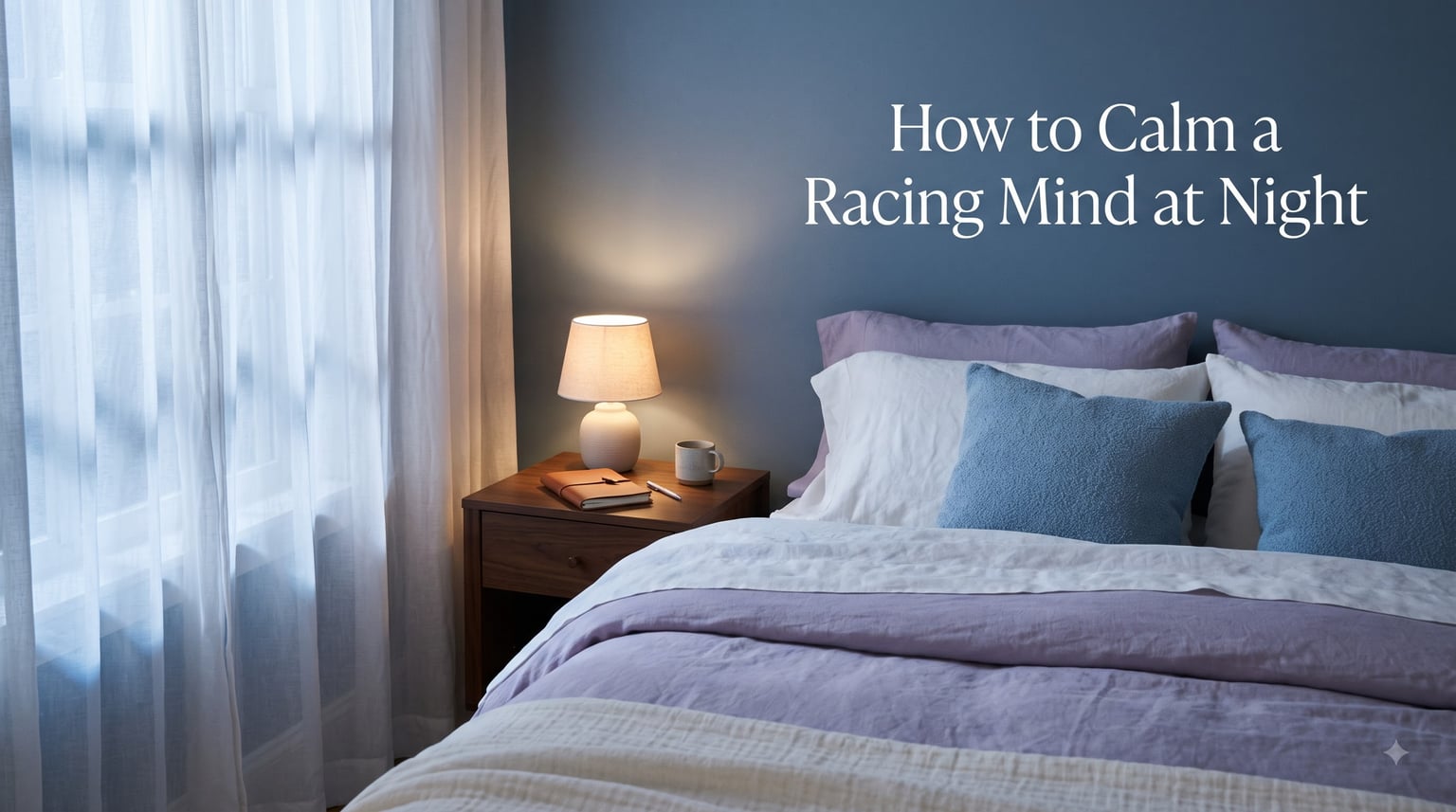
You lie down, close your eyes, and instead of drifting off, your brain decides it is the perfect time to replay every conversation from the day. Then it moves on to tomorrow’s to-do list. Then to that embarrassing thing you said three years ago. If you have ever found yourself staring at the ceiling wondering how to calm a racing mind at night, you are far from alone.
Research from the National Institute of Mental Health suggests that anxiety disorders affect roughly 19% of adults in the United States each year, and nighttime is when symptoms often peak. The quiet of the bedroom strips away the distractions that kept your worries at bay during the day. What is left is just you and your thoughts, with nowhere to run.
I have spent years researching and testing sleep techniques, both personally and through conversations with dozens of people who struggle with midnight anxiety. What I have learned is that there is no single magic switch. But there is a combination of science-backed strategies that can quiet your mind, and most of them take effect the very first night you try them.
This guide walks through exactly why your brain does this, the practical techniques that actually work, and when it might be time to talk to a professional. Everything here is grounded in clinical research and real-world experience.
Table of Contents
Why Your Mind Races at Night
Your mind races at night because of a phenomenon called hyperarousal, where your nervous system stays stuck in a heightened state of alertness even when there is no real threat. During the day, emails, conversations, traffic, and tasks keep your brain occupied with external input. When you lie down in a dark, quiet room, all of that external stimulation disappears. Your brain shifts inward, and suddenly every unfinished worry gets the spotlight.
This is closely tied to the fight-or-flight response. Your body evolved to react to danger with a burst of cortisol and adrenaline, sharpening your focus and preparing you to act. The problem is that your nervous system cannot always tell the difference between a physical threat and an anxious thought about tomorrow’s presentation. A worry about your job activates the same stress response as a predator chasing you. Your heart rate goes up, your breathing gets shallow, and sleep becomes biologically difficult.
Cortisol levels play a major role here. Normally, cortisol peaks in the early morning to help you wake and drops to its lowest point around midnight. But chronic stress can disrupt this pattern, leaving cortisol elevated when it should be tapering off. This keeps your brain in problem-solving mode instead of rest mode.
There is also a conditioning problem. If you spend night after night lying in bed worrying, your brain starts to associate the bedroom with stress rather than rest. The bed itself becomes a trigger. This is what sleep specialists call the “vicious loop” of insomnia and anxiety feeding each other. The more you worry about not sleeping, the harder it becomes to sleep, which gives you even more to worry about.
Racing Thoughts vs. Rumination: Understanding the Difference
Not all nighttime thinking is the same, and understanding which type you are dealing with changes the approach. Racing thoughts are rapid, often jumbled thoughts that jump from topic to topic. You might go from worrying about a work deadline to remembering you forgot to buy milk to replaying a social interaction, all in the span of thirty seconds. They feel chaotic and unstoppable, like a radio scanning through stations and never settling.
Rumination is different. It is repetitive, focused thinking on a single negative theme or problem. Instead of jumping between topics, you get stuck on one loop, replaying the same concern over and over without reaching any resolution. Rumination feels more like a broken record than a scrambled broadcast.
The distinction matters because the techniques that help with racing thoughts may not work as well for rumination. Racing thoughts often respond well to grounding and breathing techniques that interrupt the chaos. Rumination tends to require cognitive strategies like scheduled worry time, journaling, or cognitive behavioral techniques that address the content of the thoughts themselves.
If your mind is doing both, which is common, you may need to layer techniques. Start with breathing to slow the pace of your thinking, then use a brain dump to get the repetitive concerns out of your head and onto paper.
Breathing Techniques to Calm a Racing Mind at Night
Breathing techniques work because they directly signal your nervous system that you are safe. Slow, controlled breathing activates the parasympathetic nervous system, which is the body’s rest-and-digest mode. It is the biological opposite of fight-or-flight. Here are the three most effective methods, each backed by clinical research.
The 4-7-8 Breathing Method
The 4-7-8 method, developed by Dr. Andrew Weil, is one of the most popular breathing techniques for sleep. The pattern is simple: inhale through your nose for 4 seconds, hold your breath for 7 seconds, and exhale slowly through your mouth for 8 seconds. Repeat this cycle four times.
The long exhale is the key. When you exhale longer than you inhale, you stimulate the vagus nerve, which slows your heart rate and triggers relaxation. The 7-second hold allows carbon dioxide to build slightly in your bloodstream, which also has a calming effect on the nervous system. Many people report feeling noticeably calmer after just two or three cycles.
Boxed Breathing
Boxed breathing, also called square breathing, is used by Navy SEALs to stay calm under pressure. It follows a simple four-count pattern: inhale for 4 seconds, hold for 4 seconds, exhale for 4 seconds, and hold empty for 4 seconds. The symmetry makes it easy to remember and follow even when your mind is scattered.
This technique works particularly well if you tend to feel physically anxious at night, with symptoms like a racing heart or chest tightness. The steady rhythm gives your brain something to focus on besides your worries, while the breathing itself brings your heart rate down.
Diaphragmatic Breathing
Diaphragmatic breathing, or belly breathing, focuses on breathing deeply into your abdomen rather than shallowly into your chest. Place one hand on your chest and one on your belly. When you breathe in, the hand on your belly should rise while the hand on your chest stays relatively still.
A 2018 study published in the journal Frontiers in Psychology found that participants who practiced diaphragmatic breathing for 20 minutes daily showed significantly lower cortisol levels and improved sustained attention. For nighttime use, you do not need 20 minutes. Even five minutes of slow belly breathing in bed can shift your body out of stress mode.
Grounding Techniques to Stop Racing Thoughts
Grounding techniques pull your attention away from internal thoughts and anchor it in the present moment through your senses. They are especially effective when your mind feels like it is spinning out of control and breathing alone is not enough.
The 5-4-3-2-1 Method
The 5-4-3-2-1 method is a sensory grounding exercise that forces your brain to process external information instead of internal worries. Here is how it works: identify 5 things you can see, 4 things you can physically feel, 3 things you can hear, 2 things you can smell, and 1 thing you can taste.
If you are lying in the dark, you can adapt this. Instead of sight, focus on what you feel against your skin, the weight of the blankets, the temperature of the air. The point is to engage your senses so thoroughly that there is less mental bandwidth left for anxious thoughts.
Body Scan Meditation
A body scan involves slowly moving your attention through your body from head to toe, noticing sensations in each area without trying to change them. Start at the top of your head and work downward, spending a few breaths on each body part. Notice tension in your jaw, your shoulders, your hands. Simply observe without judgment.
This technique serves double duty. It grounds you in physical sensation, and it helps you identify and release tension you may not have realized you were holding. Many people carry stress in their jaw, shoulders, or stomach without noticing it until they do a body scan.
The Cognitive Shuffle
The cognitive shuffle is a technique that mimics the random, nonsensical thought patterns your brain naturally produces as you fall asleep. Think of a random word, like “boat.” Then picture something that starts with each letter: B, O, A, T. Banana, orange, apple, turtle. Keep going with new words and new associations.
The theory is that by forcing your brain to generate random, unrelated images, you interrupt the logical worry loops that keep you awake and nudge your brain toward the associative thinking of early sleep stages. Many people on sleep forums report this technique works when nothing else does.
Journaling and Brain Dump Strategies
Sometimes the reason your mind will not stop is that it is trying to hold onto information. Your brain treats unspoken worries like open browser tabs, each one consuming mental energy. A brain dump is the act of writing everything down so your brain can let go.
Here is a simple three-step process for a nighttime brain dump. Keep a notebook and pen on your nightstand, not your phone, since screens interfere with melatonin production.
Step one: Write down everything on your mind without filtering or organizing. Worries, tasks, random thoughts, conversations you need to have. Get it all out. Do not worry about complete sentences or neat handwriting. The goal is transfer, not literature.
Step two: For each worry, write one small action you can take tomorrow. It does not need to solve the whole problem. Just identify the next step. This signals to your brain that the concern has been acknowledged and assigned a plan, which reduces the urgency to keep thinking about it.
Step three: Close the notebook and say to yourself, either silently or out loud, “These are tomorrow’s problems. I have done what I can tonight.” This verbal cue may sound simple, but it helps create a mental boundary between planning time and sleeping time.
Clinicians also recommend “worry time,” which is scheduling a specific 15 to 20 minute window earlier in the day, ideally before 8pm, to process concerns. If a worry pops up at bedtime, you remind yourself that it has already been addressed or will be addressed during tomorrow’s worry time. This trains your brain to contain anxious thinking to a designated period rather than letting it bleed into sleep.
Sleep Environment and Habits That Help
Your bedroom environment and daily habits shape how easily your brain transitions into sleep mode. If your room is bright, noisy, or associated with work and worry, no amount of breathing technique will fully compensate.
Start with light exposure. Your circadian rhythm, the internal clock that regulates sleep, is primarily set by light. Morning sunlight tells your brain to be alert, and evening darkness triggers melatonin production. If you are looking at screens late into the evening, the blue light suppresses melatonin and confuses your body clock. Try to stop using phones, tablets, and computers at least 60 minutes before bed. If that is not realistic, use blue light filters on your devices and keep screen brightness low.
Temperature matters more than most people realize. The ideal sleeping temperature is between 60 and 67 degrees Fahrenheit (15 to 19 degrees Celsius). A cooler room facilitates the natural drop in body temperature that occurs as you fall asleep. If your room is too warm, your body has to work harder to cool down, which can keep you alert.
If you have been lying in bed unable to sleep for more than 20 minutes, get up. This is a core principle of stimulus control therapy, a component of CBT-I. Go to another room, do something calm and low-light like reading a physical book or gentle stretching, and only return to bed when you feel drowsy. The goal is to break the association between your bed and wakefulness, and rebuild the association between your bed and sleep.
Consistency is also important. Going to bed and waking up at the same time every day, including weekends, stabilizes your circadian rhythm. This makes it easier for your brain to know when to wind down and when to wake up. An irregular schedule is like constantly changing time zones without ever traveling.
Special Considerations: ADHD, Menopause, and Anxiety
Racing thoughts at night are not a one-size-fits-all problem. Different underlying conditions require different approaches, and much of the standard advice glosses over these distinctions.
ADHD and Racing Thoughts
People with ADHD often experience racing thoughts more intensely at night. During the day, hyperactivity and external stimulation keep the brain engaged. When those fade at bedtime, the internal mental activity becomes overwhelming. Many people with undiagnosed or unmanaged ADHD describe their nighttime mind as a television with the volume turned all the way up.
Strategies that help with ADHD-related racing thoughts include physical outlets earlier in the day. Exercise, even moderate activity like a long walk, helps burn off excess energy. Some people with ADHD report that static exercises like planks or gentle stretching in the evening help focus the body and quiet the mind. Body-doubled activities, where you do something alongside another person, can also help the brain settle. Working with a psychiatrist or therapist who understands ADHD is important, as medication timing and dosage can significantly affect nighttime symptoms.
Menopause and Perimenopause
Hormonal changes during perimenopause and menopause can trigger racing thoughts and nighttime anxiety. Declining estrogen levels affect serotonin and cortisol regulation, which can lead to mood swings, anxiety, and sleep disruption. Night sweats and hot flashes add another layer of physical discomfort that makes sleep difficult.
If you are going through perimenopause or menopause and experiencing racing thoughts, it is worth discussing with a healthcare provider. Hormone therapy, certain antidepressants, and lifestyle changes can all help. Cooling the bedroom, using moisture-wicking sleepwear, and practicing breathing techniques specifically during hot flashes can reduce the anxiety spike that often accompanies them.
Chronic Anxiety Disorders
For people with generalized anxiety disorder, social anxiety, or other anxiety conditions, racing thoughts at night are often a symptom of a broader pattern. In these cases, techniques like breathing and journaling can provide temporary relief, but treating the underlying anxiety through therapy, particularly cognitive behavioral therapy, is what creates lasting change.
When to Seek Professional Help
Occasional racing thoughts are normal, especially during stressful periods. But if nighttime anxiety is happening three or more nights per week for a month or longer, it is time to talk to a professional. Chronic sleep problems affect your immune system, cognitive function, emotional regulation, and long-term health.
The gold standard treatment for sleep-related anxiety is CBT-I, or Cognitive Behavioral Therapy for Insomnia. Research consistently shows it is more effective than sleep medication for long-term results. CBT-I combines stimulus control, sleep restriction, cognitive restructuring, and relaxation training to address both the behaviors and thought patterns that drive insomnia. A typical course runs 6 to 8 sessions, and many people see significant improvement within the first few weeks.
Regarding medication, several options exist but should only be considered under medical supervision. Doctors may prescribe short-term sleep aids, anti-anxiety medications, or, in some cases, low-dose antidepressants that also help with sleep. Over-the-counter supplements like melatonin can help with sleep timing but do not address the underlying anxiety driving racing thoughts. Melatonin is not a sedative. It signals to your brain that it is dark and time to sleep, so timing matters more than dosage.
Pay attention to red flags. If racing thoughts are accompanied by panic attacks, persistent feelings of dread, thoughts of self-harm, or if they are interfering with your ability to function during the day, seek help promptly. These may be signs of an anxiety disorder, depression, or another condition that requires professional treatment. There is no shame in getting help, and these conditions are highly treatable.
FAQs
What can I do to stop racing thoughts?
Try the 4-7-8 breathing method (inhale for 4 seconds, hold for 7, exhale for 8), do a brain dump by writing all worries in a notebook, use the 5-4-3-2-1 grounding technique to engage your senses, or try the cognitive shuffle by picturing random unrelated objects. Combining two or three of these techniques works better than relying on just one.
What are the symptoms of an overactive mind?
Common symptoms include rapid jumbled thoughts jumping between topics, inability to focus on one thing, physical tension in the jaw or shoulders, shallow breathing, racing heart, inability to fall asleep despite feeling tired, and waking up in the middle of the night with thoughts immediately resuming. Persistent symptoms affecting daily functioning may indicate an anxiety disorder.
Why am I having racing thoughts and can’t sleep?
Racing thoughts at night occur because the quiet environment removes external distractions, causing your brain to shift inward and process unaddressed worries. Chronic stress keeps cortisol elevated, maintaining the fight-or-flight response. Over time, your brain may associate the bed with worry, creating a cycle where anxiety and insomnia reinforce each other.
What medication can I take to stop racing thoughts?
Medication options include prescription anti-anxiety medications, certain antidepressants that also treat anxiety, and short-term sleep aids. Over-the-counter melatonin can help regulate sleep timing but does not treat anxiety. Always consult a doctor before starting any medication, as the right choice depends on the underlying cause of your racing thoughts.
Can racing thoughts be a symptom of BPD?
Racing thoughts can occur in borderline personality disorder, but they are also common in anxiety disorders, ADHD, bipolar disorder, depression, and during periods of high stress. BPD involves a broader pattern of emotional instability, unstable relationships, and fear of abandonment. A mental health professional can provide an accurate diagnosis based on a full evaluation.
What could be causing my constant racing thoughts all day long?
Constant racing thoughts throughout the day may point to generalized anxiety disorder, ADHD, bipolar disorder, thyroid dysfunction, or chronic stress. Caffeine intake, certain medications, and substance use can also contribute. If racing thoughts persist throughout the day and interfere with daily life, consult a healthcare provider for a thorough evaluation.
Your Tonight Checklist for a Quieter Mind
Learning how to calm a racing mind at night is not about finding one perfect technique. It is about building a system that works for your brain and your life. Some nights you will need breathing exercises. Other nights a brain dump will do the trick. What matters is having a toolkit ready so you are not lying there experimenting when you should be sleeping.
Here is what to try tonight. One hour before bed, turn off screens and dim the lights. Twenty minutes before bed, do a brain dump in a physical notebook. When you get into bed, start with 4-7-8 breathing for four cycles. If your mind is still active, switch to the cognitive shuffle or a body scan. If you are still awake after 20 minutes, get up, read or stretch in low light, and return when you feel drowsy.
Stick with this routine for at least two weeks. The techniques become more effective with practice as your nervous system learns new patterns. If you do not see improvement after consistent effort, or if your symptoms are severe, reach out to a healthcare provider or sleep specialist. CBT-I is highly effective, and you do not have to solve this alone.
Sleep is not a luxury. It is the foundation of everything else in your life. Your racing mind is not broken, it is just stuck in a pattern. With the right tools and a little patience, that pattern can change.