
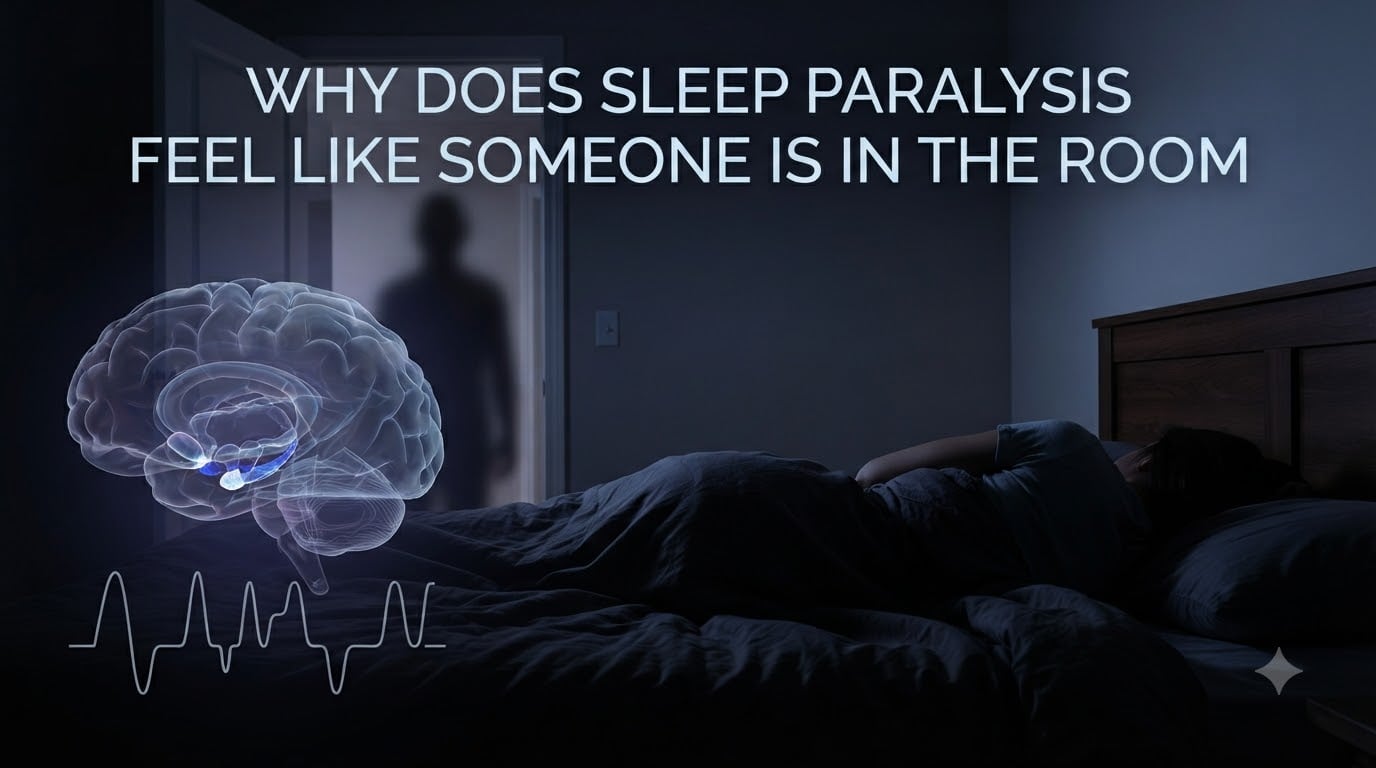
You wake up in the middle of the night, completely aware of your surroundings, but your body will not move. Then you sense it. Someone, or something, is standing in the corner of your room. You cannot turn your head to look. You cannot call out for help. The presence feels undeniable, threatening, and real.
If you have experienced this, you are not alone. Up to 30% of people will go through at least one sleep paralysis episode in their lifetime. The sensation of an intruder in the room is one of the most common and frightening features of the experience.
So why does sleep paralysis feel like someone is in the room? The answer lies in a temporary glitch in your brain’s sleep-wake transition, where dream-state hallucinations bleed into waking consciousness while your body remains paralyzed. In this article, we break down the science behind the presence hallucination, the brain regions involved, and what you can do about it.
Table of Contents
What Is Sleep Paralysis?
Sleep paralysis is a state where your mind is conscious but your body is temporarily unable to move or speak. It happens during the transition between sleep and wakefulness, either as you are falling asleep or as you are waking up.
During normal REM (rapid eye movement) sleep, your brain sends a signal that temporarily paralyzes your voluntary muscles. This process, called muscle atonia, prevents you from physically acting out your dreams. Sleep paralysis occurs when you become conscious while this paralysis is still active. Your brain is essentially caught between dreaming and waking.
Doctors recognize two main types of sleep paralysis. Hypnagogic sleep paralysis happens as you are falling asleep, when your body relaxes into atonia before your mind has fully lost awareness. Hypnopompic sleep paralysis happens as you are waking up, when your mind regains consciousness before your body has been released from paralysis. The hypnopompic form is more common and tends to produce the most vivid hallucinations.
Sleep paralysis is classified as a parasomnia, a category of sleep disorders that involves abnormal behaviors or experiences during sleep. While the episodes can be terrifying, they are not physically harmful. They typically last anywhere from a few seconds to a couple of minutes.
Why Does Sleep Paralysis Feel Like Someone Is in the Room
The short answer: sleep paralysis feels like someone is in the room because your brain is still generating dream imagery while you are partially awake. During REM sleep, your brain activates the same regions involved in fear detection and threat assessment. When you wake into sleep paralysis, those fear circuits remain switched on, and your brain tries to make sense of the lingering dream state by projecting a threat into your environment.
This process is called REM intrusion. Your dreaming brain spills its content into your waking consciousness. Because REM sleep naturally produces intense, emotionally charged imagery, the hallucinations feel completely real. You are not imagining them. Your brain is generating them through the same neural pathways it uses to construct dreams.
The specific feeling of a presence comes down to a structure deep in your brain called the amygdala. The amygdala is your threat-detection center, and it becomes highly active during REM sleep. When you wake into sleep paralysis, your amygdala is already on high alert. It interprets the strange, paralyzed sensation of your body as a sign of danger and begins searching for a source.
Because you cannot move, your brain has limited sensory information to work with. So it fills in the gaps. The result is a vivid, often terrifying projection of a presence, a figure, or an entity in the room with you. Your brain is not malfunctioning. It is doing exactly what it evolved to do: detecting threats and constructing a narrative to explain a frightening situation.
The Threat Assessment Theory Explained
Researchers have proposed a compelling explanation called the threat assessment theory (also referred to as the threat simulation theory). According to this framework, the presence hallucination is a product of your brain’s ancient survival machinery misfiring during a confused sleep-wake state.
When you are in sleep paralysis, your brain registers two alarming signals simultaneously: you are awake, but you cannot move. From an evolutionary standpoint, being conscious and immobilized is extremely dangerous. Your amygdala and related fear circuits interpret this vulnerability as a predator or attacker nearby.
Your brain then constructs a hallucination to match the threat it perceives. This is why the presence almost always feels hostile rather than friendly. The intruder hallucination is your brain’s way of explaining the fear and immobility you are experiencing. It invents a cause for the alarm your body is already feeling.
This theory also explains why the presence feels so real. The hallucination is generated by the same sensory and emotional systems you use in waking life. You are not seeing a fantasy. Your visual cortex, your auditory cortex, and your emotional centers are all actively processing the experience as though it were happening.
The Evolutionary Purpose of the Presence Hallucination
Why would the human brain produce such a terrifying experience? From an evolutionary perspective, the threat detection system that drives the presence hallucination was built for survival. Early humans who were more sensitive to potential threats during vulnerable states were more likely to survive and pass on their genes.
Sleep paralysis essentially activates this survival system at the wrong time. Your brain’s threat detection apparatus, designed to protect you from real predators, fires during a harmless sleep transition. The presence you feel is a vestige of an ancient defense mechanism responding to the unusual situation of being conscious but immobilized.
This evolutionary lens helps explain why sleep paralysis experiences are remarkably similar across cultures. From the Old Hag of Newfoundland to the Pop Bawa of Zanzibar to the shadow people reported across the United States, the core experience is the same. The human brain, regardless of culture, generates the same threat projection when caught in this state.
The Science Behind the Presence Hallucination
To understand the presence hallucination on a neurological level, we need to look at what happens in the brain during REM sleep and how those processes carry over into sleep paralysis.
During REM sleep, several brain regions become highly active. The amygdala, which processes fear and emotional responses, shows increased activity. The visual association areas generate vivid dream imagery. Meanwhile, the prefrontal cortex, responsible for logical reasoning and reality testing, becomes less active. This combination explains why dreams feel emotionally intense and logically bizarre at the same time.
When you wake into sleep paralysis, this REM activity pattern does not shut off cleanly. Your amygdala remains activated, your visual areas keep generating imagery, and your prefrontal cortex has not fully come back online to tell you that what you are experiencing is not real. You are essentially dreaming with your eyes open.
Neuroscientists have identified three key hallucination categories that result from this REM intrusion. Each one corresponds to a different brain system that remains active during the sleep-wake transition:
Intruder hallucinations involve sensing a presence in the room. This is driven by the amygdala and the threat-detection network. You may hear footsteps, whispers, or breathing. You may see a shadowy figure standing nearby. This is the most common type and directly answers why sleep paralysis feels like someone is in the room.
Incubus hallucinations involve pressure on the chest or a feeling of being restrained or suffocated. This is driven by the brain’s misinterpretation of the muscle atonia itself. Because you naturally try to move during the episode but cannot, your brain interprets the lack of movement as external pressure or a weight on your body.
Vestibular-motor hallucinations involve sensations of floating, flying, falling, or out-of-body experiences. These are driven by the vestibular system, which controls your sense of balance and spatial orientation. When this system misfires during sleep paralysis, you may feel like you are rising out of your body or spinning through space.
These three categories often overlap during a single episode. Many people experience the intruder and incubus hallucinations together, which is why the presence often feels like it is sitting on your chest or pinning you down.
Common Hallucination Types During Sleep Paralysis
People who experience sleep paralysis describe a wide range of hallucinations, but certain themes appear again and again. Understanding these common patterns can help you recognize them if they happen to you, which is one of the most effective ways to reduce fear during an episode.
The intruder or shadow person is the most frequently reported hallucination. People describe seeing a dark, humanoid figure standing in the doorway, at the foot of the bed, or hovering near them. The figure is usually featureless or has glowing eyes. Some people report that the figure moves toward them or simply watches.
The demon or old hag experience is closely related. Many cultures have historical names for this phenomenon, from the mare in Scandinavian folklore (which gave us the word nightmare) to the Pisadeira of Brazilian legend, a crone who sits on the chests of people who sleep on their backs with full stomachs. These cultural frameworks show how universal the experience is.
Sensory hallucinations are also extremely common. People report hearing footsteps approaching, doors creaking, whispering voices, or heavy breathing. Some hear their name called. Others feel a physical touch, such as fingers on their arm or pressure on their legs. These sensations are generated by the same brain systems that process real sounds and touches, which is why they feel completely authentic.
On Reddit’s sleep paralysis communities, users frequently share these experiences. One common description involves a sense of absolute certainty that someone has entered the room, even before any visual or auditory hallucination appears. The feeling of presence often precedes the more specific hallucinations, which supports the threat assessment theory: your brain first detects a threat, then constructs details to explain it.
Less commonly, people report neutral or even positive presences. Some describe feeling a guardian figure or a deceased loved one nearby. These gentler experiences are less frequent but demonstrate that the presence hallucination is not always terrifying, even though the threat-detection system makes fear the dominant emotional response.
What Triggers Sleep Paralysis Episodes
Sleep paralysis does not happen randomly. Researchers have identified several factors that increase the likelihood of episodes, and understanding these triggers can help you reduce their frequency.
Sleep deprivation is the single most common trigger. When you do not get enough sleep, your brain enters REM sleep more quickly and spends more time in it, a phenomenon called REM rebound. This increases the chances that you will wake during a REM cycle while paralysis is still active.
Stress and anxiety also play a major role. High stress levels disrupt normal sleep architecture and can increase the frequency of parasomnias. Many people report that their sleep paralysis episodes cluster during periods of intense work pressure, relationship difficulties, or major life changes.
Sleeping position matters more than most people realize. Studies show that sleeping on your back (supine position) significantly increases the likelihood of sleep paralysis. This position may contribute to the incubus hallucination, as it can cause mild airway restriction that the brain misinterprets as chest pressure or suffocation.
Irregular sleep schedules are another factor. Shift workers, people with jet lag, and anyone whose sleep timing varies significantly from day to day are at higher risk. The brain thrives on consistent sleep-wake cycles, and disrupting them can trigger parasomnias.
Certain medical conditions are associated with higher rates of sleep paralysis. Narcolepsy is the most significant, and sleep paralysis is one of its hallmark symptoms. Sleep apnea, post-traumatic stress disorder (PTSD), and generalized anxiety disorder also increase risk. Some medications, particularly those that affect REM sleep, can contribute as well.
Substance use plays a role for some people. Alcohol disrupts REM sleep, and caffeine and stimulants can interfere with sleep quality. The use of certain sleep aids or their withdrawal can also trigger episodes in susceptible individuals.
How to End a Sleep Paralysis Episode
Knowing what to do during a sleep paralysis episode can make the experience far less frightening. While the episode will end on its own within seconds to minutes, there are strategies you can use to regain control more quickly.
The single most important thing to remember is that you are safe. Remind yourself that what you are experiencing is sleep paralysis, that it is temporary, and that the presence you feel is a hallucination generated by your brain. This cognitive reframing, while difficult in the moment, significantly reduces fear.
Do not try to force your entire body to move. Fighting against the paralysis tends to increase panic and can make the hallucinations feel more intense. Instead, focus on moving a small part of your body. Try wiggling a finger, a toe, or your tongue. These small movements can help signal to your brain that it is time to release the muscle atonia.
Focus on your breathing. Because breathing is controlled automatically during sleep paralysis, you will continue to breathe even if it feels difficult. Concentrating on slow, steady breaths can help calm your nervous system and reduce the sense of threat that fuels the hallucinations.
Some people find that trying to make a small sound, like a hum or a grunt, helps break the episode. If you sleep with a partner, you can work out a system where they recognize these sounds and gently wake you fully.
If you experience sleep paralysis frequently, practice these techniques during waking hours so they become automatic. Mental rehearsal of your response can make a real difference when an episode occurs. The goal is to shift from panic to recognition as quickly as possible.
How to Prevent Sleep Paralysis
While you cannot eliminate sleep paralysis entirely if you are prone to it, several lifestyle adjustments can significantly reduce how often episodes occur.
Prioritize consistent, adequate sleep. Aim for 7 to 9 hours per night and try to go to bed and wake up at the same times each day, even on weekends. This consistency helps regulate your sleep cycles and reduces REM rebound that triggers episodes.
Change your sleeping position if you typically sleep on your back. Training yourself to sleep on your side can reduce the frequency of sleep paralysis for many people. Using a body pillow can help you stay on your side throughout the night.
Manage stress through whatever methods work for you. Regular exercise, meditation, deep breathing exercises, and limiting screen time before bed can all improve sleep quality and reduce parasomnia frequency.
Avoid heavy meals, alcohol, and caffeine close to bedtime. These substances disrupt normal sleep architecture and can increase the likelihood of sleep paralysis, especially in combination with other risk factors.
Improve your sleep environment. Keep your bedroom cool, dark, and quiet. A comfortable mattress and minimal noise disruption help your brain move smoothly through sleep cycles without the micro-awakenings that can trigger sleep paralysis.
When to See a Doctor About Sleep Paralysis
For most people, occasional sleep paralysis is a normal, if unsettling, experience that does not require medical treatment. However, there are situations where consulting a healthcare provider is appropriate.
Talk to a doctor if your episodes are frequent, occurring weekly or more often. Frequent sleep paralysis can significantly impact your sleep quality and mental health, leading to anxiety about falling asleep that creates a vicious cycle.
Seek medical advice if your episodes are accompanied by excessive daytime sleepiness, sudden loss of muscle tone during emotional moments (cataplexy), or falling asleep uncontrollably during the day. These can be signs of narcolepsy, which requires professional diagnosis and management.
If sleep paralysis is causing you significant distress, anxiety, or fear of sleeping, a sleep medicine specialist or therapist can help. Cognitive behavioral therapy has shown effectiveness in reducing the anxiety associated with recurrent episodes. In some cases, doctors may recommend treating underlying conditions like sleep apnea that could be contributing.
Frequently Asked Questions About Sleep Paralysis
Is it normal to feel someone’s presence during sleep paralysis?
Yes, feeling a presence in the room is one of the most common sleep paralysis experiences. Research suggests that up to 60% of sleep paralysis episodes include this intruder hallucination. It is caused by your brain’s threat detection system remaining active during the sleep-wake transition, projecting a sensed presence into your environment. It is frightening but completely normal and harmless.
How to snap someone out of sleep paralysis?
To help someone in sleep paralysis, do not shake them aggressively. Instead, speak to them calmly, call their name, or gently touch their arm or shoulder. Light stimulation can help their brain fully transition out of REM sleep. Avoid startling them, as waking suddenly from a hallucination can be disorienting. Most episodes end on their own within seconds to a couple of minutes.
Why can’t you yell during sleep paralysis?
You cannot yell during sleep paralysis because the same muscle atonia that paralyzes your limbs also affects your vocal cords and chest muscles. During REM sleep, your brain shuts down voluntary muscle control to prevent you from acting out dreams. In sleep paralysis, you regain consciousness before this paralysis lifts, so you cannot speak, scream, or make intentional sounds even though you are fully aware and trying.
What are the scariest things people see during sleep paralysis?
The most commonly reported frightening visions include a dark shadowy figure standing in the room, a demon or old hag sitting on the chest, glowing eyes watching from a corner, and a faceless humanoid approaching the bed. People also report hearing footsteps, whispers, their name being called, and feeling physical touch or pressure. These hallucinations feel completely real because they are generated by the same brain systems that process actual sensory information.
Can sleep paralysis kill you?
No, sleep paralysis cannot kill you. It is a benign, temporary phenomenon. Your breathing continues automatically during an episode, even though it may feel difficult. The experience is frightening but physically harmless. Episodes resolve on their own within seconds to minutes as your brain completes the transition to full wakefulness.
How long does sleep paralysis last?
A typical sleep paralysis episode lasts anywhere from a few seconds to about two minutes, though some people report episodes lasting up to ten minutes. The hypnopompic type (occurring while waking up) tends to last slightly longer than the hypnagogic type (occurring while falling asleep). Time perception during episodes can feel distorted, making them seem longer than they actually are.
Conclusion
Understanding why sleep paralysis feels like someone is in the room transforms a terrifying mystery into a recognizable, manageable phenomenon. The presence you sense is not a ghost, a demon, or an intruder. It is your brain’s threat-detection system, the amygdala, continuing to fire during a confused sleep-wake transition and constructing a hallucination to explain the fear and immobility you are experiencing.
REM intrusion, the threat assessment theory, and the evolutionary origins of our fear response all work together to explain why this experience is so vivid, so universal, and so convincing. The same brain systems that kept our ancestors alert to danger are the ones generating the shadow figure in your bedroom.
If you experience sleep paralysis, the most powerful tool you have is recognition. Knowing what is happening, knowing it will end, and knowing you are safe can dramatically reduce the fear that makes episodes so distressing. Practice the techniques for ending episodes, address the triggers that increase their frequency, and talk to a doctor if they are disrupting your life.
Sleep paralysis is your brain doing too much with too little information. Now that you know the science, you are equipped to face it with understanding instead of fear.