
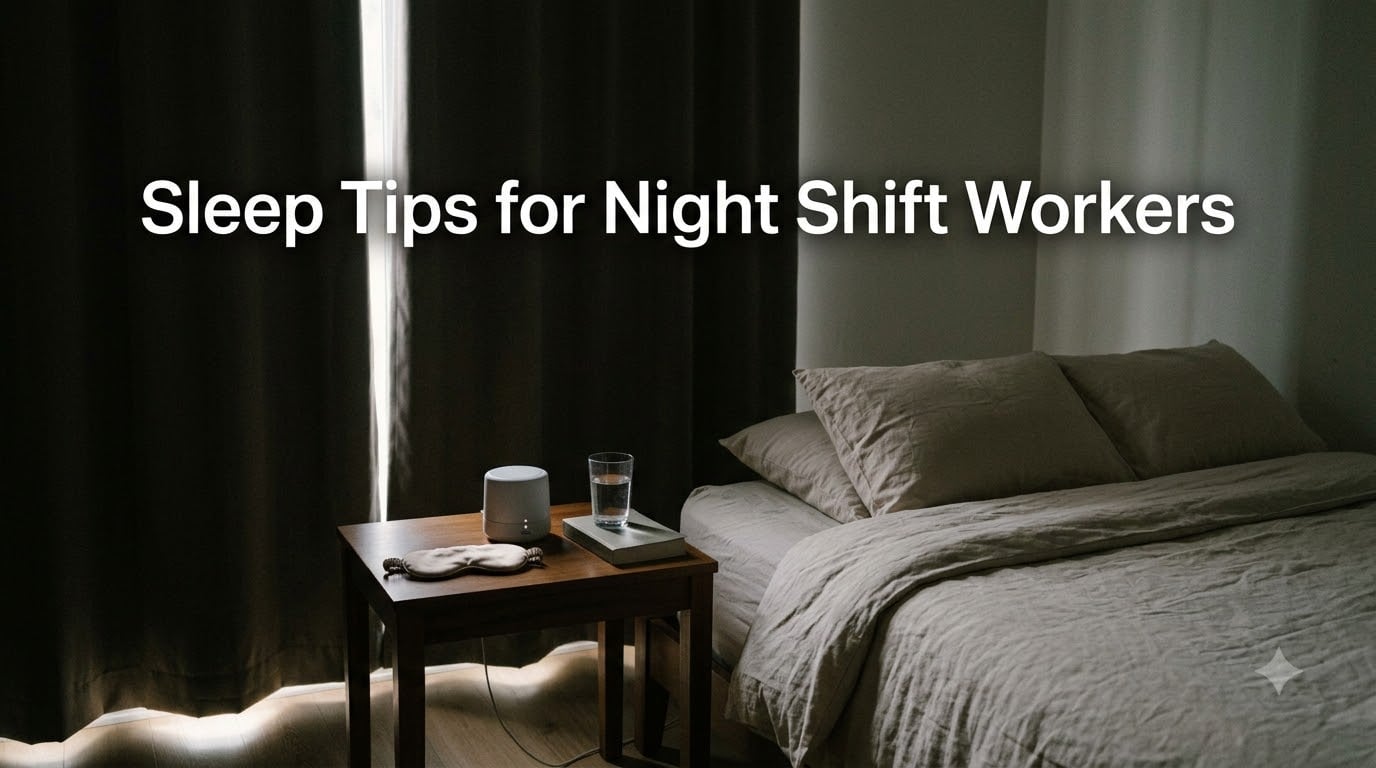
If you work the night shift, you already know the struggle. You clock out at 7 AM, drive home through morning traffic with the sun blazing in your eyes, and crawl into bed while the rest of the world is just waking up. Then you lie there, staring at the ceiling, wondering why you cannot fall asleep despite being exhausted.
You are not alone. According to the Bureau of Labor Statistics, roughly 15 million Americans work evening, night, or rotating shifts. Healthcare workers, emergency responders, factory operators, and security personnel make up the largest groups. Many of them are running on 4 to 6 hours of fragmented sleep per day, accumulating dangerous levels of sleep debt.
The problem is not a lack of willpower. Your body is biologically wired to stay awake during daylight hours. When you work against that wiring night after night, your circadian rhythm fights back. This guide brings together sleep tips for night shift workers that are backed by clinical research, recommended by sleep specialists, and tested by real shift workers who have been doing this for years.
I have organized this into specific, actionable sections. You will find concrete time frames, specific temperature targets, and step-by-step routines you can start using tonight. Whether you are new to night shift or a veteran looking to improve your sleep quality, there is something here for you.
Table of Contents
Why Your Circadian Rhythm Works Against Night Shift Sleep
Your circadian rhythm is a 24-hour internal clock that regulates when you feel alert and when you feel sleepy. It responds primarily to light and dark signals from your environment. When sunlight hits your eyes in the morning, your brain suppresses melatonin production and pumps out cortisol to wake you up. When darkness falls, melatonin rises and prepares your body for sleep.
Night shift work flips this entire system upside down. You need to be alert when your body is producing melatonin, and you need to sleep when your brain is flooding with cortisol. This misalignment is the root cause of nearly every sleep problem shift workers face.
Research published in the Journal of Clinical Sleep Medicine shows that night shift workers get an average of 1 to 4 hours less sleep than day workers. The sleep they do get is often fragmented, with less time spent in deep REM sleep stages. Over weeks and months, this sleep debt accumulates into chronic sleep deprivation.
Here is the good news. Your circadian rhythm is not fixed. It can be shifted, trained, and partially adapted to a night schedule. But it requires consistency and strategic manipulation of light, sleep timing, and daily habits. You cannot rely on willpower alone. You need a system.
One nurse I spoke with on the r/Nightshift community put it perfectly: “The first three weeks were brutal. But once I committed to the same sleep window every single day, even on days off, my body actually started adjusting. Not fully, but enough to function.”
Creating the Perfect Daytime Sleep Environment
Your bedroom environment is the single most controllable factor in how well you sleep during the day. Most night shift workers fail here because they try to sleep in a room designed for nighttime rest. Daytime sleep demands a completely different setup.
Block Every Ounce of Light
Light is the number one enemy of daytime sleep. Even a thin crack of sunlight around your curtains signals your brain to stay awake. You need total darkness, and that means investing in proper blackout curtains.
Blackout curtains should cover the entire window frame with no gaps at the sides. Many night shift workers layer blackout curtains with a blackout blind underneath for double coverage. If you rent or cannot install curtains, a high-quality sleep mask is your next best option.
Reddit users on r/Nightshift consistently recommend the Manta Sleep Mask and the Alaska Bear mask for comfort and total light blocking. The key is finding one that does not put pressure on your eyelids while blocking light from every angle.
Do not forget about electronic lights. Cover LED indicators on your TV, charger, smoke detector, and any other devices. Even small amounts of blue light can disrupt melatonin production by up to 30 percent according to Harvard Medical School research.
Control Your Room Temperature
The ideal sleeping temperature is between 65 and 68 degrees Fahrenheit. Your body temperature needs to drop slightly for you to fall and stay asleep. During summer months, daytime heat makes this especially challenging.
Use a programmable thermostat to lower your room temperature about 30 minutes before your scheduled sleep time. If air conditioning is not available, a cooling mattress pad or gel pillow can help regulate your body temperature during sleep.
Eliminate Daytime Noise
Daytime noise is the complaint I hear most from night shift workers. Garbage trucks, lawn mowers, neighbors, delivery drivers, and family members all conspire against your sleep window. You need an aggressive noise management strategy.
White noise machines are the most popular solution. They create a consistent sound wall that masks sudden noises. The LectroFan and Magicteam models are frequently recommended by shift workers for their variety of sound options and volume range.
Earplugs are another option, though opinions are mixed. Some workers find foam earplugs like Howard Leight or Mack’s Ultra Soft comfortable and effective. Others find them irritating or worry about missing alarms. If you use earplugs, pair them with a white noise machine for maximum noise reduction.
Talk to your family and housemates about your sleep schedule. Put a sign on your door. Silence your phone and use the Do Not Disturb feature, allowing calls only from emergency contacts. These conversations feel awkward at first, but they are essential for protecting your sleep.
Create a Wind-Down Routine
Your brain needs a transition period between work mode and sleep mode. Just like day workers benefit from a bedtime routine, you need a decompression ritual that signals to your body that sleep is coming.
Spend 20 to 30 minutes after your shift doing something calming. Take a warm shower, read a physical book, practice light stretching, or listen to a podcast. Avoid screens during this window. The blue light from your phone or TV will delay melatonin production and make falling asleep harder.
One ER technician shared this routine: “I get home, take a hot shower with the lights dimmed, drink chamomile tea, and read for 15 minutes. My brain knows the routine now. I am usually asleep within 10 minutes of putting the book down.”
Light Exposure Management Strategies That Actually Work
Light is the most powerful tool you have for manipulating your circadian rhythm. Used strategically, it can help your body adapt to a night schedule. Used carelessly, it will sabotage every other effort you make.
Maximize Bright Light During Your Shift
When you arrive at work, expose yourself to bright light immediately. This suppresses melatonin and signals your brain that it is time to be alert. If your workplace has bright overhead lights, keep them on. If not, consider a light therapy box that delivers at least 10,000 lux.
Position the light therapy box about 16 to 24 inches from your face for 20 to 30 minutes at the start of your shift. This mimics the morning sunlight that day workers naturally receive. Research from the Cleveland Clinic shows that bright light exposure during night shifts significantly improves alertness and reaction times.
Block Light on Your Commute Home
Your morning commute home is a critical moment. Sunlight hitting your eyes at 6 or 7 AM tells your brain that daytime has started. This is the worst possible signal when you are trying to go to bed.
Wear blue light blocking glasses or dark sunglasses during your drive home. Even on overcast days, outdoor light levels are far brighter than indoor lighting and will disrupt your sleep onset. This simple step alone can cut your time to fall asleep by 15 to 20 minutes.
A factory worker on r/Nightshift shared: “I started wearing my darkest sunglasses on the drive home and kept the car visor down. It felt ridiculous, but I was falling asleep in half the time. Morning light was my biggest enemy.”
Use Light Therapy Strategically
A light therapy box is not just for your shift. You can use it strategically to help anchor your circadian rhythm. Use bright light at the start of your shift and avoid bright light in the 2 hours before your planned sleep time.
If you wake up before your shift and it is already dark outside, use the light therapy box for 15 to 20 minutes. This helps establish a consistent “morning” signal for your body, even when that morning happens at 9 PM.
Avoid screens entirely during your last hour before bed. If you must use your phone, enable night mode or use blue light filtering apps. But even filtered screen light is not ideal. The best strategy is to keep your bedroom a screen-free zone during your sleep preparation.
Caffeine Timing and Management for Night Shift Workers
Caffeine is the lifeline of most night shift workers. Used strategically, it keeps you alert and safe during your shift. Used poorly, it destroys your ability to sleep when you get home. The difference comes down to timing.
Understand the Caffeine Half-Life
Caffeine has a half-life of approximately 5 to 6 hours in most adults. That means if you drink a cup of coffee containing 100 mg of caffeine at 2 AM, you still have 50 mg active in your system at 7 or 8 AM. Half of that is still circulating at noon.
This is why many shift workers cannot fall asleep after their shift. They are still loaded with caffeine from the back half of their work night. Your body may feel tired, but your nervous system is still stimulated.
The 4-to-6 Hour Cutoff Rule
Stop consuming caffeine at least 4 to 6 hours before your planned sleep time. If you plan to sleep at 8 AM, your last caffeinated drink should be no later than 2 to 4 AM. This gives your body enough time to metabolize most of the caffeine before you try to sleep.
Switch to decaf coffee, herbal tea, or water for the second half of your shift. Chamomile tea is a popular choice among experienced shift workers for its mild sedative effects without the grogginess of sleep aids.
The Caffeine Nap Technique
If you are struggling with mid-shift drowsiness, try the caffeine nap strategy. Drink a cup of coffee quickly, then immediately take a 15 to 20 minute nap. Caffeine takes about 20 minutes to enter your bloodstream. When you wake up, you get the combined benefit of nap recovery and caffeine stimulation hitting simultaneously.
This technique is backed by research from Loughborough University, which found that caffeine naps improved alertness more than either caffeine or napping alone. Many night shift workers report it as a game-changer for the 3 AM slump.
Avoid These Caffeine Mistakes
Do not drink energy drinks loaded with sugar. The sugar crash will make you more tired than before. Avoid caffeine pills unless recommended by a doctor, as the doses are often much higher than a cup of coffee and can cause jitters, anxiety, and heart palpitations.
Also, be aware of hidden caffeine sources. Chocolate, certain teas, some medications, and even decaf coffee contain small amounts. If you are sensitive to caffeine, these can add up and interfere with sleep.
Strategic Napping Techniques for Shift Workers
Napping is not a luxury for night shift workers. It is a necessity. Strategic naps can improve alertness, reduce accident risk, and help manage the sleep debt that accumulates from working against your circadian rhythm. But not all naps are created equal.
What Is the 3-3-3 Rule for Sleep?
The 3-3-3 rule is a simple framework for managing sleep on a night shift schedule. It recommends three sleep anchors: a main sleep block, a pre-shift nap, and a mid-shift nap, each timed strategically. The goal is to distribute your sleep across your active period rather than relying on one single block.
While the exact numbers vary depending on who you ask, the core principle is sound. Breaking your sleep into strategic segments can help you maintain alertness throughout a long shift and reduce the severity of the mid-shift crash that hits between 3 and 5 AM.
The 90-Minute Pre-Shift Nap
A 90-minute nap before your shift is one of the most effective strategies for night shift workers. UCLA Health recommends this timing because 90 minutes allows your body to complete one full sleep cycle, including REM sleep. You wake up naturally at the end of the cycle rather than being jolted awake during deep sleep.
If you cannot manage 90 minutes, aim for either 20 or 45 minutes. These shorter naps keep you in lighter sleep stages, making it easier to wake up without grogginess. Avoid napping for 30 or 60 minutes, as you are likely to wake up during deep sleep and feel worse than before.
Mid-Shift Power Naps
If your workplace allows it, a 15 to 20 minute power nap during your break can dramatically improve alertness for the second half of your shift. This is sometimes called a “combat nap” in military contexts. The key is keeping it short enough to avoid entering deep sleep.
Set an alarm for 20 minutes and close your eyes in a quiet, dark space. Even if you do not fully fall asleep, the rest period alone reduces mental fatigue. Research from NASA found that 26-minute naps improved pilot performance by 34 percent and alertness by 54 percent.
The Split-Nap Schedule
Some experienced shift workers use a split-nap schedule, dividing their main sleep into two blocks. For example, they might sleep 4 hours immediately after getting home, then another 3 to 4 hours before their shift starts. This approach can work well if your body resists sleeping in one long daytime block.
The trade-off is that split sleep may reduce overall sleep quality since neither block allows for full sleep cycles. But for workers who simply cannot stay asleep for 7 to 8 hours during the day, it is far better than getting only 4 hours total.
Maintaining Sleep Schedule Consistency on and Off Days
Consistency is the most important factor in adapting to night shift work. Your circadian rhythm thrives on predictability. Every time you switch your sleep schedule, you force your body to readjust, which can take days or even weeks.
The Anchor Sleep Concept
Researchers recommend a concept called anchor sleep. This means keeping at least one block of sleep at the same time every single day, regardless of whether you are working. For example, you might anchor your sleep from 8 AM to noon every day, then add an additional nap before your shift on workdays.
Anchor sleep helps your body establish a partial adaptation to your schedule. Your brain begins to expect sleep at that time, making it easier to fall asleep and stay asleep. The anchor should cover at least 4 hours and overlap with both work and non-work days.
Handling Days Off
This is where many night shift workers undo weeks of progress. On their days off, they flip back to a normal day schedule to spend time with family and friends. While understandable, this pattern, sometimes called “yo-yo sleeping,” prevents your circadian rhythm from ever fully adapting.
Try to maintain at least a partial night schedule on your days off. Sleep in until at least 10 or 11 AM, even if you go to bed earlier than usual. This compromise lets you enjoy daytime activities while keeping your sleep schedule from completely derailing.
If you absolutely must switch back to a day schedule on days off, do it gradually. Shift your sleep and wake times by 1 to 2 hours per day rather than flipping overnight. This reduces the shock to your system.
Track Your Sleep Patterns
Use a sleep tracker or a simple sleep diary to monitor your patterns. Record when you go to bed, when you wake up, sleep quality, and factors that affected your sleep (caffeine, noise, light, stress). Over time, you will identify patterns that help or hurt your sleep.
Popular sleep tracking options include the Oura Ring, Apple Watch, and apps like Sleep Cycle. You do not need expensive technology. A notebook beside your bed works just as well for identifying trends.
Managing Rotating Shifts and Schedule Transitions
Rotating shifts present the toughest sleep challenge of all. Just when your body adapts to one schedule, it changes again. Whether your rotation shifts weekly, biweekly, or monthly, you need a strategy for managing transitions.
Forward Rotation Is Easier
Research consistently shows that forward rotation (day to evening to night) is easier on the body than backward rotation (night to evening to day). This is because it is easier to delay your sleep schedule than to advance it. Your circadian rhythm naturally runs slightly longer than 24 hours, making it easier to push sleep later than to pull it earlier.
If your employer offers a choice, advocate for forward rotation. If not, you can still apply forward-rotation principles to your transition strategy.
Common Rotation Schedules
Three common rotation patterns dominate shift work. The DuPont schedule runs on a 28-day cycle with rotating day and night shifts. The Panama schedule alternates between day and night shifts within each week. The Southern Swing cycles through all three shift types in a repeating pattern.
Each schedule requires a slightly different adaptation strategy. For fast rotations (changing every few days), do not try to fully adapt. Instead, maintain a flexible anchor sleep block and rely on strategic napping. For slow rotations (changing every few weeks), commit to fully shifting your schedule for each rotation period.
Transitioning Between Day and Night Shifts
When transitioning to nights, start adjusting 3 to 4 days ahead. Go to bed 1 to 2 hours later each night and wake up 1 to 2 hours later each morning. Use bright light exposure in the evening to help shift your circadian rhythm.
When transitioning back to days, the process reverses. Wake up earlier each day and get bright morning sunlight immediately. Melatonin supplements taken 30 to 60 minutes before your target bedtime can help accelerate the shift. Start with a low dose of 0.5 to 1 mg, as higher doses can cause grogginess.
Plan Your First Day Off Carefully
Your first day after a night shift block is dangerous for drowsy driving and accidents. Many workers push through their fatigue to attend daytime events. Instead, plan a short nap before driving or attending social events. Treat transition days as recovery days, not regular days.
One security guard on r/Nightshift shared: “I almost caused an accident driving home after my last night shift. I was so used to the route that I spaced out completely. Now I always stop for a 15-minute nap at a rest stop before continuing home.”
Health Risks of Shift Work and When to Seek Help
Shift work is not just inconvenient. It carries real, documented health risks that increase the longer you work non-traditional hours. Understanding these risks helps you take preventive action and recognize when your sleep problems require professional help.
Recognizing Shift Work Sleep Disorder (SWSD)
Shift Work Sleep Disorder is a recognized medical condition that affects approximately 10 to 40 percent of shift workers. It is characterized by persistent insomnia during your scheduled sleep time and excessive sleepiness during your waking hours. The symptoms last for at least one month and cause significant distress or impairment.
Key symptoms include difficulty falling asleep after your shift, waking up frequently during daytime sleep, feeling unrefreshed after sleeping, excessive drowsiness during work hours, irritability, difficulty concentrating, and chronic headaches.
If you experience these symptoms consistently for more than a month despite following good sleep hygiene practices, you may have SWSD. This is not something to push through. It is a medical condition that deserves professional attention.
Cardiovascular and Metabolic Risks
Long-term shift work is associated with increased risk of cardiovascular disease, high blood pressure, and type 2 diabetes. A meta-analysis published in the British Medical Journal found that shift workers have a 17 percent higher risk of cardiovascular events compared to day workers.
The mechanism relates to circadian disruption affecting your metabolism. When your eating and sleeping patterns are misaligned, your body processes glucose less efficiently, increasing diabetes risk. This is why meal timing matters for shift workers.
Mental Health and Cognitive Effects
Chronic sleep deprivation increases the risk of depression and anxiety. Night shift workers also report higher rates of social isolation, which compounds mental health challenges. The feeling of being out of sync with the rest of society takes a real psychological toll.
Cognitive performance also suffers. After 17 hours of wakefulness, your reaction time and decision-making ability are equivalent to having a blood alcohol level of 0.05 percent. After 24 hours, it reaches 0.10 percent, which exceeds the legal driving limit in most jurisdictions.
When to See a Doctor
Seek professional help if you experience any of the following: persistent inability to sleep despite following all sleep hygiene recommendations, falling asleep involuntarily during work or while driving, loud snoring with pauses in breathing (possible sleep apnea), or severe mood changes including depression and anxiety.
A sleep specialist can evaluate you for SWSD, sleep apnea, and other sleep disorders. Treatment options may include cognitive behavioral therapy for insomnia (CBT-I), light therapy protocols, or in some cases, short-term medication under medical supervision.
Do not self-medicate with over-the-counter sleep aids long-term. While melatonin supplements can help with circadian adjustment, relying on antihistamine-based sleep aids or prescription sedatives without supervision can lead to dependency and worsen sleep quality over time.
Diet and Exercise Considerations for Night Shift Workers
What you eat and when you eat it significantly impacts your sleep quality as a night shift worker. Meal timing is a secondary cue that helps regulate your circadian rhythm. Ignoring it can undermine even the best sleep environment setup.
Strategic Meal Timing
Eat your largest meal before your shift or during the first half of your shift. This gives your body time to digest while you are active. Avoid heavy meals in the 2 to 3 hours before your planned sleep time, as digestion raises your body temperature and can make falling asleep harder.
Have a light snack 30 to 60 minutes before bed if you are hungry. Good options include a banana, a handful of almonds, Greek yogurt, or whole-grain toast. These foods contain sleep-promoting compounds like tryptophan, magnesium, and complex carbohydrates.
Avoid sugary foods and refined carbohydrates during your shift. They cause blood sugar spikes followed by crashes that mimic the 3 AM slump. Stick to protein-rich snacks like hard-boiled eggs, nuts, cheese sticks, or protein bars for sustained energy.
Stay Hydrated Strategically
Dehydration worsens fatigue and cognitive performance. Aim for steady water intake throughout your shift. But taper your fluid intake in the 1 to 2 hours before sleep to reduce nighttime bathroom trips that fragment your sleep.
Limit alcohol before bed. While it may help you fall asleep faster, alcohol disrupts REM sleep and causes you to wake up more frequently during your sleep block. The overall quality of your sleep will be worse, even if the total hours seem adequate.
Exercise Timing Matters
Exercise improves sleep quality, but timing is critical. Vigorous exercise raises your core body temperature and releases adrenaline, both of which can interfere with sleep onset. Complete your workout at least 2 to 3 hours before your planned bedtime.
For night shift workers, this often means exercising after you wake up from your main sleep block, before your shift starts. This timing also gives you an energy boost right when you need it. Light yoga or stretching during your shift break can help with alertness without overstimulating your nervous system.
Avoid using exercise as a way to exhaust yourself into sleep. Overtraining while sleep-deprived increases injury risk and can elevate cortisol levels, making sleep even harder. Listen to your body and adjust intensity based on how recovered you feel.
Vitamin D Supplementation
Night shift workers get significantly less sun exposure than day workers, increasing the risk of vitamin D deficiency. Low vitamin D is linked to poor sleep quality, depression, and weakened immune function. Consider taking a vitamin D3 supplement, ideally after consulting with your doctor about the right dosage.
One nurse on r/Nightshift reported: “My doctor found I was severely deficient in vitamin D after two years of nights. Started supplementing and my energy levels improved noticeably within a few weeks. Wish I had checked sooner.”
FAQs
What is the 3 3 3 rule for sleep?
The 3-3-3 rule for sleep is a framework for shift workers that distributes sleep across three periods: a main sleep block, a pre-shift nap, and a mid-shift rest period. The idea is to avoid relying on one long sleep block during the day, which is often fragmented. Instead, you anchor your sleep with a consistent daytime block and supplement it with strategic naps before and during your shift to maintain alertness and manage sleep debt.
How to survive night shift when sleepy?
To survive a night shift when you feel sleepy, try these strategies: (1) Take a 20-minute power nap before or during your break. (2) Get bright light exposure at the start of your shift and during the 2 to 4 AM low point. (3) Use caffeine strategically early in your shift but stop 4 to 6 hours before your planned sleep. (4) Stay active by walking around every 30 to 60 minutes. (5) Drink cold water and eat protein-rich snacks. (6) Avoid heavy meals that cause drowsiness. If sleepiness becomes dangerous, especially when operating machinery, notify a supervisor immediately.
What is the best sleeping routine for night shift?
The best sleeping routine for night shift workers includes these elements: (1) Sleep as soon as possible after getting home, ideally within 30 to 60 minutes. (2) Aim for 7 to 8 hours of total sleep, split into blocks if necessary. (3) Maintain the same sleep window on your days off, or at least keep a 4-hour anchor sleep block. (4) Block light with blackout curtains and wear a sleep mask. (5) Use white noise or earplugs to manage daytime sounds. (6) Avoid caffeine in the last 4 to 6 hours before sleep. (7) Follow a consistent wind-down routine after every shift.
How do night shift workers manage their sleep?
Night shift workers manage sleep by reversing their sleep-wake cycle using strategic light exposure, caffeine timing, and environment control. They sleep during the day in darkened rooms with blackout curtains and white noise machines. They use naps before and during shifts to manage fatigue. Many take melatonin supplements to help shift their circadian rhythm. The most successful workers maintain consistent schedules even on days off, communicate sleep boundaries with family, and track their sleep patterns to identify what works best for their body.
Final Thoughts: Building a Sustainable Night Shift Routine
Getting quality sleep on a night shift is genuinely difficult. These sleep tips for night shift workers will not solve every problem overnight. But applied consistently, they can transform fragmented, exhausting days into a manageable routine that protects both your performance and your health.
Start with the basics: blackout curtains, a wind-down routine, and a caffeine cutoff. Add light management, strategic napping, and schedule consistency as you build momentum. Track what works, adjust what does not, and give your body time to adapt. Most workers report significant improvement within 3 to 4 weeks of committing to a consistent routine.
If you continue to struggle despite your best efforts, do not hesitate to consult a sleep specialist. Shift Work Sleep Disorder is a real condition, and professional treatment can make a life-changing difference. Your sleep is not optional. It is the foundation of everything else you do.