
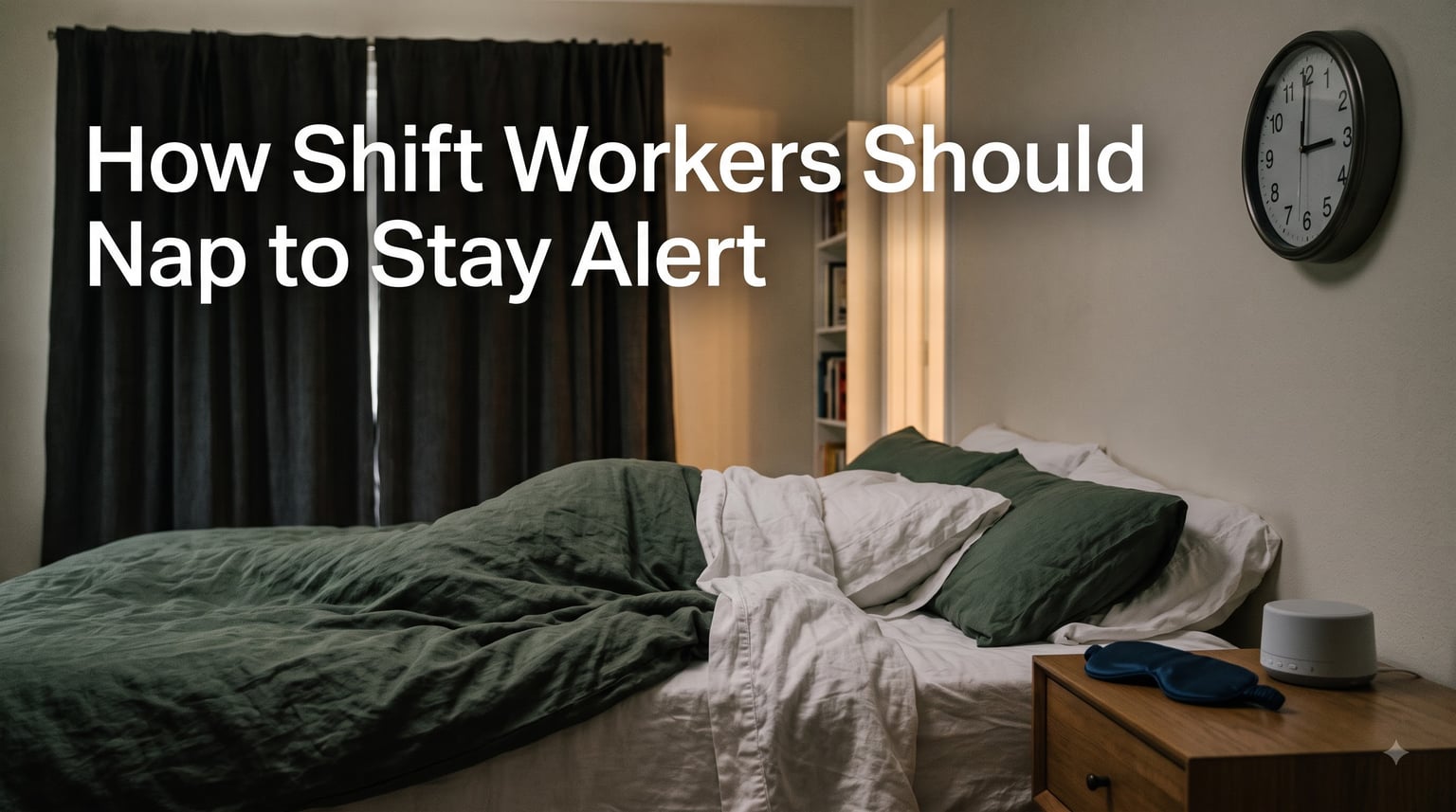
If you’ve ever finished a night shift feeling like your brain is wrapped in cotton, you’re not imagining things. Shift work fights against the most fundamental rhythm in your body, and the right nap strategy can be the difference between a safe drive home and a dangerous one. After researching sleep science and talking with dozens of shift workers, I’ve put together the framework that actually works: the 30-60-90 nap rule.
In this guide, I’ll walk you through exactly how shift workers should nap to stay alert, when to nap, how long to sleep, and how to set up your environment so every minute of rest counts. Whether you work 8-hour shifts, 12-hour shifts, or rotating schedules, the science is clear: strategic napping is one of the most effective fatigue countermeasures available.
Table of Contents
Why Shift Work Breaks Your Body Clock
Your body runs on a circadian rhythm, an internal 24-hour clock that tells you when to feel awake and when to feel sleepy. Light hitting your eyes is the primary signal that resets this clock each day. When you work nights and sleep during the day, you send confusing signals that fight against millions of years of evolution.
Melatonin, the hormone that makes you feel drowsy, normally rises in the evening and drops in the morning. Night shift workers experience this hormonal surge during work hours, which is why you feel that crushing wave of tiredness between 2 AM and 4 AM. At the same time, your homeostatic sleep drive, the pressure to sleep that builds the longer you’re awake, never gets a proper release because daytime sleep is shorter and lighter.
Over weeks and months, this mismatch creates sleep debt that accumulates faster than you can pay it back. Research published by the CDC shows that shift workers experience significantly higher rates of drowsy driving incidents, workplace injuries, and chronic health conditions. The solution is not to fight the need for sleep. The solution is to work with your body’s biology using strategic napping.
The 30-60-90 Nap Rule Framework
The 30-60-90 nap rule is the simplest, most effective framework for shift workers who want to use naps strategically. Each number represents a different nap duration, and each serves a different purpose depending on your shift length and how much recovery you need.
30 minutes is your tactical nap. A short nap of 20-30 minutes boosts alertness, reaction time, and mood without leaving you in deep sleep. You’ll wake up feeling refreshed and ready to work. This duration is ideal for breaks during 8-hour shifts or as a quick pre-shift recharge.
60 minutes is your slow-wave nap. A 60-minute nap includes slow-wave sleep, the deepest stage of non-REM sleep. This deeper recovery improves physical performance, decision-making, and immune function. The trade-off is that you may experience some sleep inertia, that groggy feeling that lasts 15-30 minutes after waking. Plan a brief recovery window before returning to demanding tasks.
90 minutes is your full-cycle nap. A 90-minute nap completes an entire sleep cycle, including REM sleep, which supports memory, emotional regulation, and creative thinking. This is the longest nap that won’t leave you feeling worse than when you started. Use it before long shifts or on days off when you need substantial recovery.
Here’s the quick reference: 30 minutes for an 8-hour shift boost, 60 minutes when you need deeper recovery, and 90 minutes for extended shifts of 12 hours or more, or for pre-shift sleep that mirrors a full sleep cycle.
When to Nap: Before, During, and After Your Shift
Timing matters as much as duration. The three windows where strategic napping delivers the biggest alertness gains are before your shift, during your shift, and immediately after your shift before your main daytime sleep.
Pre-shift prophylactic nap (90-120 minutes). Research from the University of Utah shows that taking a nap 1.5 to 3 hours before your night shift improves alertness throughout the shift. This works because you’re banking sleep in advance, then using caffeine and light to push through the biological night. A 90-minute pre-shift nap is ideal because you complete a full sleep cycle and wake before entering deep sleep.
Mid-shift tactical nap (20-30 minutes). When fatigue hits hardest, usually between 2 AM and 4 AM, a brief nap during your break delivers a measurable alertness boost. Set an alarm for 25 minutes to allow yourself to fall asleep without overshooting into deep sleep. Even closing your eyes in a quiet room for 10 minutes helps, though 20 minutes produces stronger results.
Post-shift recovery nap (90 minutes). If you arrive home and still feel exhausted, a 90-minute nap before your main daytime sleep block prevents the dangerous drowsy-driving window. Many shift workers call this a “recovery bridge.” After waking, eat a light meal, then return to your main sleep block for 4-6 hours.
For 12-hour shifts, plan for a longer nap during your break. A 60 to 90-minute nap mid-shift provides the deeper recovery you need to stay alert for the second half of your shift.
How to Beat Sleep Inertia After Waking
Sleep inertia is the grogginess, impaired performance, and slow reaction time you feel immediately after waking from a nap. It typically lasts 15 to 30 minutes and is worst when you wake from deep, slow-wave sleep. Understanding how to manage it is critical for shift workers who need to wake up and perform.
The fastest way to clear sleep inertia is bright light exposure. As soon as your alarm sounds, turn on bright lights or step outside for 2-3 minutes of sunlight. Light signals your circadian clock that it’s time to be alert and suppresses melatonin production. Washing your face with cold water produces a similar alertness boost through the mammalian dive reflex.
The caffeine nap technique combines a short nap with caffeine to maximize alertness. Drink a cup of coffee right before your 20-minute nap. Caffeine takes about 20 minutes to reach peak blood levels, so it kicks in just as you wake up. The nap clears adenosine, the molecule that builds sleep pressure, while caffeine blocks the adenosine receptors that remain. Studies show this combination produces better alertness than either caffeine or napping alone.
Building a Daytime Sleep Environment
Your daytime sleep environment needs to mimic the darkness, quiet, and cool temperature of night. Without these conditions, your daytime sleep will be shorter, lighter, and less restorative, even if you spend 8 hours in bed.
Darkness is non-negotiable. Your circadian system responds strongly to light, and even small amounts of daylight signal your brain to stay alert. Invest in blackout curtains that block 100% of light, or use a sleep mask that fits snugly without putting pressure on your eyes. I tested this personally during a stretch of night shifts and found that blackout curtains added roughly 90 minutes of effective sleep per day compared to standard blinds.
Cool temperature matters. Your core body temperature needs to drop by 1-2 degrees to initiate sleep. Keep your bedroom between 65 and 68 degrees Fahrenheit. A cool room signals melatonin release and helps you fall asleep faster.
Manage noise with white noise or earplugs. Daytime ambient noise, traffic, neighbors, deliveries, can fragment your sleep without fully waking you. A white noise machine, fan, or quality earplugs creates a consistent sound environment that masks disruptions.
Put your phone on Do Not Disturb. Sleep fragmentation from notifications destroys the deep sleep stages you need. If you rely on your phone for alarms, use a dedicated alarm clock instead.
Light Exposure Control for Alertness
Light is the most powerful tool for shifting your circadian rhythm to match your work schedule. Strategic light exposure at the right times trains your body clock to feel alert during your shift and sleepy during your daytime sleep.
At the start of your night shift, expose yourself to bright light for at least 30 minutes. This can be a bright light therapy box, overhead fluorescent lights, or even a well-lit break room. The goal is to send a strong “daytime” signal to your brain.
During your shift, maintain moderate bright light exposure. Studies on shift workers in healthcare and manufacturing show that bright workplace lighting reduces fatigue and improves cognitive performance during night shifts.
On your commute home, wear amber-tinted sunglasses or blue-light blocking glasses. Blue light in morning daylight will tell your circadian clock that it’s time to wake up, exactly when you want to fall asleep. Removing this signal helps your body transition into sleep mode faster when you get home.
Once home, keep your environment dim. Avoid bright screens, and if you must use them, enable night mode or blue light filters. This protects your melatonin production and helps you fall asleep faster.
Caffeine Timing That Works With Naps
Caffeine is the most widely used fatigue countermeasure in the world, but timing matters. Caffeine has a half-life of about 5-6 hours, meaning half the caffeine you drink at 10 PM is still active at 4 AM. Poor caffeine timing is one of the most common reasons shift workers struggle to sleep during the day.
For night shift workers, the sweet spot for caffeine is the first half of your shift. Drinking coffee or tea during the early hours of your shift, roughly 7 PM to 1 AM for a typical night shift, gives you alertness support when you need it most and allows enough time for caffeine to clear before your daytime sleep.
Stop consuming caffeine at least 4 hours before your planned sleep time. If you plan to sleep from 8 AM to 2 PM, your last coffee should be no later than 4 AM. Many shift workers find that switching to half-caff or decaf in the late shift hours makes a meaningful difference in their daytime sleep quality.
The caffeine nap technique I mentioned earlier is worth repeating because it works so well: drink coffee immediately before a 20-minute nap, then wake up to peak caffeine effects and a cleared sleep pressure. This combo is more effective than either approach alone.
Warning Signs of Shift Work Sleep Disorder
Strategic napping helps most shift workers, but if you’re experiencing persistent symptoms despite using these techniques, you may have shift work sleep disorder (SWSD). This is a recognized circadian rhythm sleep disorder that affects up to 40% of shift workers.
Watch for these red flags: excessive sleepiness that interferes with work or social activities, ongoing insomnia despite trying multiple strategies, difficulty concentrating, frequent headaches, microsleeps, those brief 1-2 second episodes where you fall asleep without realizing it, and persistent mood changes or irritability.
Microsleeps deserve special attention because they are extremely dangerous. If you experience microsleeps while driving, operating machinery, or caring for patients, you need to talk to a doctor immediately. Sleep specialists can offer treatments including chronotherapy, light therapy, and in some cases melatonin supplements or prescription medications.
Don’t ignore chronic fatigue. Shift work increases the risk of cardiovascular disease, metabolic disorders, and mental health challenges. Treating sleep as seriously as you treat safety protocols protects both your career and your long-term health.
Building a Sustainable Shift Work Routine
The nap strategies I’ve shared work best when combined with a stable routine. Going to bed and waking at consistent times, even on days off, anchors your circadian rhythm to your shift schedule. Many shift workers find that maintaining a sleep schedule that’s offset by a few hours on days off, rather than flipping back to a normal daytime schedule, produces better long-term results.
Forward-rotating shifts, where you rotate from day to evening to night, are easier on your body than backward rotations. If you have any say in your schedule, request forward rotations. If you don’t, your nap strategy becomes even more important during transition weeks.
Regular exercise improves sleep quality, but timing matters. Avoid vigorous exercise within 3 hours of your planned sleep time, as it raises core body temperature and cortisol levels. Morning workouts before your shift can boost alertness when you need it most.
Split sleep schedules, where you break your daytime sleep into two blocks, work well for some shift workers, especially those with family responsibilities. A 4-hour main sleep plus a 90-minute recovery nap can total 5.5 hours while accommodating school pickups and family meals.
Frequently Asked Questions
What is the 30 60 90 nap rule?
The 30-60-90 nap rule is a framework for choosing nap duration based on your needs. 30 minutes provides quick alertness without sleep inertia and works well for 8-hour shifts. 60 minutes includes slow-wave sleep for deeper recovery but may cause brief grogginess. 90 minutes completes a full sleep cycle including REM sleep, ideal for 12-hour shifts or pre-shift prophylactic sleep.
Are naps good for shift workers?
Yes, strategic napping is one of the most effective fatigue countermeasures for shift workers. Research from the CDC and Cleveland Clinic shows that planned naps improve alertness, reaction time, decision-making, and safety during night shifts. The key is choosing the right duration and timing based on your shift length and recovery needs.
What is the 3 3 3 rule for sleep?
The 3-3-3 rule is a sleep foundation framework that complements shift work napping: aim for 3 hours of sleep before your shift, 3 hours during shift if possible, and 3 hours after your shift. This split approach helps shift workers accumulate adequate total sleep across a 24-hour period when a single long sleep block is difficult.
How to stay alert during night shift?
To stay alert during night shift, combine these strategies: take a 90-minute prophylactic nap before your shift, drink caffeine only in the first half of your shift, expose yourself to bright light at the start of your shift, take a 20-30 minute tactical nap during your break if needed, and wear blue-light blocking glasses on your commute home to protect daytime sleep.
Final Thoughts on Shift Work Napping
Learning how shift workers should nap to stay alert is one of the highest-leverage skills you can develop for a sustainable shift work career. The 30-60-90 nap rule gives you a simple framework to choose the right nap duration, and combining it with proper light exposure, caffeine timing, and a dark sleep environment turns fragmented rest into genuine recovery.
Start with one change this week. Pick the nap timing that fits your schedule, set up blackout conditions, and give your body a week to adjust. Most shift workers I’ve talked to notice a measurable difference in alertness, mood, and energy within the first two weeks. Your sleep is the foundation of your health, your safety, and your performance on the job. Treat it with the seriousness it deserves.