
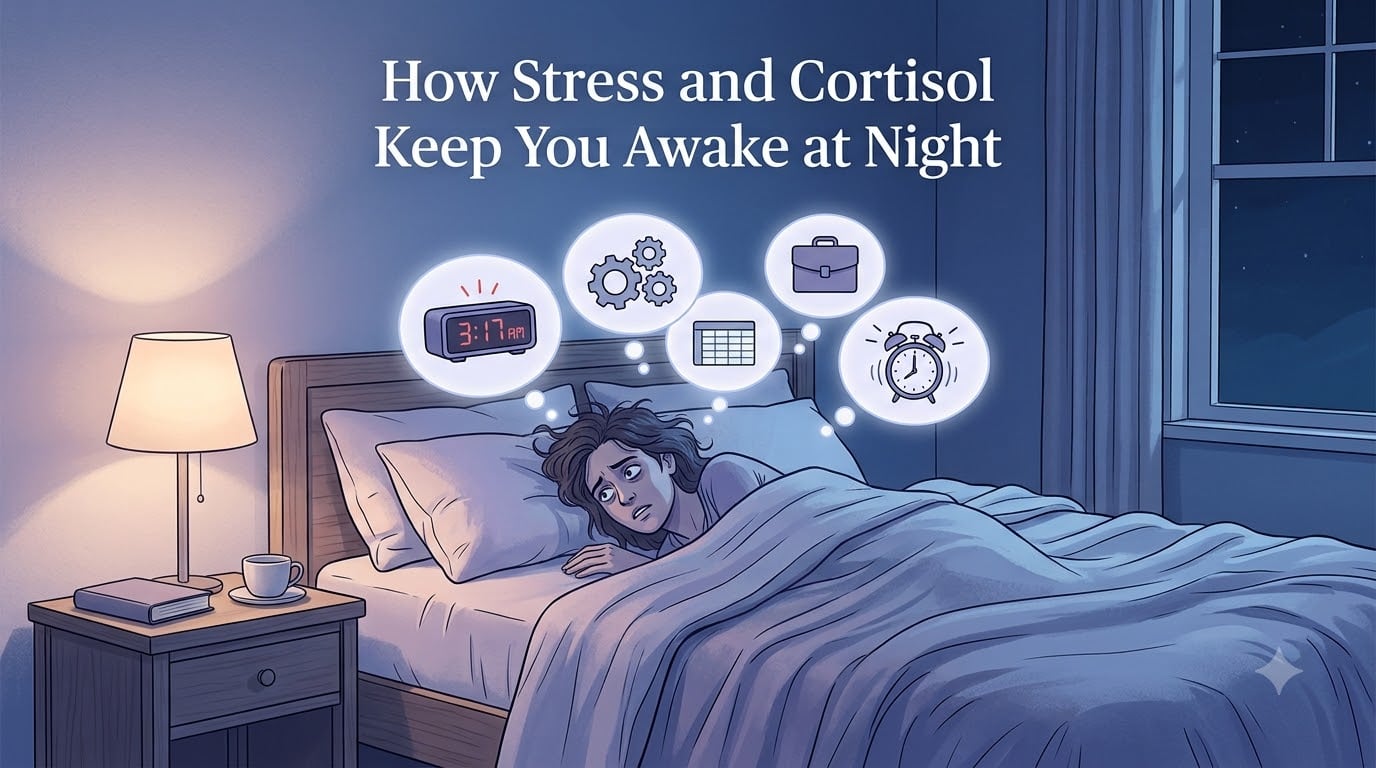
You lie in bed exhausted, but your mind refuses to quiet down. Your heart feels like it’s racing even though you’ve been still for an hour. If this sounds familiar, you’re experiencing something millions of people deal with every night, and understanding how stress and cortisol keep you awake at night can change everything about how you approach sleep.
I spent years thinking my sleep problems were purely psychological. It turned out my body was running a chemical program I didn’t understand. Once I learned what cortisol was actually doing to my brain at bedtime, everything started making sense. This guide breaks down the science in plain language and gives you real strategies you can use tonight.
Cortisol is your body’s primary stress hormone, and when its timing gets thrown off, it fights directly against your sleep system. The good news is that cortisol levels respond to specific lifestyle changes. Once you understand the mechanism, you can take control of the cycle.
Here’s what you’ll learn: what cortisol is and how it works, why stress hijacks your sleep hormones, how to recognize the signs of high nighttime cortisol, and natural ways to bring those levels back into balance so you can sleep deeply again.
Table of Contents
What Is Cortisol and Why Does It Matter for Sleep?
Cortisol is a steroid hormone produced by your adrenal glands, which sit on top of your kidneys. It’s often called the stress hormone because your body releases it in response to perceived threats. But cortisol isn’t just about panic. It’s essential for life.
Under normal conditions, cortisol follows a predictable daily pattern. It peaks in the early morning to help you wake up and feel alert, then gradually drops throughout the day. By evening, cortisol should be at its lowest point, allowing your body to wind down and prepare for sleep.
The system that controls this rhythm is called the HPA axis, short for the hypothalamic-pituitary-adrenal axis. Here’s how it works in simple terms: your hypothalamus detects stress or a threat, sends a signal to your pituitary gland, which then tells your adrenal glands to release cortisol. This chain reaction happens in seconds.
When the threat passes, cortisol levels should return to baseline. The problem starts when the threat never really passes. Work deadlines, financial worries, relationship tension, scrolling through alarming news, even chronic pain, all keep the HPA axis activated. Your body can’t tell the difference between a looming deadline and a charging predator.
This matters for sleep because cortisol and melatonin are essentially opposites. Cortisol wakes you up. Melatonin puts you to sleep. When cortisol stays elevated at night, it directly suppresses melatonin production. Your body is getting conflicting signals: one system says sleep, the other says run.
The Cortisol-Sleep Connection Explained
To understand how stress and cortisol keep you awake at night, you need to picture what happens inside your brain when cortisol floods your system. Cortisol raises your heart rate, increases blood sugar, sharpens your alertness, and prepares your muscles for action. None of that is compatible with sleep.
Cortisol also affects the structure of your sleep itself. Research shows that elevated cortisol at night reduces the amount of time you spend in deep sleep, also called slow-wave sleep. This is the stage where your body repairs tissue, consolidates memories, and regulates immune function. When cortisol cuts this phase short, you wake up feeling unrefreshed even after eight hours in bed.
REM sleep takes a hit too. Rapid eye movement sleep is when your brain processes emotions and files away the day’s experiences. High cortisol fragments REM sleep, which is why stressed-out sleepers often report vivid, anxious dreams or frequent awakenings.
So can high cortisol give you insomnia? Absolutely. Cortisol insomnia is one of the most common yet underdiagnosed sleep problems. You fall asleep fine because you’re exhausted, but then you wake at 2 or 3 AM with a racing mind. That’s cortisol peaking at the wrong time, pulling you out of sleep and making it nearly impossible to fall back asleep.
The key insight is this: cortisol doesn’t just keep you from falling asleep. It actively pulls you out of sleep once you’re there. This is why stress-related sleep problems feel different from other types of insomnia. You’re not lying awake because you can’t relax. You’re lying awake because your body has been chemically told to stay alert.
How Stress Triggers Cortisol Release at Night?
Stress doesn’t just happen during the day. For many people, the moment they lie down and stop being busy is exactly when stress floods in. The mental noise you suppressed all day suddenly becomes impossible to ignore.
This isn’t a character flaw. It’s how your brain works. During the day, cognitive tasks and external stimulation keep the stress response partially occupied. When those distractions disappear at bedtime, your mind finally has space to process unresolved worries. The problem is that this mental activity reactivates the HPA axis right when you need it to power down.
Rumination is the biggest offender here. Rumination means repeatedly thinking about the same stressful thoughts without reaching resolution. Studies show that rumination at bedtime directly correlates with elevated cortisol levels and longer sleep onset times. The more you think about your problems in bed, the more cortisol your body produces, and the harder it becomes to sleep.
Anticipatory stress plays a role too. If you dread the next day, your body starts preparing for it physiologically. You might not consciously feel panicked, but your adrenal glands are already releasing cortisol because your brain has decided tomorrow is a threat.
Modern life adds another layer. Blue light from phones and laptops suppresses melatonin, but it also simulates daylight, which signals your body to produce cortisol. So scrolling through your phone in bed is doing double damage: cutting melatonin while boosting cortisol at the exact moment you need the opposite.
Understanding Your Cortisol Circadian Rhythm
Under healthy conditions, cortisol follows a beautiful daily curve. Levels start rising about two to three hours before you wake up, peak around 7 or 8 AM, then decline steadily through the afternoon. By late evening, cortisol should be barely detectable. This gives melatonin room to rise and carry you into sleep.
This morning surge is called the cortisol awakening response, or CAR. Within the first 30 to 45 minutes after waking, cortisol spikes by about 50 percent above your baseline. This is what gives you that morning energy and mental sharpness. A strong CAR means you feel ready to face the day. A weak or flat CAR is one reason some people feel groggy and slow for hours after waking.
The afternoon brings a natural dip, typically between 2 and 4 PM. This is why many cultures have afternoon rest traditions and why the post-lunch slump feels so universal. A healthy cortisol rhythm embraces this dip rather than fighting it with caffeine, which itself raises cortisol.
By evening, a well-functioning rhythm has cortisol at its lowest point. This allows melatonin to begin rising around 9 or 10 PM, depending on your chronotype. The two hormones trade places smoothly, and you drift into sleep.
Chronic stress flattens and distorts this curve. Instead of a strong morning peak and low evening levels, stressed individuals often show a flattened rhythm. They wake up tired because their morning cortisol is too low, then feel wired at night because their evening cortisol is too high. The entire pattern shifts in the wrong direction.
Signs of High Cortisol at Night
Recognizing the signs of high cortisol at night is the first step toward fixing the problem. Many people suffer for years without realizing their sleep issues have a hormonal component. Here are the most common signs:
You feel wired but tired at bedtime. Your body is exhausted, but your mind won’t shut off.
You fall asleep easily but wake between 2 and 4 AM and can’t get back to sleep.
Your mind races with anxious thoughts the moment you lie down.
You wake up with a pounding heart or feeling of dread for no clear reason.
You feel exhausted in the morning despite spending eight or more hours in bed.
You experience vivid, stressful, or anxiety-filled dreams regularly.
You get a second wind of energy late at night, around 10 or 11 PM, even though you were tired earlier.
You crave salty or sugary foods, especially in the evening.
If you checked four or more of these signs, elevated nighttime cortisol is likely part of your sleep problem. The pattern of feeling tired all day then suddenly alert at night is a classic hallmark of a disrupted cortisol rhythm.
It’s worth noting that these symptoms overlap with several other conditions, including thyroid disorders, sleep apnea, and generalized anxiety. That’s why tracking your symptoms over a couple of weeks is more useful than trying to diagnose yourself in a single night. A sleep diary noting when you feel most alert and most tired can reveal a lot about your cortisol pattern.
Why You Wake Up at 3AM: The Cortisol Spike Mystery
Waking up at 3 AM is one of the most searched sleep complaints online, and cortisol is usually at the center of it. The 3 AM wake-up has a specific physiological explanation that most articles gloss over. Let’s break it down.
Between 2 and 4 AM, your body undergoes several natural changes. Your core body temperature reaches its lowest point. Your blood sugar naturally dips because you haven’t eaten in hours. And your cortisol levels are near their daily minimum.
Here’s where the problem starts. If your cortisol rhythm is disrupted, or if your blood sugar drops too low during the night, your body perceives this dip as a threat. In response, it triggers a cortisol surge to bring your blood sugar back up and keep you alive. This emergency cortisol spike yanks you out of deep sleep and floods your system with alertness hormones.
You wake up suddenly, heart racing, mind spinning. You’re not anxious because of a dream. You’re anxious because your body just dumped stress hormones into your bloodstream to fix a blood sugar crash.
This is particularly common in people who skip dinner, eat very low-carb diets, or drink alcohol before bed. Alcohol causes an initial blood sugar spike followed by a dramatic crash several hours later, often right around 3 AM. Eating a balanced dinner with protein and complex carbs can help stabilize overnight blood sugar and prevent the cortisol rescue response.
People in perimenopause and menopause are especially vulnerable to nighttime cortisol spikes because declining estrogen affects both cortisol regulation and blood sugar stability. If you’re in this life stage and experiencing 3 AM wake-ups, hormonal changes are a likely contributor.
Cortisol vs Melatonin: The Sleep Hormone Balance
Think of cortisol and melatonin as two children on a seesaw. When cortisol goes up, melatonin goes down. When melatonin rises, cortisol falls. They can’t both be high at the same time. Sleep requires melatonin to win the seesaw battle, and that only happens when cortisol gets out of the way.
Melatonin production is triggered by darkness. When light hits your eyes, specialized cells in your retina send signals to your brain’s master clock, the suprachiasmatic nucleus. In darkness, this clock tells your pineal gland to start producing melatonin. The hormone builds up gradually, making you feel drowsy and lowering your body temperature.
Cortisol disrupts this process in two ways. First, elevated cortisol directly suppresses melatonin synthesis. Second, cortisol raises body temperature and alertness, both of which fight melatonin’s sleep-promoting effects. You end up with low melatonin and high cortisol, which is the exact opposite of what you need for sleep.
Many people try to fix this by taking melatonin supplements. That can help short-term, but if cortisol is the root problem, melatonin alone won’t solve it. You’re adding more weight to one side of the seesaw without removing weight from the other. Real balance requires lowering cortisol while supporting natural melatonin production through proper light exposure, sleep timing, and stress management.
The Vicious Cycle: Cortisol and Sleep Deprivation
Here’s where things get truly frustrating for anyone dealing with cortisol-related sleep issues. High cortisol causes poor sleep, and poor sleep causes high cortisol. It’s a feedback loop that traps you in a cycle of exhaustion.
Sleep deprivation itself is a stressor. When you don’t get enough sleep, your body interprets this as a threat and ramps up cortisol production the next day. Studies show that even a single night of partial sleep deprivation can raise afternoon and evening cortisol levels significantly.
Higher daytime cortisol makes it harder to fall asleep the next night. You lie awake longer, get less sleep, and wake up even more sleep-deprived. Your body responds with more cortisol. The cycle tightens.
This is why stress-related insomnia often gets worse over time rather than better. It’s not that your willpower is failing. You’re fighting a biochemical loop that your body is actively maintaining. Understanding this removes the self-blame that so many insomniacs carry.
Breaking the cycle requires addressing both sides simultaneously. You need strategies that lower cortisol and strategies that improve sleep quality, because each one reinforces the other. Sleep hygiene improvements lower cortisol by reducing stress, and lower cortisol improves sleep. Once you start the loop in the right direction, progress can accelerate surprisingly fast.
This is also why the first few nights of any new sleep routine are the hardest. Your cortisol is still elevated from accumulated sleep debt. Around the one to two week mark, as sleep improves and cortisol normalizes, most people report a noticeable shift. Falling asleep starts feeling natural again instead of like a battle.
Natural Ways to Lower Cortisol for Better Sleep
You don’t need to wait for a prescription to start rebalancing your cortisol. The following strategies are backed by research and have helped thousands of people in sleep communities break the cortisol insomnia cycle. I’ve grouped them by when to apply them during your day.
Morning Strategies to Anchor Your Rhythm
Get morning sunlight within 30 minutes of waking. Bright outdoor light signals your master clock to set the cortisol awakening response properly. This strengthens your morning peak, which indirectly lowers evening cortisol. Aim for 10 to 20 minutes of natural light exposure before looking at any screens.
Eat breakfast within an hour of waking. Skipping breakfast keeps cortisol elevated because your body has to maintain blood sugar through stress hormones. A breakfast with protein and healthy fats stabilizes blood sugar and gives your adrenal glands a break.
Exercise in the morning or early afternoon. Physical activity temporarily raises cortisol, which is fine early in the day but problematic in the evening. If you must work out later, keep it to moderate intensity and finish at least three hours before bed.
Daytime Habits That Protect Your Evening
Manage caffeine carefully. Caffeine has a half-life of about five to six hours, meaning half of it is still in your system that long after consumption. More importantly, caffeine directly stimulates cortisol release. If you struggle with nighttime cortisol, cut off caffeine by noon or earlier.
Practice active stress processing during the day. Don’t save your worries for bedtime. Journaling, talking with a friend, or even a five-minute brain dump at lunch can prevent stress from accumulating and erupting at night. Many people in sleep communities swear by a simple brain dump practice: write down everything on your mind for five minutes, no editing, no solving. Just get it out of your head and onto paper.
Take movement breaks. Sitting for hours keeps your stress hormones stagnant. Brief walks, stretching, or even standing every hour helps regulate cortisol throughout the day.
Evening Wind-Down to Lower Cortisol Before Bed
Dim the lights two hours before bed. Reducing light exposure tells your brain that night is coming, allowing melatonin to rise while cortisol naturally falls. Use warm, low-intensity lighting and avoid overhead lights.
Stop screens 60 to 90 minutes before bed, or at minimum use blue light blocking glasses and night mode. The blue light from phones and tablets suppresses melatonin and stimulates cortisol simultaneously.
Try slow breathing techniques. Research consistently shows that paced breathing at around six breaths per minute activates your parasympathetic nervous system and lowers cortisol. Box breathing, where you inhale for four counts, hold for four, exhale for four, hold for four, is simple and effective.
Avoid alcohol within three hours of bed. While alcohol might help you fall asleep faster, it disrupts sleep architecture and causes blood sugar crashes that trigger cortisol spikes in the middle of the night.
Supplements That Support Cortisol Balance
Sleep communities frequently discuss several supplements for cortisol management. Magnesium glycinate is one of the most recommended, as magnesium supports nervous system relaxation and may help regulate the HPA axis. Many users report deeper sleep within a week of starting it.
Ashwagandha, an adaptogenic herb, has research supporting its ability to lower cortisol levels. However, community members note that its effects may diminish over time, so cycling it with breaks is worth considering.
Phosphatidylserine, particularly the Seriphos brand, is specifically mentioned in sleep forums for blunting the afternoon and evening cortisol response. It’s often taken a few hours before bed.
Always consult your doctor before starting supplements, especially if you take prescription medications or have a medical condition. These options work best as part of a comprehensive approach, not as standalone fixes.
When to See a Doctor About Cortisol Issues?
Most cortisol-related sleep problems improve with lifestyle changes within two to four weeks. But some situations call for professional help. Knowing when to seek medical guidance can save you months of frustration.
See a doctor if your insomnia persists for more than four weeks despite consistent sleep hygiene efforts. Also seek help if you experience symptoms like unexplained weight gain, severe fatigue, muscle weakness, high blood pressure, or changes in your skin. These could indicate cortisol levels that are outside the normal range due to conditions like Cushing’s syndrome or adrenal insufficiency.
A doctor can order specific tests. The most common are a morning blood cortisol test, a 24-hour saliva cortisol panel that measures levels at four points during the day, or a salivary cortisol test done at night. These tests reveal whether your cortisol rhythm is simply shifted or genuinely dysfunctional.
Sleep specialists can also evaluate you for disorders that mimic cortisol problems, such as sleep apnea. Because the symptoms overlap significantly, a sleep study might reveal an issue you hadn’t considered.
Frequently Asked Questions
How to reset cortisol cycle?
To reset your cortisol cycle, get morning sunlight within 30 minutes of waking, eat breakfast on time, exercise early in the day, reduce evening light exposure, and maintain a consistent sleep schedule. Most people see improvements within one to two weeks of consistent practice.
What does high cortisol feel like?
High cortisol typically feels like being wired but tired, with racing thoughts, a pounding heart, difficulty falling asleep, frequent nighttime awakenings, morning fatigue despite adequate sleep, and cravings for sugary or salty foods. Some people also experience irritability and difficulty concentrating.
How long does it take for cortisol levels to return to normal?
With consistent lifestyle changes, cortisol levels typically begin normalizing within two to four weeks. Morning light exposure, regular sleep timing, and stress management accelerate the process. Chronic cases may take several months to fully rebalance.
How do you stop cortisol surges at night?
To stop nighttime cortisol surges, avoid alcohol and heavy sugars before bed, eat a balanced dinner with protein and complex carbs, practice slow breathing or meditation, dim lights two hours before sleep, and avoid screens. If you wake with a surge, try box breathing and avoid checking the time.
Can high cortisol give you insomnia?
Yes, high cortisol is a leading cause of insomnia. Elevated cortisol at night suppresses melatonin, raises alertness and body temperature, and fragments deep and REM sleep. This produces a pattern of falling asleep easily but waking in the early morning hours unable to return to sleep.
Can low cortisol make it hard to sleep?
Low cortisol can also disrupt sleep, though differently than high cortisol. Chronically low cortisol, often associated with adrenal fatigue patterns, can cause difficulty staying asleep, morning grogginess, and afternoon energy crashes. A flattened cortisol curve with low morning levels can make it hard to feel alert during the day and properly tired at night.
Conclusion
Understanding how stress and cortisol keep you awake at night gives you something powerful: a map of the problem. Cortisol isn’t your enemy. It’s a vital hormone doing its job, just at the wrong time. When you work with your body’s natural rhythm instead of against it, real change becomes possible.
Start small. Pick one strategy from this guide and apply it consistently for one week. Morning sunlight is usually the highest-impact first step because it anchors your entire cortisol rhythm. From there, layer in evening wind-down practices, dietary adjustments, and stress processing during the day.
Remember the vicious cycle works in both directions. Just as poor sleep raises cortisol and high cortisol worsens sleep, better sleep lowers cortisol and lower cortisol improves sleep. Once you tip the balance in the right direction, your body does much of the recovery work on its own.
Be patient with yourself. It took time for your cortisol rhythm to get disrupted, and it takes time to restore it. Most people start feeling meaningful improvements within two weeks of consistent changes. You’re not broken, and you’re not alone. Your sleep system is waiting for the right conditions to work properly again.